eSUN Carbon Fiber PLA High-Strength 3D Printer Filament
Official Store Deal
Expert Analysis Overview
eSUN Carbon Fiber PLA is a performance-oriented filament engineered for makers who demand enhanced mechanical properties and a superior aesthetic finish from their 3D prints. This material is designed to push the boundaries of functional prototyping and end-use parts, offering a significant upgrade over conventional PLA.
This filament fundamentally combines a PLA substrate with a high content of imported carbon fiber. The base material, PLA (Polylactic Acid), is a popular thermoplastic known for its ease of printing, biodegradability, and relatively low toxicity, making it a staple in the desktop 3D printing community. However, standard PLA often falls short when prints require high rigidity or strength under load.
By integrating carbon fiber, eSUN addresses the inherent limitations of pure PLA. The carbon fibers act as a reinforcing agent, much like rebar in concrete, distributing stress and preventing crack propagation. This composite structure fundamentally alters the material's mechanical behavior, transforming it from a general-purpose plastic into a high-performance engineering material.
Compared to a standard PLA, the addition of carbon fiber fundamentally re-engineers the material's internal structure. This isn't merely a cosmetic change; it's a profound enhancement that impacts every aspect of the printed part, from its feel to its functional lifespan. The base PLA provides the printability, while the carbon fiber delivers the brawn.
Performance metrics for this eSUN PLA-CF are compelling, demonstrating significant improvements over common alternatives like ABS. Rigidity, measured as flexural modulus, is increased by a remarkable 240% compared to ABS, reaching approximately 3552 MPa. This means parts printed with PLA-CF will exhibit considerably less bending or deformation under stress, maintaining their shape even in demanding applications.
When fabricating structural components, the increased rigidity translates directly into more stable and reliable parts. Imagine designing custom brackets for a robotics project; with standard PLA, minor flexing might introduce inaccuracies or premature wear. With PLA-CF, the component holds its geometry with far greater precision, ensuring consistent performance. This enhanced stiffness also makes it ideal for jigs, fixtures, and tool handles where minimal flex is paramount. This is a material for serious builders.
Furthermore, bending strength sees an impressive 167% increase, reaching 77 MPa compared to 46 MPa for ABS. This indicates a significantly higher resistance to fracturing when a force is applied perpendicular to the material's surface. For tinkerers creating custom drone frames or robust enclosures for electronic projects, this translates to parts that can withstand impacts and operational stresses far better than their plain PLA or even ABS counterparts. The ability to create more durable components directly reduces the need for frequent reprinting due to failure, saving both time and material.
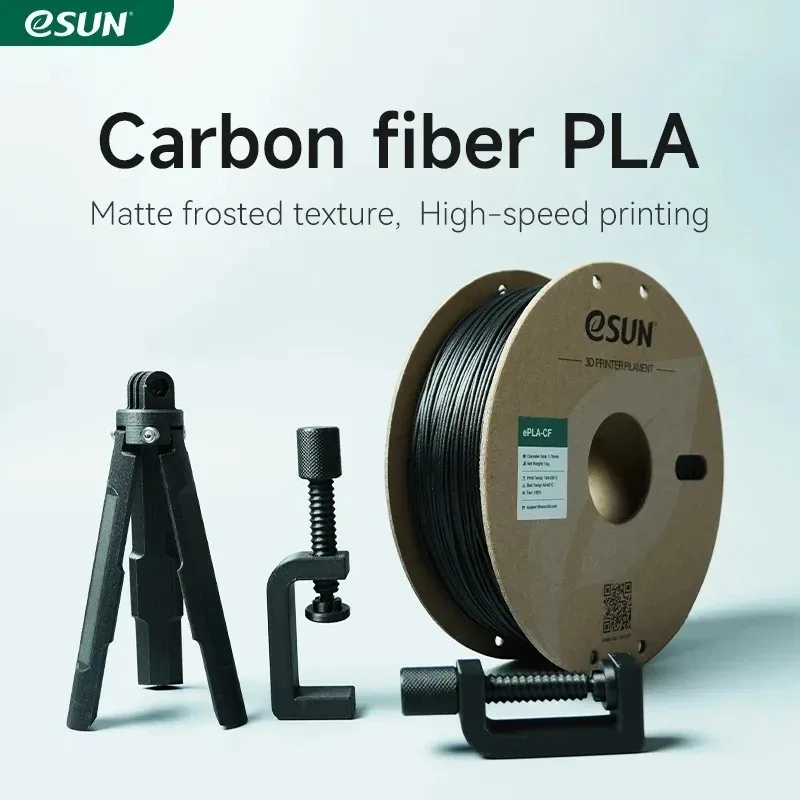
One of the most immediate and appealing aspects of eSUN Carbon Fiber PLA is its matte frosted texture. Unlike the often glossy or semi-glossy finish of standard PLA, this filament produces prints with a sophisticated, non-reflective surface. This matte finish effectively hides layer lines and minor imperfections, giving parts a professional, almost injection-molded appearance straight off the print bed.
This distinct texture enhances the perceived quality of printed objects, making them feel more substantial and refined. For custom enclosures, architectural models, or artistic prints where aesthetics are critical, this frosted look provides a high-end appeal without additional post-processing. The material feels dense and solid.
The visual benefit extends to functional parts as well. A matte finish can reduce glare, which is particularly useful for components interacting with sensors or cameras. Compared to the often shiny and sometimes plasticky look of untreated PLA, the carbon fiber infused variant offers a subtle yet significant upgrade in visual and tactile experience, making prints look and feel more premium. It simply looks better.
The eSUN Carbon Fiber PLA is marketed for high-speed printing, which is a crucial consideration for modern 3D printing workflows. Many newer printers, such as the Bambu Lab X1 and Creality K1, are designed for rapid fabrication, but not all filaments can keep up without compromising print quality or structural integrity. This PLA-CF is formulated to perform well under these accelerated conditions.
High-speed compatibility means that makers can significantly reduce print times for large or complex projects, accelerating their iteration cycles and bringing designs to life faster. This is particularly beneficial for those involved in rapid prototyping or small-batch manufacturing, where efficiency directly impacts productivity. Imagine printing a complex prototype in half the time, allowing for quicker testing and design revisions. This capability unlocks new levels of throughput.
Achieving high speeds typically requires a filament that melts consistently, flows smoothly, and solidifies quickly without warping or stringing. The specific composition of eSUN's PLA-CF, with its carbon fiber reinforcement, contributes to its thermal stability and flow characteristics, allowing for faster extrusion and cooling. Many standard filaments struggle with maintaining dimensional accuracy at higher speeds, often leading to ghosting or ringing artifacts; this filament aims to mitigate those issues for cleaner, quicker prints.
For the dedicated maker and tinkerer, eSUN Carbon Fiber PLA opens up a world of possibilities for modifying and improving existing machines or creating custom, high-performance parts. The enhanced rigidity and strength are perfect for printing upgraded printer components, such as stronger fan shrouds, more stable gantry brackets, or custom tool holders that won't flex under load. These self-printed upgrades can directly improve the performance, longevity, and accuracy of a 3D printer itself, closing the loop on additive manufacturing.
The 3D printing community thrives on shared knowledge and community troubleshooting. As a widely adopted material type, carbon fiber PLA benefits from extensive online discussions, forums, and user groups. This means that if a specific printing challenge arises, there's a good chance another user has encountered it and shared a solution or optimized profile. This collective intelligence significantly reduces the learning curve and empowers users to push the material's limits with confidence. Finding answers is easy.
Furthermore, the properties of this filament make it an excellent choice for experimenting with custom parts that require more than just aesthetic appeal. Think about designing custom jigs for woodworking, specialized camera mounts that need to be rigid and lightweight, or even functional repair parts for household appliances. The ability to print robust, dimensionally stable components allows tinkerers to move beyond decorative prints and into truly practical, problem-solving applications. This filament elevates the output from mere trinkets to tangible engineering solutions.
While the benefits are clear, utilizing carbon fiber-infused filaments does come with certain considerations. The abrasive nature of carbon fibers means that a hardened steel nozzle is highly recommended over standard brass nozzles. Brass nozzles will wear down rapidly, leading to inconsistent extrusion and print quality issues over time. This is a small investment for long-term material compatibility.
Optimizing print settings is also key. While designed for high speed, fine-tuning parameters like retraction, print temperature, and bed adhesion will yield the best results. The matte finish can sometimes make it harder to spot very fine defects during printing, so careful monitoring is still advised. A well-calibrated machine makes a difference.
Proper filament storage is another important aspect. Like all PLA variants, PLA-CF is hygroscopic, meaning it absorbs moisture from the air. Moisture absorption can lead to poor print quality, including bubbling, stringing, and weakened parts. Storing the filament in a dry box or a sealed bag with desiccant is essential to maintain its performance characteristics over time. A dry filament always prints better.
Imagine the satisfaction of holding a custom-designed, structurally sound part, knowing it was printed quickly and precisely with a professional-grade finish. This filament enables makers to transform their innovative ideas into robust, functional realities, whether upgrading their own machines or crafting durable solutions for everyday problems. It’s about building better, faster, and with greater confidence in the end result. Your projects will simply perform better. This material empowers serious fabrication.```
The Core Composition: Engineering Beyond Standard PLA
This filament fundamentally combines a PLA substrate with a high content of imported carbon fiber. The base material, PLA (Polylactic Acid), is a popular thermoplastic known for its ease of printing, biodegradability, and relatively low toxicity, making it a staple in the desktop 3D printing community. However, standard PLA often falls short when prints require high rigidity or strength under load.
By integrating carbon fiber, eSUN addresses the inherent limitations of pure PLA. The carbon fibers act as a reinforcing agent, much like rebar in concrete, distributing stress and preventing crack propagation. This composite structure fundamentally alters the material's mechanical behavior, transforming it from a general-purpose plastic into a high-performance engineering material.
Compared to a standard PLA, the addition of carbon fiber fundamentally re-engineers the material's internal structure. This isn't merely a cosmetic change; it's a profound enhancement that impacts every aspect of the printed part, from its feel to its functional lifespan. The base PLA provides the printability, while the carbon fiber delivers the brawn.
Pushing the Limits: Speed, Strength, and Precision
Performance metrics for this eSUN PLA-CF are compelling, demonstrating significant improvements over common alternatives like ABS. Rigidity, measured as flexural modulus, is increased by a remarkable 240% compared to ABS, reaching approximately 3552 MPa. This means parts printed with PLA-CF will exhibit considerably less bending or deformation under stress, maintaining their shape even in demanding applications.
When fabricating structural components, the increased rigidity translates directly into more stable and reliable parts. Imagine designing custom brackets for a robotics project; with standard PLA, minor flexing might introduce inaccuracies or premature wear. With PLA-CF, the component holds its geometry with far greater precision, ensuring consistent performance. This enhanced stiffness also makes it ideal for jigs, fixtures, and tool handles where minimal flex is paramount. This is a material for serious builders.
Furthermore, bending strength sees an impressive 167% increase, reaching 77 MPa compared to 46 MPa for ABS. This indicates a significantly higher resistance to fracturing when a force is applied perpendicular to the material's surface. For tinkerers creating custom drone frames or robust enclosures for electronic projects, this translates to parts that can withstand impacts and operational stresses far better than their plain PLA or even ABS counterparts. The ability to create more durable components directly reduces the need for frequent reprinting due to failure, saving both time and material.
Achieving Pristine Finishes: The Visual and Tactile Difference
One of the most immediate and appealing aspects of eSUN Carbon Fiber PLA is its matte frosted texture. Unlike the often glossy or semi-glossy finish of standard PLA, this filament produces prints with a sophisticated, non-reflective surface. This matte finish effectively hides layer lines and minor imperfections, giving parts a professional, almost injection-molded appearance straight off the print bed.
This distinct texture enhances the perceived quality of printed objects, making them feel more substantial and refined. For custom enclosures, architectural models, or artistic prints where aesthetics are critical, this frosted look provides a high-end appeal without additional post-processing. The material feels dense and solid.
The visual benefit extends to functional parts as well. A matte finish can reduce glare, which is particularly useful for components interacting with sensors or cameras. Compared to the often shiny and sometimes plasticky look of untreated PLA, the carbon fiber infused variant offers a subtle yet significant upgrade in visual and tactile experience, making prints look and feel more premium. It simply looks better.
Optimized for Speed: A Maker's Advantage
The eSUN Carbon Fiber PLA is marketed for high-speed printing, which is a crucial consideration for modern 3D printing workflows. Many newer printers, such as the Bambu Lab X1 and Creality K1, are designed for rapid fabrication, but not all filaments can keep up without compromising print quality or structural integrity. This PLA-CF is formulated to perform well under these accelerated conditions.
High-speed compatibility means that makers can significantly reduce print times for large or complex projects, accelerating their iteration cycles and bringing designs to life faster. This is particularly beneficial for those involved in rapid prototyping or small-batch manufacturing, where efficiency directly impacts productivity. Imagine printing a complex prototype in half the time, allowing for quicker testing and design revisions. This capability unlocks new levels of throughput.
Achieving high speeds typically requires a filament that melts consistently, flows smoothly, and solidifies quickly without warping or stringing. The specific composition of eSUN's PLA-CF, with its carbon fiber reinforcement, contributes to its thermal stability and flow characteristics, allowing for faster extrusion and cooling. Many standard filaments struggle with maintaining dimensional accuracy at higher speeds, often leading to ghosting or ringing artifacts; this filament aims to mitigate those issues for cleaner, quicker prints.
The Tinkerer's Toolkit: Expanding Possibilities and Community Support
For the dedicated maker and tinkerer, eSUN Carbon Fiber PLA opens up a world of possibilities for modifying and improving existing machines or creating custom, high-performance parts. The enhanced rigidity and strength are perfect for printing upgraded printer components, such as stronger fan shrouds, more stable gantry brackets, or custom tool holders that won't flex under load. These self-printed upgrades can directly improve the performance, longevity, and accuracy of a 3D printer itself, closing the loop on additive manufacturing.
The 3D printing community thrives on shared knowledge and community troubleshooting. As a widely adopted material type, carbon fiber PLA benefits from extensive online discussions, forums, and user groups. This means that if a specific printing challenge arises, there's a good chance another user has encountered it and shared a solution or optimized profile. This collective intelligence significantly reduces the learning curve and empowers users to push the material's limits with confidence. Finding answers is easy.
Furthermore, the properties of this filament make it an excellent choice for experimenting with custom parts that require more than just aesthetic appeal. Think about designing custom jigs for woodworking, specialized camera mounts that need to be rigid and lightweight, or even functional repair parts for household appliances. The ability to print robust, dimensionally stable components allows tinkerers to move beyond decorative prints and into truly practical, problem-solving applications. This filament elevates the output from mere trinkets to tangible engineering solutions.
Navigating the Nuances: Considerations for Optimal Use
While the benefits are clear, utilizing carbon fiber-infused filaments does come with certain considerations. The abrasive nature of carbon fibers means that a hardened steel nozzle is highly recommended over standard brass nozzles. Brass nozzles will wear down rapidly, leading to inconsistent extrusion and print quality issues over time. This is a small investment for long-term material compatibility.
Optimizing print settings is also key. While designed for high speed, fine-tuning parameters like retraction, print temperature, and bed adhesion will yield the best results. The matte finish can sometimes make it harder to spot very fine defects during printing, so careful monitoring is still advised. A well-calibrated machine makes a difference.
Proper filament storage is another important aspect. Like all PLA variants, PLA-CF is hygroscopic, meaning it absorbs moisture from the air. Moisture absorption can lead to poor print quality, including bubbling, stringing, and weakened parts. Storing the filament in a dry box or a sealed bag with desiccant is essential to maintain its performance characteristics over time. A dry filament always prints better.
Imagine the satisfaction of holding a custom-designed, structurally sound part, knowing it was printed quickly and precisely with a professional-grade finish. This filament enables makers to transform their innovative ideas into robust, functional realities, whether upgrading their own machines or crafting durable solutions for everyday problems. It’s about building better, faster, and with greater confidence in the end result. Your projects will simply perform better. This material empowers serious fabrication.```