eSUN ASA+ 3D Printer Filament
Official Store Deal
Expert Analysis Overview
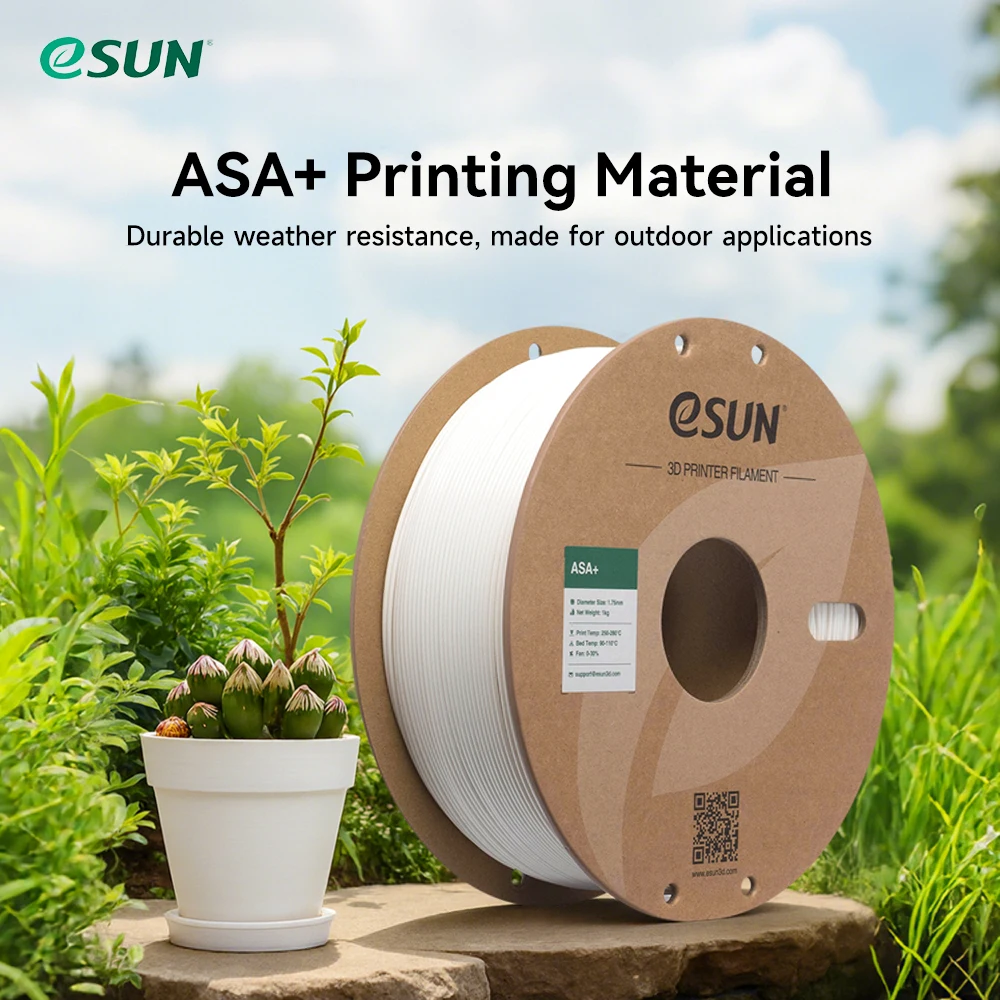
eSUN ASA+ Filament is a high-performance 3D printing material engineered for demanding outdoor and industrial applications where environmental resilience is critical.
The visual evidence prominently features the ASA+ filament's primary advantage: outstanding weatherability. Images display printed objects like colorful pinwheels exposed to the outdoors, explicitly stating resistance to UV radiation, fading, yellowing, and brittleness under long-term sunlight. This material is designed to maintain its stable color and mechanical properties even in harsh external environments.
For engineers and designers creating parts destined for outdoor deployment, this characteristic is indispensable. Components for garden equipment, automotive exteriors, drone frames, or outdoor signage require a material that will not degrade under constant sun exposure or fluctuating weather conditions. The inherent UV stability of ASA+ ensures that functional and aesthetic integrity is preserved over extended periods, minimizing the need for frequent replacements.
Unlike standard ABS, which is prone to UV degradation and yellowing when exposed to sunlight, ASA+ offers a direct upgrade. Traditional filaments often require post-processing or protective coatings to achieve similar outdoor longevity, adding complexity and cost to production. This filament provides a robust, ready-to-deploy solution for exterior applications, surpassing the environmental limitations of many common 3D printing plastics.
Images illustrate the material's robust mechanical properties, specifically highlighting a notched impact strength of 20.11 KJ/m². This metric indicates the material's resistance to fracture when subjected to sudden force or impact. The visual of a printed part undergoing an impact test underscores its ability to withstand significant stress without failing.
This level of impact resistance, coupled with inherent toughness and strength, translates directly into durable and reliable printed parts. If you are fabricating functional prototypes or end-use components that will experience mechanical stress, such as protective housings, tool handles, or structural brackets, the material's ability to absorb energy without catastrophic failure is paramount. It ensures that printed objects can endure daily wear and tear, accidental drops, or operational forces.
Many entry-level filaments, while easy to print, often compromise on mechanical robustness. PLA, for instance, is known for its rigidity but can be brittle under impact. PETG offers some flexibility but may not match the sheer impact strength of ASA+. This filament positions itself as a superior choice for applications where the physical integrity of the printed part is non-negotiable, offering a significant advantage over less resilient alternatives.
A comparative image clearly demonstrates ASA+'s heat resistance, showing cones of ASA+, ABS, and PETG at both 25°C and 96°C. While ABS and PETG show signs of deformation at 96°C, the ASA+ cone maintains its shape. A bar chart further quantifies this, showing ASA+ with a heat distortion temperature (HDT) of 96.4°C, significantly higher than ABS (78°C), PETG (64°C), and PLA+ (53°C).
This high heat distortion temperature means printed parts can maintain their shape and functionality in elevated temperature environments. For components used near heat sources, within engine compartments, or in industrial settings where ambient temperatures can rise, this thermal stability is crucial. It prevents warping, softening, or structural compromise that would render parts unusable.
Compared to common filaments like PLA, which can begin to soften at temperatures as low as 60°C, or even ABS, ASA+ offers a distinct thermal performance advantage. This makes it suitable for applications where thermal stability is a primary concern, such as automotive parts, electrical enclosures, or outdoor fixtures exposed to direct sunlight, which can heat surfaces significantly. The material also provides strong resistance to many chemicals, oils, and acidic or alkaline substances, further extending its utility in challenging environments.
The consistent diameter of 1.75mm, as indicated by the product specifications, is fundamental for reliable 3D printing. A uniform filament diameter ensures consistent material extrusion through the nozzle, which is vital for achieving accurate layer adhesion and dimensional precision in printed parts. Inconsistent filament can lead to under-extrusion, over-extrusion, and ultimately, print failures or weak parts.
For precision prototyping, where dimensional accuracy is paramount, this consistency minimizes variables that could affect print quality. Engineers rely on precise measurements for fit and function, and a stable filament diameter reduces the need for constant printer calibration or compensation. This allows for more predictable and repeatable results, saving time and material during iterative design processes.
Many lower-quality filaments often exhibit variations in diameter, leading to frustrating print inconsistencies. This eSUN ASA+ filament, by maintaining a tight tolerance, offers a more dependable printing experience compared to generic alternatives. It contributes directly to minimizing print failures and producing dimensionally accurate engineering parts, which is a key capability for professional users.
While not explicitly detailed in every image, the nature of ASA+ as a material implies specific printing requirements for optimal results. Typically, ASA+ requires higher extrusion temperatures (around 240-260°C) and a heated bed (around 90-110°C) to prevent warping and ensure good layer adhesion. An enclosed print chamber is also highly recommended to maintain a stable ambient temperature around the print.
Understanding and adhering to these parameters is essential for successful prints. Users transitioning from easier-to-print materials like PLA will need to adjust their printer settings and potentially their hardware setup to accommodate ASA+. Proper calibration and environmental control directly impact the final part's strength, surface finish, and dimensional accuracy.
This contrasts with the more forgiving printing conditions of PLA or PETG, which often print well on open-frame printers without enclosures. The specialized requirements of ASA+ mean it is not a 'plug-and-play' filament for every 3D printer. However, for those with the appropriate equipment and willingness to fine-tune settings, the resulting material properties far outweigh the initial setup considerations, enabling the reliable printing of difficult materials.
The eSUN ASA+ filament, priced at approximately 41.55 USD for a 1KG spool, represents a strategic investment for specific applications. While it may be priced higher than commodity PLA, its specialized properties for outdoor use, high mechanical performance, and thermal stability justify the cost for functional parts that require longevity and resilience.
Considering the cost-per-use for parts that would otherwise fail prematurely or require expensive post-processing, ASA+ offers significant long-term value. For example, a weather-resistant outdoor sensor housing printed in ASA+ will likely outlast one printed in ABS or PETG, reducing replacement costs and maintenance efforts. This shifts the focus from the initial filament price to the overall project economy and part reliability.
This filament is not merely a consumable; it is a solution for engineering challenges where standard plastics fall short. It provides a robust alternative to more expensive industrial materials or complex manufacturing processes, offering a cost-effective path to producing durable, high-performance components directly on a 3D printer. The investment in ASA+ is an investment in the longevity and functionality of the final product.
Imagine creating custom components for your vehicle's exterior that withstand harsh sunlight and road grime without degradation, or designing durable garden tools that resist cracking and fading season after season. This filament empowers the creation of truly resilient, long-lasting 3D printed objects, expanding the possibilities for functional prototyping and end-use parts in challenging environments. It provides the confidence that your printed designs will perform reliably, even when exposed to the most demanding conditions, ensuring your projects stand the test of time and the elements.
Enduring the Elements: Superior Weatherability
The visual evidence prominently features the ASA+ filament's primary advantage: outstanding weatherability. Images display printed objects like colorful pinwheels exposed to the outdoors, explicitly stating resistance to UV radiation, fading, yellowing, and brittleness under long-term sunlight. This material is designed to maintain its stable color and mechanical properties even in harsh external environments.
For engineers and designers creating parts destined for outdoor deployment, this characteristic is indispensable. Components for garden equipment, automotive exteriors, drone frames, or outdoor signage require a material that will not degrade under constant sun exposure or fluctuating weather conditions. The inherent UV stability of ASA+ ensures that functional and aesthetic integrity is preserved over extended periods, minimizing the need for frequent replacements.
Unlike standard ABS, which is prone to UV degradation and yellowing when exposed to sunlight, ASA+ offers a direct upgrade. Traditional filaments often require post-processing or protective coatings to achieve similar outdoor longevity, adding complexity and cost to production. This filament provides a robust, ready-to-deploy solution for exterior applications, surpassing the environmental limitations of many common 3D printing plastics.
Structural Integrity: Excellent Mechanical Performance
Images illustrate the material's robust mechanical properties, specifically highlighting a notched impact strength of 20.11 KJ/m². This metric indicates the material's resistance to fracture when subjected to sudden force or impact. The visual of a printed part undergoing an impact test underscores its ability to withstand significant stress without failing.
This level of impact resistance, coupled with inherent toughness and strength, translates directly into durable and reliable printed parts. If you are fabricating functional prototypes or end-use components that will experience mechanical stress, such as protective housings, tool handles, or structural brackets, the material's ability to absorb energy without catastrophic failure is paramount. It ensures that printed objects can endure daily wear and tear, accidental drops, or operational forces.
Many entry-level filaments, while easy to print, often compromise on mechanical robustness. PLA, for instance, is known for its rigidity but can be brittle under impact. PETG offers some flexibility but may not match the sheer impact strength of ASA+. This filament positions itself as a superior choice for applications where the physical integrity of the printed part is non-negotiable, offering a significant advantage over less resilient alternatives.
Resisting the Heat: High Stability and Thermal Resistance
A comparative image clearly demonstrates ASA+'s heat resistance, showing cones of ASA+, ABS, and PETG at both 25°C and 96°C. While ABS and PETG show signs of deformation at 96°C, the ASA+ cone maintains its shape. A bar chart further quantifies this, showing ASA+ with a heat distortion temperature (HDT) of 96.4°C, significantly higher than ABS (78°C), PETG (64°C), and PLA+ (53°C).
This high heat distortion temperature means printed parts can maintain their shape and functionality in elevated temperature environments. For components used near heat sources, within engine compartments, or in industrial settings where ambient temperatures can rise, this thermal stability is crucial. It prevents warping, softening, or structural compromise that would render parts unusable.
Compared to common filaments like PLA, which can begin to soften at temperatures as low as 60°C, or even ABS, ASA+ offers a distinct thermal performance advantage. This makes it suitable for applications where thermal stability is a primary concern, such as automotive parts, electrical enclosures, or outdoor fixtures exposed to direct sunlight, which can heat surfaces significantly. The material also provides strong resistance to many chemicals, oils, and acidic or alkaline substances, further extending its utility in challenging environments.
Precision Prototyping and Production
The consistent diameter of 1.75mm, as indicated by the product specifications, is fundamental for reliable 3D printing. A uniform filament diameter ensures consistent material extrusion through the nozzle, which is vital for achieving accurate layer adhesion and dimensional precision in printed parts. Inconsistent filament can lead to under-extrusion, over-extrusion, and ultimately, print failures or weak parts.
For precision prototyping, where dimensional accuracy is paramount, this consistency minimizes variables that could affect print quality. Engineers rely on precise measurements for fit and function, and a stable filament diameter reduces the need for constant printer calibration or compensation. This allows for more predictable and repeatable results, saving time and material during iterative design processes.
Many lower-quality filaments often exhibit variations in diameter, leading to frustrating print inconsistencies. This eSUN ASA+ filament, by maintaining a tight tolerance, offers a more dependable printing experience compared to generic alternatives. It contributes directly to minimizing print failures and producing dimensionally accurate engineering parts, which is a key capability for professional users.
Optimized Printing Parameters
While not explicitly detailed in every image, the nature of ASA+ as a material implies specific printing requirements for optimal results. Typically, ASA+ requires higher extrusion temperatures (around 240-260°C) and a heated bed (around 90-110°C) to prevent warping and ensure good layer adhesion. An enclosed print chamber is also highly recommended to maintain a stable ambient temperature around the print.
Understanding and adhering to these parameters is essential for successful prints. Users transitioning from easier-to-print materials like PLA will need to adjust their printer settings and potentially their hardware setup to accommodate ASA+. Proper calibration and environmental control directly impact the final part's strength, surface finish, and dimensional accuracy.
This contrasts with the more forgiving printing conditions of PLA or PETG, which often print well on open-frame printers without enclosures. The specialized requirements of ASA+ mean it is not a 'plug-and-play' filament for every 3D printer. However, for those with the appropriate equipment and willingness to fine-tune settings, the resulting material properties far outweigh the initial setup considerations, enabling the reliable printing of difficult materials.
Value Proposition for Demanding Applications
The eSUN ASA+ filament, priced at approximately 41.55 USD for a 1KG spool, represents a strategic investment for specific applications. While it may be priced higher than commodity PLA, its specialized properties for outdoor use, high mechanical performance, and thermal stability justify the cost for functional parts that require longevity and resilience.
Considering the cost-per-use for parts that would otherwise fail prematurely or require expensive post-processing, ASA+ offers significant long-term value. For example, a weather-resistant outdoor sensor housing printed in ASA+ will likely outlast one printed in ABS or PETG, reducing replacement costs and maintenance efforts. This shifts the focus from the initial filament price to the overall project economy and part reliability.
This filament is not merely a consumable; it is a solution for engineering challenges where standard plastics fall short. It provides a robust alternative to more expensive industrial materials or complex manufacturing processes, offering a cost-effective path to producing durable, high-performance components directly on a 3D printer. The investment in ASA+ is an investment in the longevity and functionality of the final product.
Imagine creating custom components for your vehicle's exterior that withstand harsh sunlight and road grime without degradation, or designing durable garden tools that resist cracking and fading season after season. This filament empowers the creation of truly resilient, long-lasting 3D printed objects, expanding the possibilities for functional prototyping and end-use parts in challenging environments. It provides the confidence that your printed designs will perform reliably, even when exposed to the most demanding conditions, ensuring your projects stand the test of time and the elements.