ERYONE PETG Carbon Fiber 3D Printer Filament
Official Store Deal
Expert Analysis Overview
ERYONE PETG Carbon Fiber 3D Printer Filament is a high-performance composite material engineered for educators and students seeking to produce robust, functional prototypes and end-use parts with enhanced mechanical properties. This filament bridges the gap between ease of use and advanced material capabilities, making it an ideal choice for STEM curricula and hands-on learning environments. Its formulation specifically addresses common frustrations associated with more exotic filaments, offering a more forgiving printing experience without compromising on strength.
The core of this filament is PETG, or Polyethylene Terephthalate Glycol, a thermoplastic polymer widely appreciated for its excellent layer adhesion, chemical resistance, and good temperature stability. Unlike PLA, which can be brittle, PETG offers a degree of flexibility and impact resistance, making printed objects less prone to shattering. It's a reliable choice.
The significant enhancement comes from the 15% carbon fiber content infused into the PETG matrix. Carbon fibers are renowned for their exceptional strength-to-weight ratio and stiffness. When integrated into a polymer, they create a composite material that exhibits significantly improved tensile strength, modulus of elasticity, and dimensional stability. This means parts printed with this filament will be much stronger and less flexible under load than those made from pure PETG. Students can observe these material property changes directly.
Compared to standard PETG, the carbon fiber variant offers a substantial upgrade in mechanical performance, particularly in applications requiring structural integrity or resistance to deformation. While pure PETG is robust, the carbon fiber addition transforms it into a material suitable for more demanding engineering challenges, providing a practical demonstration of material science principles in a classroom setting. This is a clear step up.
A critical factor in successful 3D printing, especially in an educational context where consistency is key, is filament quality. This ERYONE filament maintains a 1.75mm diameter with a tight tolerance of ±0.03mm. Such precision ensures that the extruder motor consistently feeds the correct amount of material, leading to uniform layer lines and accurate part dimensions. Inconsistent filament diameter is a frequent cause of print failures, manifesting as under-extrusion, over-extrusion, or even nozzle clogs. This filament minimizes such issues.
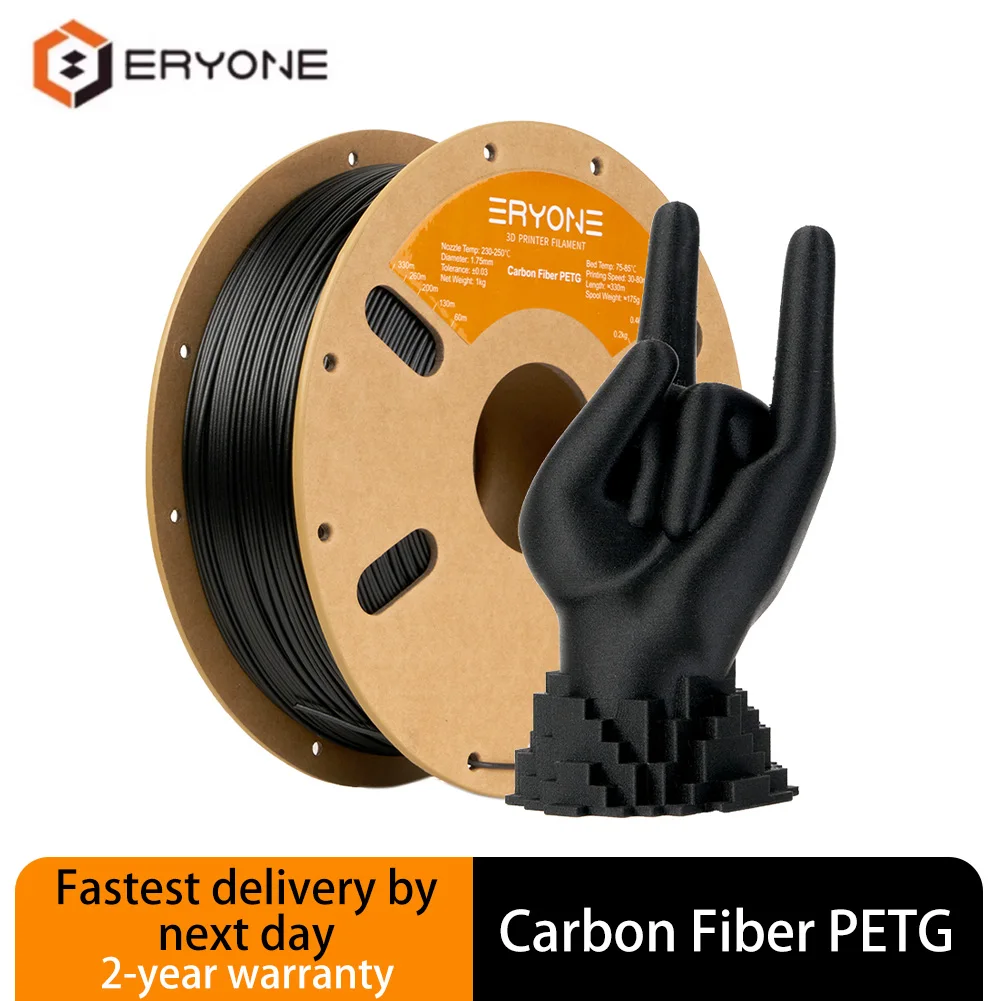
The neat winding on the spool is another visual indicator of quality and a practical benefit. Poorly wound filament can lead to tangles, causing the print to stop mid-process or even damaging the printer's extruder mechanism. The organized winding visible on the spool suggests a manufacturing process focused on user experience, reducing the likelihood of frustrating feed issues. Smooth feeding is paramount.
Compared to generic, unbranded filaments that often suffer from wider diameter variations and haphazard winding, this ERYONE offering provides a much more reliable foundation for printing. This consistency simplifies the troubleshooting process for students, allowing them to focus on design principles and print settings rather than battling material inconsistencies. It removes a common hurdle.
The primary appeal of carbon fiber PETG lies in its enhanced mechanical properties. The material delivers high strength and stiffness, making it suitable for functional prototypes, jigs, fixtures, and even end-use parts. Imagine a student designing a custom bracket for a robotics project; this filament ensures the bracket can withstand the forces and vibrations encountered during operation without deformating or breaking. Such resilience is vital.
Beyond stiffness, the filament also boasts impact resistance. This is particularly valuable for parts that might experience accidental drops or moderate physical stress. Consider classroom projects where prototypes are handled frequently; a material that can absorb impact without fracturing significantly extends the lifespan of the printed object. This reduces material waste and allows for more iterative design cycles. Durability matters.
When contrasted with conventional PLA, which tends to be brittle, or even standard PETG, the carbon fiber variant stands out for its ability to endure more rigorous conditions. This characteristic allows students to experiment with designs that require greater structural integrity, pushing the boundaries of what can be achieved with FDM printing in an educational setting. It handles tough jobs.
Beyond its mechanical advantages, this carbon fiber PETG filament offers a distinct matte aesthetic finish. The inclusion of carbon fibers typically results in a less glossy surface compared to pure PETG. This matte texture effectively hides layer lines and minor imperfections, giving printed objects a more professional and refined appearance. It looks great.
The unique surface quality provides a sophisticated look that is often preferred for functional parts or display models where a high-quality finish is desired without extensive post-processing. This can be particularly motivating for students who are proud of their creations and want them to look as good as they perform. A professional finish encourages creativity.
Unlike the often shiny or translucent finish of standard PETG, the carbon fiber variant presents a subdued, technical aesthetic. This subtle difference can significantly impact the perceived quality of a printed part, making it an excellent choice for projects intended for presentation or exhibition. The visual impact is strong.
For educators introducing students to 3D printing, simplifying the slicing workflow is crucial. While carbon fiber PETG is an advanced material, its PETG base makes it relatively approachable for those familiar with standard PETG settings. Typical nozzle temperatures range from 230-250°C, and a heated bed between 70-90°C is recommended. These are common settings.
The key to simplifying the slicing process for this material lies in understanding its specific requirements, particularly regarding nozzle material. While the fundamental temperature and speed settings are similar to regular PETG, the abrasive nature of carbon fiber necessitates the use of a hardened steel or other wear-resistant nozzle. Slicing software should be configured to account for the material's slightly higher stiffness, potentially requiring minor adjustments to flow rates or print speeds to achieve optimal layer adhesion without over-extrusion. Small tweaks make a difference.
Compared to more challenging materials like Nylon or high-temperature composites, carbon fiber PETG offers a more straightforward path to successful prints. The learning curve is manageable for students who have already mastered PLA or standard PETG, allowing them to experiment with advanced materials without overwhelming complexity in the slicing software. The transition is smooth.
Operating 3D printers in a classroom requires careful consideration of safety and equipment longevity. The primary safety feature related to this filament is the recommendation for a hardened nozzle. Carbon fibers are abrasive; printing with a standard brass nozzle will lead to rapid wear, causing inconsistent extrusion and potential print failures, which can be frustrating for students and costly for institutions. A hardened nozzle prevents this.
Proper ventilation is another important aspect. While PETG generally produces fewer noxious fumes than ABS, printing with any heated plastic should ideally occur in a well-ventilated area or with an enclosure that filters air. This ensures a healthier environment for students and instructors, particularly during longer print jobs. Good air quality is essential.
In contrast to ignoring material-specific requirements, proactive measures like using the correct nozzle and ensuring adequate ventilation contribute to a safer, more efficient, and more sustainable 3D printing program. Educating students on these practices instills good habits for future engineering and manufacturing careers. These are vital lessons.
This ERYONE PETG Carbon Fiber filament serves as an exceptional tool for teaching students 3D printing without frustration. Its consistent diameter, neat winding, and relatively forgiving print characteristics (compared to other composites) mean students spend less time troubleshooting material issues and more time focusing on design, iteration, and problem-solving. Success builds confidence.
The material's high strength and stiffness make it perfect for demonstrating real-world engineering principles. Students can design and print load-bearing components, test their designs, and understand the impact of material choice on performance. This hands-on experience is invaluable for understanding concepts like stress, strain, and material selection in practical contexts. Real-world application is key.
Furthermore, the need for specific nozzle types and proper storage introduces students to the practicalities of advanced manufacturing and material handling. This simplifies the slicing workflow not by making it trivial, but by providing a clear set of parameters and considerations that, once understood, lead to reliable results. It prepares them for industry. This filament truly empowers.
The filament arrives on a recycled cardboard spool, reflecting a commitment to sustainability. This choice of material for the spool is not just environmentally conscious but also lightweight and durable enough to withstand shipping and handling. The spool design includes perforations, which are common for filament spools, allowing for easy mounting on various printer setups. Sustainability is a bonus.
The filament is securely packaged in a vacuum-sealed bag with a desiccant packet. This is a crucial detail for any hygroscopic filament like PETG, which readily absorbs moisture from the air. The vacuum seal prevents moisture absorption during storage and transit, ensuring the filament arrives dry and ready for immediate use. A dry filament prints better.
Compared to filaments that might come in less protective packaging, this professional approach to sealing and spooling significantly contributes to the material's shelf life and print quality. This attention to detail means less pre-print preparation for the user and more consistent results from the first layer. It's a thoughtful design.
Imagine a classroom where students confidently design and print complex, functional parts that withstand real-world testing. Picture them holding a robot arm component, knowing it will perform reliably due to the material's inherent strength and their careful design. Envision the satisfaction of seeing their engineering concepts materialize into durable, high-performance objects. This ERYONE PETG Carbon Fiber filament provides the foundation for such experiences, allowing young innovators to explore advanced manufacturing techniques with a material that is both powerful and manageable. It fosters a deeper understanding of engineering principles, encouraging experimentation and problem-solving. This filament is a gateway to more advanced projects, equipping students with practical skills and a tangible appreciation for material science. The future of innovation starts here.
The Material Science Foundation: A Blend of Durability and Printability
The core of this filament is PETG, or Polyethylene Terephthalate Glycol, a thermoplastic polymer widely appreciated for its excellent layer adhesion, chemical resistance, and good temperature stability. Unlike PLA, which can be brittle, PETG offers a degree of flexibility and impact resistance, making printed objects less prone to shattering. It's a reliable choice.
The significant enhancement comes from the 15% carbon fiber content infused into the PETG matrix. Carbon fibers are renowned for their exceptional strength-to-weight ratio and stiffness. When integrated into a polymer, they create a composite material that exhibits significantly improved tensile strength, modulus of elasticity, and dimensional stability. This means parts printed with this filament will be much stronger and less flexible under load than those made from pure PETG. Students can observe these material property changes directly.
Compared to standard PETG, the carbon fiber variant offers a substantial upgrade in mechanical performance, particularly in applications requiring structural integrity or resistance to deformation. While pure PETG is robust, the carbon fiber addition transforms it into a material suitable for more demanding engineering challenges, providing a practical demonstration of material science principles in a classroom setting. This is a clear step up.
Precision in the Print Path: Consistent Extrusion for Reliable Outcomes
A critical factor in successful 3D printing, especially in an educational context where consistency is key, is filament quality. This ERYONE filament maintains a 1.75mm diameter with a tight tolerance of ±0.03mm. Such precision ensures that the extruder motor consistently feeds the correct amount of material, leading to uniform layer lines and accurate part dimensions. Inconsistent filament diameter is a frequent cause of print failures, manifesting as under-extrusion, over-extrusion, or even nozzle clogs. This filament minimizes such issues.
The neat winding on the spool is another visual indicator of quality and a practical benefit. Poorly wound filament can lead to tangles, causing the print to stop mid-process or even damaging the printer's extruder mechanism. The organized winding visible on the spool suggests a manufacturing process focused on user experience, reducing the likelihood of frustrating feed issues. Smooth feeding is paramount.
Compared to generic, unbranded filaments that often suffer from wider diameter variations and haphazard winding, this ERYONE offering provides a much more reliable foundation for printing. This consistency simplifies the troubleshooting process for students, allowing them to focus on design principles and print settings rather than battling material inconsistencies. It removes a common hurdle.
Crafting Resilient Creations: Strength and Impact Resistance for Functional Designs
The primary appeal of carbon fiber PETG lies in its enhanced mechanical properties. The material delivers high strength and stiffness, making it suitable for functional prototypes, jigs, fixtures, and even end-use parts. Imagine a student designing a custom bracket for a robotics project; this filament ensures the bracket can withstand the forces and vibrations encountered during operation without deformating or breaking. Such resilience is vital.
Beyond stiffness, the filament also boasts impact resistance. This is particularly valuable for parts that might experience accidental drops or moderate physical stress. Consider classroom projects where prototypes are handled frequently; a material that can absorb impact without fracturing significantly extends the lifespan of the printed object. This reduces material waste and allows for more iterative design cycles. Durability matters.
When contrasted with conventional PLA, which tends to be brittle, or even standard PETG, the carbon fiber variant stands out for its ability to endure more rigorous conditions. This characteristic allows students to experiment with designs that require greater structural integrity, pushing the boundaries of what can be achieved with FDM printing in an educational setting. It handles tough jobs.
Aesthetic Appeal and Finish: A Professional Look for Every Project
Beyond its mechanical advantages, this carbon fiber PETG filament offers a distinct matte aesthetic finish. The inclusion of carbon fibers typically results in a less glossy surface compared to pure PETG. This matte texture effectively hides layer lines and minor imperfections, giving printed objects a more professional and refined appearance. It looks great.
The unique surface quality provides a sophisticated look that is often preferred for functional parts or display models where a high-quality finish is desired without extensive post-processing. This can be particularly motivating for students who are proud of their creations and want them to look as good as they perform. A professional finish encourages creativity.
Unlike the often shiny or translucent finish of standard PETG, the carbon fiber variant presents a subdued, technical aesthetic. This subtle difference can significantly impact the perceived quality of a printed part, making it an excellent choice for projects intended for presentation or exhibition. The visual impact is strong.
Optimizing the Slicing Workflow: Simplifying the Path from Design to Object
For educators introducing students to 3D printing, simplifying the slicing workflow is crucial. While carbon fiber PETG is an advanced material, its PETG base makes it relatively approachable for those familiar with standard PETG settings. Typical nozzle temperatures range from 230-250°C, and a heated bed between 70-90°C is recommended. These are common settings.
The key to simplifying the slicing process for this material lies in understanding its specific requirements, particularly regarding nozzle material. While the fundamental temperature and speed settings are similar to regular PETG, the abrasive nature of carbon fiber necessitates the use of a hardened steel or other wear-resistant nozzle. Slicing software should be configured to account for the material's slightly higher stiffness, potentially requiring minor adjustments to flow rates or print speeds to achieve optimal layer adhesion without over-extrusion. Small tweaks make a difference.
Compared to more challenging materials like Nylon or high-temperature composites, carbon fiber PETG offers a more straightforward path to successful prints. The learning curve is manageable for students who have already mastered PLA or standard PETG, allowing them to experiment with advanced materials without overwhelming complexity in the slicing software. The transition is smooth.
Ensuring Classroom Safety and Longevity: Practical Considerations for Educators
Operating 3D printers in a classroom requires careful consideration of safety and equipment longevity. The primary safety feature related to this filament is the recommendation for a hardened nozzle. Carbon fibers are abrasive; printing with a standard brass nozzle will lead to rapid wear, causing inconsistent extrusion and potential print failures, which can be frustrating for students and costly for institutions. A hardened nozzle prevents this.
Proper ventilation is another important aspect. While PETG generally produces fewer noxious fumes than ABS, printing with any heated plastic should ideally occur in a well-ventilated area or with an enclosure that filters air. This ensures a healthier environment for students and instructors, particularly during longer print jobs. Good air quality is essential.
In contrast to ignoring material-specific requirements, proactive measures like using the correct nozzle and ensuring adequate ventilation contribute to a safer, more efficient, and more sustainable 3D printing program. Educating students on these practices instills good habits for future engineering and manufacturing careers. These are vital lessons.
The Educational Advantage: Empowering Hands-On STEM Learning
This ERYONE PETG Carbon Fiber filament serves as an exceptional tool for teaching students 3D printing without frustration. Its consistent diameter, neat winding, and relatively forgiving print characteristics (compared to other composites) mean students spend less time troubleshooting material issues and more time focusing on design, iteration, and problem-solving. Success builds confidence.
The material's high strength and stiffness make it perfect for demonstrating real-world engineering principles. Students can design and print load-bearing components, test their designs, and understand the impact of material choice on performance. This hands-on experience is invaluable for understanding concepts like stress, strain, and material selection in practical contexts. Real-world application is key.
Furthermore, the need for specific nozzle types and proper storage introduces students to the practicalities of advanced manufacturing and material handling. This simplifies the slicing workflow not by making it trivial, but by providing a clear set of parameters and considerations that, once understood, lead to reliable results. It prepares them for industry. This filament truly empowers.
Beyond the Spool: Packaging and Presentation for Enduring Quality
The filament arrives on a recycled cardboard spool, reflecting a commitment to sustainability. This choice of material for the spool is not just environmentally conscious but also lightweight and durable enough to withstand shipping and handling. The spool design includes perforations, which are common for filament spools, allowing for easy mounting on various printer setups. Sustainability is a bonus.
The filament is securely packaged in a vacuum-sealed bag with a desiccant packet. This is a crucial detail for any hygroscopic filament like PETG, which readily absorbs moisture from the air. The vacuum seal prevents moisture absorption during storage and transit, ensuring the filament arrives dry and ready for immediate use. A dry filament prints better.
Compared to filaments that might come in less protective packaging, this professional approach to sealing and spooling significantly contributes to the material's shelf life and print quality. This attention to detail means less pre-print preparation for the user and more consistent results from the first layer. It's a thoughtful design.
Final Thoughts: Empowering Future Innovators with Advanced Materials
Imagine a classroom where students confidently design and print complex, functional parts that withstand real-world testing. Picture them holding a robot arm component, knowing it will perform reliably due to the material's inherent strength and their careful design. Envision the satisfaction of seeing their engineering concepts materialize into durable, high-performance objects. This ERYONE PETG Carbon Fiber filament provides the foundation for such experiences, allowing young innovators to explore advanced manufacturing techniques with a material that is both powerful and manageable. It fosters a deeper understanding of engineering principles, encouraging experimentation and problem-solving. This filament is a gateway to more advanced projects, equipping students with practical skills and a tangible appreciation for material science. The future of innovation starts here.