ERYONE ASA Glass Fiber 3D Printer Filament
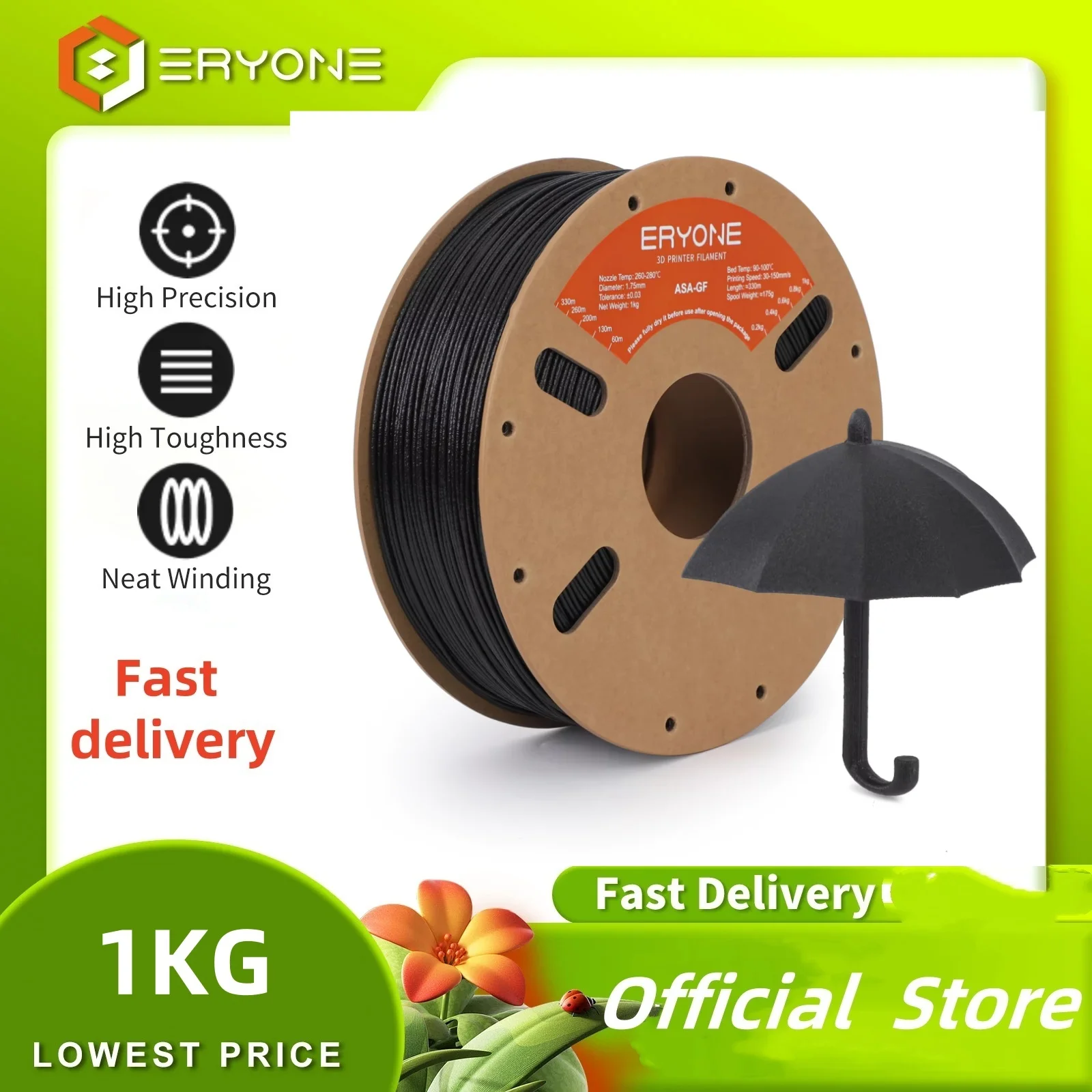
Official Store Deal
Expert Analysis Overview
Material Science and Composition: The ASA-GF Deep Dive
The core of this filament is Acrylonitrile Styrene Acrylate (ASA), a polymer primarily recognized for its superior weatherability when compared directly to Acrylonitrile Butadiene Styrene (ABS). While ABS is a common engineering plastic, it tends to degrade under prolonged UV exposure, leading to yellowing, embrittlement, and a significant loss of mechanical properties over time. ASA, on the other hand, inherently resists UV degradation, maintaining its aesthetic and structural integrity even after extensive exposure to sunlight. This makes ASA an unequivocally preferred choice for any application destined for the outdoors. It endures the sun's glare.
The addition of 10% glass fiber is a critical enhancement, fundamentally altering the filament's mechanical profile. Glass fibers act as internal reinforcement, similar to rebar in concrete, significantly increasing the material's tensile strength, stiffness, and overall dimensional stability. This composite material can therefore withstand greater stress and strain before deforming or failing, proving invaluable for structural components that must bear loads or resist deflection. This is a game-changer for functional prints that demand rigidity. The fibers create a stronger matrix.
Unlike common consumer-grade filaments such as Polylactic Acid (PLA) or Polyethylene Terephthalate Glycol (PETG), ASA-GF offers a distinct and superior performance profile in specific applications. While PLA is celebrated for its ease of printing and PETG for its good layer adhesion and moderate durability, neither can match ASA-GF's resilience against the elements or its enhanced rigidity and heat deflection. This material effectively bridges the gap between accessible desktop 3D printing and the demanding requirements typically associated with industrial-grade plastics. It is a true engineering material, enabling projects that were previously impractical with standard filaments. Makers can build with confidence.
Precision and Printing Reliability: The Foundation of Functional Parts
The filament boasts high precision and exhibits a neat winding pattern on its spool, both critical factors for successful and reliable 3D printing. Consistent filament diameter is paramount for predictable extrusion, directly influencing the accuracy and quality of printed parts. A uniform diameter minimizes print failures that can arise from inconsistent material flow, such as under-extrusion (leading to weak layers) or over-extrusion (causing blobs and stringing), and reduces the risk of nozzle clogging. This ensures smoother, more reliable print runs, saving time and material. Every millimeter counts.
Further reinforcing its commitment to reliability, the filament is specifically advertised as no tangle, no warping, no clogging, and bubble-free. These are among the most common and frustrating issues encountered by 3D printer users. Tangled spools can halt a print midway, leading to wasted time and filament. Warping, where prints lift from the build plate, compromises part integrity and adhesion. Clogging can damage hotends and waste significant material and effort. Being bubble-free indicates proper manufacturing and rigorous moisture control, as trapped moisture can cause steam bubbles during extrusion, leading to weak, porous prints. Consistency matters greatly here for optimal results.
The specified dimensional accuracy of ±0.03mm is a particularly tight tolerance for 3D printing filament. This level of precision ensures that the extruded plastic adheres precisely to the intended path and dimension, resulting in parts that are not only aesthetically pleasing but also dimensionally accurate. For intricate mechanical parts, such as gears, interlocking components, or custom enclosures where exact fitment is crucial, this tight tolerance is non-negotiable. Small tolerances improve fitment and functionality. This level of control empowers makers to create complex assemblies with confidence, knowing their parts will integrate as designed.
Engineering for the Elements: Robustness Beyond the Bench
This filament is explicitly marketed as "Suit for Outdoor Use," which immediately highlights its most significant advantage for the maker community. The accompanying images, featuring items like outdoor lanterns, birdhouses, and bicycle components, visually reinforce its capability for such demanding applications. The ability to produce durable outdoor items expands the scope of 3D printing dramatically. Outdoor durability is a major selling point for functional designs.
High heat resistance is an indispensable property for any parts exposed to direct sunlight, operating in warmer climates, or situated near heat-generating components. Standard plastics like PLA can soften, deform, or even melt at relatively low temperatures, compromising their structural integrity and functionality. ASA-GF, however, maintains its form and mechanical strength even at elevated temperatures, making it ideal for enclosures for outdoor electronics, automotive parts, or garden tools. Heat stability is paramount for longevity.
UV resistance is another critical feature, preventing the material degradation, discoloration, and embrittlement that often plague plastics exposed to prolonged sun exposure. This means outdoor prints made with ERYONE ASA-GF will retain their original color, strength, and structural integrity over extended periods, resisting the fading and weakening commonly seen with other materials. No more brittle, faded parts after a season. This longevity ensures that projects, from decorative garden ornaments to critical sensor housings, remain functional and attractive for years.
Furthermore, its inherent water resistance and overall weather resistance ensure the material can endure diverse environmental conditions, including rain, high humidity, snow, and significant temperature fluctuations, without significant impact on its performance. This comprehensive environmental protection makes it supremely suitable for a wide array of outdoor applications, ranging from robust garden fixtures and signage to essential components for outdoor robotics or drone parts. It handles harsh conditions with ease. Makers can deploy their creations confidently, knowing they are built to last against nature's challenges.
Structural Integrity and Mechanical Performance: Building for Strength
The filament delivers high mechanical strength, a direct and significant benefit derived from the combination of the ASA polymer matrix and the reinforcing glass fiber. This strength is absolutely vital for functional parts that are expected to bear significant loads, withstand physical stress, or maintain their shape under pressure. Strong parts last longer and perform reliably. For engineers and makers prototyping structural elements, this property means the difference between a proof-of-concept that quickly fails and a component that can be tested under realistic conditions.
High toughness is equally important, signifying the material's ability to absorb energy and undergo plastic deformation before ultimately fracturing. This characteristic stands in stark contrast to brittle materials, which tend to snap suddenly and catastrophically under sudden impact or stress concentrations. Toughness is crucial for parts that might be dropped, subjected to dynamic forces, or need to flex slightly without breaking. It resists sudden impacts effectively, making it suitable for tool handles, protective guards, or moving parts in machinery. The material offers resilience.
For makers designing custom machine components, intricate jigs, robust fixtures, or even replacement parts for household items, this material's superior mechanical properties are a significant advantage. It allows for the creation of durable, long-lasting parts that can confidently replace weaker stock components made from standard plastics or enable entirely new functionalities previously unattainable with less capable filaments. Upgrade your printer, upgrade your tools, upgrade your projects. This filament empowers the creation of truly functional and reliable end-use parts, moving beyond mere aesthetic prototypes.
Packaging and Presentation: Protecting the Precision
The professional packaging employed by ERYONE underscores a clear understanding of filament preservation and user experience. The use of a recycled cardboard box is a nod towards environmental responsibility, a growing concern within the maker community. However, the most critical aspect of the packaging for filament quality is the internal protection. Sustainable choices are good.
Each spool is sealed within a vacuum ziplock bag, which is essential for protecting the ASA-GF filament from moisture during shipping and long-term storage. ASA, like many engineering plastics, is hygroscopic, meaning it readily absorbs moisture from the air. Moisture absorption can severely degrade print quality, leading to issues such as stringing, bubbling, poor layer adhesion, and a significant reduction in the mechanical properties of the final print. The inclusion of desiccant within this bag further ensures a dry environment. Good packaging protects investments.
The edge banding design on the spool itself is a thoughtful detail that directly contributes to a smoother printing experience. This design helps prevent filament tangling, a common and frustrating problem that can lead to failed prints and even damage to the printer. A neatly wound and secured spool ensures consistent feeding into the extruder, reducing friction and the chances of snags or blockages. This attention to detail enhances the overall user experience and protects the product from common handling issues. Smooth feeding prevents frustration.
The provided spool dimensions (20cm diameter, 5.6cm width, 2.2cm inner hole) and box dimensions (21cm x 21cm x 6.5cm) indicate a standard 1kg spool size. This standardization ensures broad compatibility with the vast majority of desktop 3D printers on the market, simplifying integration into existing maker workflows without requiring specialized spool holders or modifications. Standard sizes are convenient for all users. This eliminates a common hurdle for many enthusiasts.
The Maker's Advantage: Community & Customization Unleashed
For the dedicated tinkerer and the avid maker, this ASA Glass Fiber filament represents a significant leap forward in the types of projects that can be undertaken. The material's enhanced durability, high mechanical strength, and superior environmental resistance mean that components designed not just for external use, but for the 3D printers themselves, can be printed with unprecedented longevity and performance. Imagine crafting custom fan shrouds, robust cable chains, or even structural braces for your 3D printer that outperform stock injection-molded parts. It builds better machines, capable of more.
The ability to reliably print weather-resistant and mechanically strong parts also significantly fosters and expands opportunities for community-driven projects. Makers can now contribute designs for open-source weather stations, durable outdoor sensor housings for environmental monitoring, or specialized custom garden tools that are truly built to withstand the elements year-round. This material encourages collaborative innovation where reliability is paramount. Collaboration thrives with robust materials, pushing collective capabilities.
Furthermore, the material's properties make experimentation with custom parts and modifications far more viable and rewarding. If a user aims to modify their 3D printer for a new, specialized function, or to build a unique, application-specific tool, the high mechanical strength and toughness of ASA-GF ensure that these printed components will perform reliably under stress. This capability drastically reduces the need for constant reprinting due to failure, allowing for quicker iteration and more robust final designs. This material empowers innovation and resilience in design. It transforms ideas into lasting realities.
The Future of Functional Prints: A Vision for Makers
Imagine a world where your 3D printed creations are no longer confined to the pristine environment of the workbench but are confidently deployed outdoors, resisting the relentless assault of sun, rain, wind, and heat with unwavering resilience. This filament empowers makers to decisively move beyond the realm of decorative trinkets and fragile prototypes, enabling the crafting of truly functional components that dramatically elevate the capabilities of their machines and projects. Consider the profound satisfaction of designing and printing a custom drone frame that laughs in the face of harsh weather conditions, or an upgraded tool handle for heavy-duty use that sustains years of rigorous application without cracking, fading, or degrading. This material isn't merely a consumable; it's a powerful enabler, providing the means to create a new generation of durable, high-performance, custom-engineered solutions that stand the test of time and environment. Embrace the outdoors.