ELEGOO TPU 3D Printer Filament 1.75mm 95A Shore Hardness
Official Store Deal
Expert Analysis Overview
The ELEGOO TPU 3D Printer Filament is a highly elastic and resilient material engineered for demanding functional prototyping and end-use applications. This filament targets users requiring parts with significant flexibility, impact absorption, and durability, moving beyond the capabilities of standard rigid plastics. Its specific 95A Shore Hardness rating positions it as a robust yet pliable option for a wide array of engineering challenges.
The visual evidence highlights this TPU filament's inherent flexibility and resilience. A printed blue object, resembling a flexible clamp, is shown being significantly bent without fracturing. This demonstrates the material's capacity for extreme deformation and recovery.
Such high elasticity is critical for components subjected to repeated bending, compression, or impact. Unlike brittle PLA or even stiffer PETG, TPU's ability to stretch over 500% before breaking ensures parts can withstand considerable stress. This makes it ideal for gaskets, protective casings, flexible joints, or wearable items where material fatigue is a concern.
Standard rigid filaments like PLA Plus typically exhibit an elongation at break of around 7.9% ± 1.6%, while PETG Pro offers slightly more at 7.6% ± 1.1%. The ELEGOO TPU 95A, with its >500% elongation at break, represents a significant leap in mechanical properties. This is a substantial difference.
Shore Hardness, specifically 95A for this filament, quantifies the material's resistance to indentation. A 95A rating indicates a material that is firm yet still highly flexible, akin to a car tire tread or a soft skateboard wheel. This balance is crucial.
For engineers and designers, this specific hardness allows for the creation of parts that are not overly soft or squishy, maintaining structural integrity while offering flexibility. It bridges the gap between rubber-like materials and more rigid plastics. This precision is vital.
Compared to softer TPUs (e.g., 85A) which might be too pliable for some functional applications, or harder materials that lack the necessary give, 95A strikes an optimal balance. It offers sufficient rigidity for consistent extrusion while delivering the desired flexibility in the final print. This makes it a versatile choice.
Strict tolerance and consistency are paramount for reliable 3D printing, especially with flexible materials. The filament is advertised with a ±0.02mm dimensional accuracy. This is a tight tolerance.
Such precise diameter control minimizes issues like under-extrusion or over-extrusion, which are common culprits for print failures. Consistent filament diameter ensures a steady flow of material through the nozzle, leading to uniform layer adhesion and stronger parts. This directly impacts print quality.
Many generic filaments often have wider tolerances, leading to inconsistent extrusion and frustrating print failures, particularly with flexible materials. The ELEGOO TPU's tight tolerance reduces the need for constant printer calibration and adjustments. This saves significant time and material.
The images clearly show neatly wound spools, both in black and white variants. The winding appears uniform and free of tangles. A well-wound spool is essential.
Neatly wound filament prevents tangles and knots during printing, which can otherwise lead to nozzle clogs, skipped layers, or complete print failures. This is especially important during long print jobs where unattended operation is desired. A smooth feed path is critical.
Poorly wound spools are a frequent source of frustration for 3D printer users, often requiring constant supervision or leading to wasted material. The emphasis on a less-tangle and neatly wound spool directly addresses a common pain point in 3D printing. This enhances user experience.
Printing with TPU requires specific considerations due to its flexible nature. While the material offers incredible properties, successful prints depend on proper printer setup and settings. Slower print speeds are often necessary.
Flexible filaments tend to buckle or stretch in the extruder if printed too quickly, especially with Bowden setups. Users should anticipate adjusting print speeds downwards to ensure smooth material flow and prevent jams. This is a common practice.
Unlike rigid PLA which can be printed at high speeds, TPU demands patience and optimized retraction settings to prevent stringing and blobs. Direct drive extruders are generally recommended for the best results with flexible filaments. This improves control.
Achieving good first-layer adhesion is crucial for any 3D print, and TPU is no exception. While TPU generally adheres well to various surfaces, proper bed preparation is still recommended. A clean bed is always best.
Using an appropriate build surface, such as PEI sheets, glass with an adhesive, or textured plates, can significantly improve adhesion. Ensuring the bed is level and heated to the recommended temperature (typically 50-60°C) will prevent warping and detachment during printing. This ensures print stability.
Compared to PLA which is forgiving on bed adhesion, or ABS which requires high bed temperatures and enclosures, TPU often finds a middle ground. Experimentation with bed temperature and adhesion aids may be necessary for optimal results. This fine-tuning is part of the process.
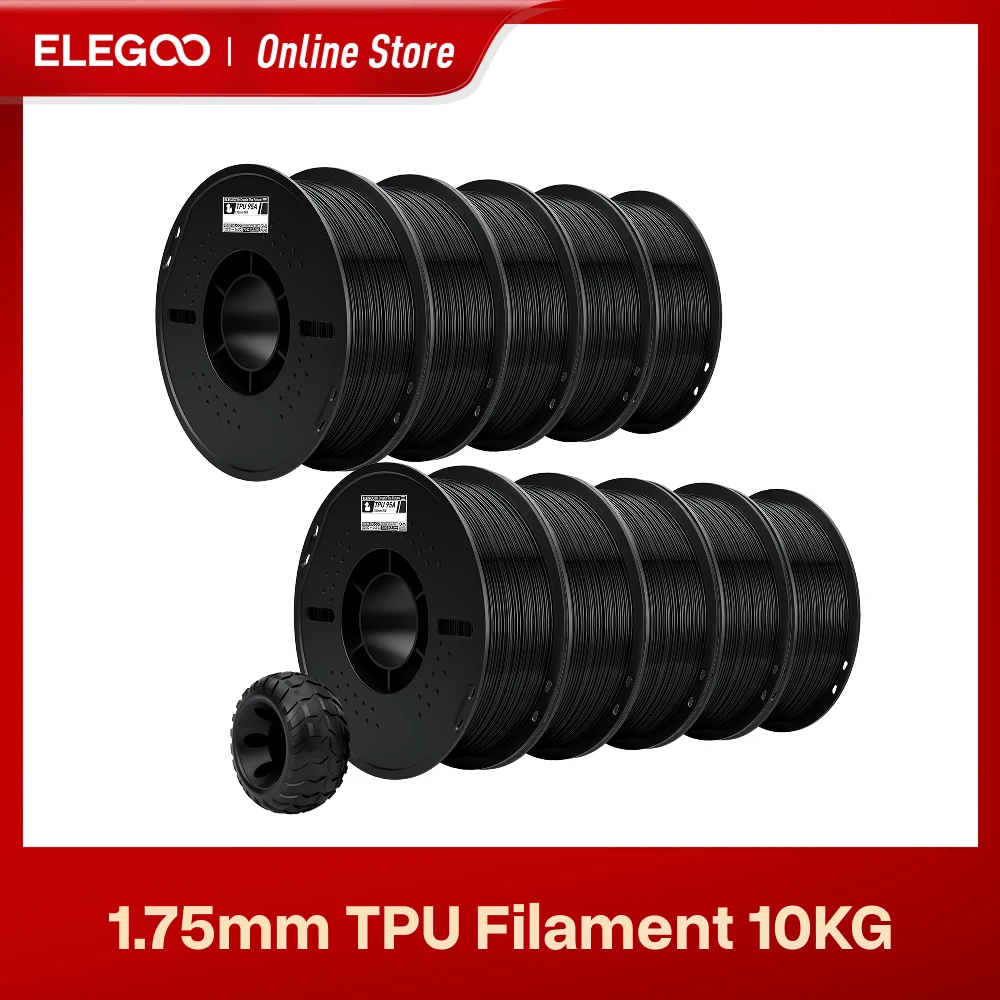
The availability of this TPU filament in multi-kilogram packs, such as the 10KG option shown, indicates a focus on users with high-volume printing needs or those who frequently utilize flexible materials. Bulk purchasing offers value.
For businesses, workshops, or dedicated hobbyists, buying in larger quantities reduces the per-kilogram cost and ensures a consistent supply of material. This minimizes downtime and streamlines production workflows. This is a cost-effective approach.
Individual 1kg spools are standard, but the option for larger quantities positions this product as a serious contender for professional applications. It caters to users who understand the long-term value of reliable, specialized materials. This supports continuous projects.
Imagine designing and printing custom drone parts that absorb impact, creating ergonomic tool grips that reduce fatigue, or fabricating durable seals for industrial machinery. This filament empowers users to produce functional components that simply aren't possible with traditional rigid plastics. The consistent quality and high elasticity of ELEGOO TPU ensure these critical parts perform reliably, project after project, transforming concepts into resilient, real-world solutions.
Material Characteristics and Mechanical Performance
The visual evidence highlights this TPU filament's inherent flexibility and resilience. A printed blue object, resembling a flexible clamp, is shown being significantly bent without fracturing. This demonstrates the material's capacity for extreme deformation and recovery.
Such high elasticity is critical for components subjected to repeated bending, compression, or impact. Unlike brittle PLA or even stiffer PETG, TPU's ability to stretch over 500% before breaking ensures parts can withstand considerable stress. This makes it ideal for gaskets, protective casings, flexible joints, or wearable items where material fatigue is a concern.
Standard rigid filaments like PLA Plus typically exhibit an elongation at break of around 7.9% ± 1.6%, while PETG Pro offers slightly more at 7.6% ± 1.1%. The ELEGOO TPU 95A, with its >500% elongation at break, represents a significant leap in mechanical properties. This is a substantial difference.
Shore Hardness and Application Versatility
Shore Hardness, specifically 95A for this filament, quantifies the material's resistance to indentation. A 95A rating indicates a material that is firm yet still highly flexible, akin to a car tire tread or a soft skateboard wheel. This balance is crucial.
For engineers and designers, this specific hardness allows for the creation of parts that are not overly soft or squishy, maintaining structural integrity while offering flexibility. It bridges the gap between rubber-like materials and more rigid plastics. This precision is vital.
Compared to softer TPUs (e.g., 85A) which might be too pliable for some functional applications, or harder materials that lack the necessary give, 95A strikes an optimal balance. It offers sufficient rigidity for consistent extrusion while delivering the desired flexibility in the final print. This makes it a versatile choice.
Dimensional Precision and Print Consistency
Strict tolerance and consistency are paramount for reliable 3D printing, especially with flexible materials. The filament is advertised with a ±0.02mm dimensional accuracy. This is a tight tolerance.
Such precise diameter control minimizes issues like under-extrusion or over-extrusion, which are common culprits for print failures. Consistent filament diameter ensures a steady flow of material through the nozzle, leading to uniform layer adhesion and stronger parts. This directly impacts print quality.
Many generic filaments often have wider tolerances, leading to inconsistent extrusion and frustrating print failures, particularly with flexible materials. The ELEGOO TPU's tight tolerance reduces the need for constant printer calibration and adjustments. This saves significant time and material.
Spool Winding and Extrusion Reliability
The images clearly show neatly wound spools, both in black and white variants. The winding appears uniform and free of tangles. A well-wound spool is essential.
Neatly wound filament prevents tangles and knots during printing, which can otherwise lead to nozzle clogs, skipped layers, or complete print failures. This is especially important during long print jobs where unattended operation is desired. A smooth feed path is critical.
Poorly wound spools are a frequent source of frustration for 3D printer users, often requiring constant supervision or leading to wasted material. The emphasis on a less-tangle and neatly wound spool directly addresses a common pain point in 3D printing. This enhances user experience.
Optimizing for Flexible Prints
Printing with TPU requires specific considerations due to its flexible nature. While the material offers incredible properties, successful prints depend on proper printer setup and settings. Slower print speeds are often necessary.
Flexible filaments tend to buckle or stretch in the extruder if printed too quickly, especially with Bowden setups. Users should anticipate adjusting print speeds downwards to ensure smooth material flow and prevent jams. This is a common practice.
Unlike rigid PLA which can be printed at high speeds, TPU demands patience and optimized retraction settings to prevent stringing and blobs. Direct drive extruders are generally recommended for the best results with flexible filaments. This improves control.
Adhesion and Bed Preparation
Achieving good first-layer adhesion is crucial for any 3D print, and TPU is no exception. While TPU generally adheres well to various surfaces, proper bed preparation is still recommended. A clean bed is always best.
Using an appropriate build surface, such as PEI sheets, glass with an adhesive, or textured plates, can significantly improve adhesion. Ensuring the bed is level and heated to the recommended temperature (typically 50-60°C) will prevent warping and detachment during printing. This ensures print stability.
Compared to PLA which is forgiving on bed adhesion, or ABS which requires high bed temperatures and enclosures, TPU often finds a middle ground. Experimentation with bed temperature and adhesion aids may be necessary for optimal results. This fine-tuning is part of the process.
Long-Term Value and Application Versatility
The availability of this TPU filament in multi-kilogram packs, such as the 10KG option shown, indicates a focus on users with high-volume printing needs or those who frequently utilize flexible materials. Bulk purchasing offers value.
For businesses, workshops, or dedicated hobbyists, buying in larger quantities reduces the per-kilogram cost and ensures a consistent supply of material. This minimizes downtime and streamlines production workflows. This is a cost-effective approach.
Individual 1kg spools are standard, but the option for larger quantities positions this product as a serious contender for professional applications. It caters to users who understand the long-term value of reliable, specialized materials. This supports continuous projects.
Imagine designing and printing custom drone parts that absorb impact, creating ergonomic tool grips that reduce fatigue, or fabricating durable seals for industrial machinery. This filament empowers users to produce functional components that simply aren't possible with traditional rigid plastics. The consistent quality and high elasticity of ELEGOO TPU ensure these critical parts perform reliably, project after project, transforming concepts into resilient, real-world solutions.