EDUP 8W 2.4GHz WiFi Signal Amplifier
Official Store Deal
Expert Analysis Overview
The EDUP 8W WiFi Booster is a high-power 2.4GHz signal amplifier engineered for extending wireless network reach in challenging RF environments. This device is not merely a repeater; it functions as a dedicated power amplifier, designed to significantly augment the transmit and receive capabilities of an existing 2.4GHz wireless router or access point. Its primary utility lies in transforming a standard residential or small business Wi-Fi deployment into a robust, wide-area 2.4GHz infrastructure, particularly where signal penetration and long-distance coverage are paramount.
The core capability of this EDUP booster resides in its formidable 39dBm (8W) RF output power. This specification represents a substantial increase over the typical transmit power of consumer-grade wireless routers, which often operate in the 100mW (20dBm) to 500mW (27dBm) range. The sheer power output allows for a dramatic expansion of the 2.4GHz Wi-Fi footprint.
Consider a scenario where a standard router struggles to penetrate multiple concrete walls or reach distant outbuildings. The amplified signal from this unit possesses the necessary energy to overcome significant attenuation. This translates directly into improved signal strength at the client device, leading to more stable connections and higher effective throughput in areas previously plagued by dead zones or intermittent connectivity. The 17dB typical transmit gain ensures that the outgoing signal from the access point is boosted considerably before reaching the antenna.
Compared to a conventional range extender that merely re-broadcasts a weakened signal, this amplifier actively strengthens the original signal at its source. This fundamental difference means less signal degradation and a more reliable connection across greater distances. The 2.4GHz frequency, while slower than 5GHz, offers superior penetration through physical barriers, making this booster particularly effective for overcoming structural impediments within a building or extending coverage across a property with varied terrain.
Beyond its impressive transmit power, the EDUP booster also incorporates an 11dB typical receiver gain. This bidirectional amplification is a critical, often overlooked, aspect of effective signal boosting. It is not enough for the access point to transmit a powerful signal; it must also be able to "hear" the weaker return signals from distant client devices.
Without adequate receiver sensitivity, a powerful outgoing signal would be futile, as client devices would struggle to send data back to the access point. The 11dB receiver gain ensures that even faint signals from smartphones, Laptops, or IoT devices at the edge of the expanded network are adequately received and processed. This creates a balanced communication link, essential for maintaining stable data flow.
Imagine a large warehouse environment where Wi-Fi coverage is critical for inventory management systems. Standard access points often fail to provide reliable connectivity to handheld scanners or mobile terminals operating at the periphery. The enhanced receiver gain of this booster ensures that these devices can consistently communicate back to the central network, preventing costly operational interruptions. This balanced approach to amplification distinguishes it from simpler, unidirectional boosters.
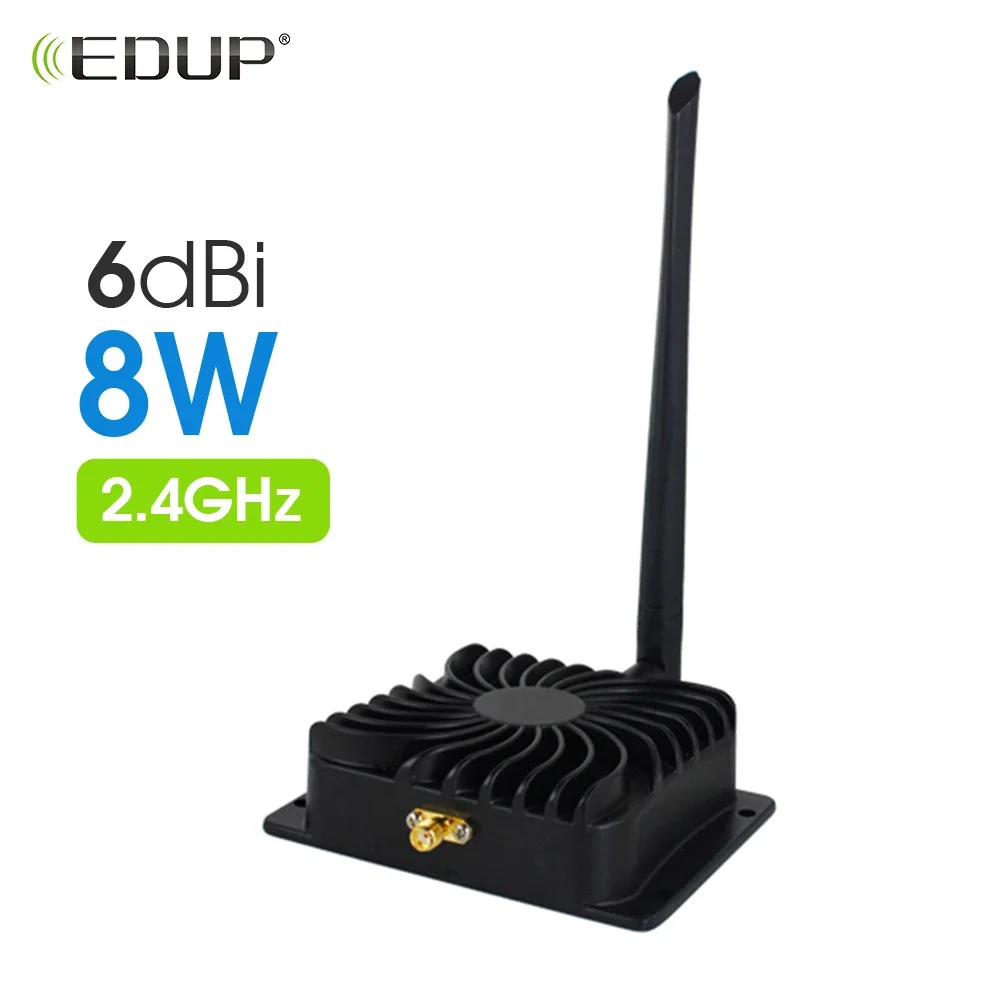
The physical design of the EDUP 8W booster immediately conveys its intended purpose: sustained high-power operation. The unit features a robust, finned aluminum enclosure. This construction is not merely aesthetic; it serves as a highly efficient passive heatsink.
High-power RF amplification generates considerable heat. Without effective thermal dissipation, components can overheat, leading to performance degradation, instability, or even premature failure. The intricate fin design maximizes the surface area exposed to ambient air, facilitating natural convection cooling. This ensures the internal circuitry operates within optimal temperature ranges, even during continuous, heavy network traffic.
Compared to plastic-cased boosters that often rely on smaller, less efficient internal heatsinks, the EDUP's all-metal, finned chassis provides superior thermal management. This design choice underscores its suitability for demanding applications where reliability and consistent performance are non-negotiable. The solid feel of the unit in hand suggests a durable construction, capable of withstanding the rigors of various installation environments.
This booster adheres to the IEEE 802.11 b/g/n standards, making it compatible with a vast majority of existing 2.4GHz wireless networks. Its integration into an existing network architecture is straightforward, typically involving a simple inline connection between the wireless router's 2.4GHz antenna port and the booster, with the external 6dBi antenna then connecting to the booster.
The device operates on the 2.4GHz frequency band. This band is known for its longer wavelength, which allows for better penetration through walls and obstacles compared to the higher-frequency 5GHz band. While the 2.4GHz band can be more susceptible to interference from other devices (like microwaves or Bluetooth), the sheer power output of this booster helps to overcome much of this noise, ensuring a stronger signal-to-noise ratio at the client.
For network administrators or power users managing a network with OpenWRT-capable routers, this booster can be a valuable addition. While the booster itself does not run OpenWRT, its integration with an OpenWRT router allows for granular control over the upstream Wi-Fi signal. An OpenWRT-enabled router can manage channel selection, transmit power (before amplification), and client associations, providing a highly customizable and optimized source signal for the EDUP booster to amplify. This synergy allows for the creation of a highly controlled and extended 2.4GHz network.
The inclusion of a 6dBi omni-directional antenna is a significant factor in the booster's performance. A higher gain antenna focuses the RF energy more effectively, extending the reach of the wireless signal. The omni-directional pattern ensures coverage in all horizontal directions, making it suitable for central placement within a large area.
The booster utilizes standard RP-SMA connectors for both the input from the router and the output to the external antenna. This common connector type ensures broad compatibility with a wide range of aftermarket antennas, allowing for further customization if a specific directional pattern (e.g., a Yagi or panel antenna for point-to-point links) is required for specialized applications. The gold-plated connectors observed on the unit suggest attention to detail in maintaining signal integrity and minimizing loss at connection points.
The working voltage range of 6-18VDC provides flexibility in power sourcing, though a dedicated power adapter is typically supplied. This wide voltage tolerance can be beneficial in installations where power stability might fluctuate slightly, contributing to the device's overall reliability.
The EDUP 8W WiFi Booster is particularly well-suited for scenarios demanding robust 2.4GHz coverage over expansive areas. Consider a multi-story building where Wi-Fi signals struggle to propagate between floors. By strategically placing an access point with this booster, a single 2.4GHz network can effectively cover the entire structure, reducing the need for multiple access points and simplifying network management.
Another compelling use case involves outdoor Wi-Fi extension. For properties with large yards, detached garages, or outdoor entertainment areas, a standard router's signal often fades rapidly. This booster can project a strong 2.4GHz signal across significant outdoor distances, enabling reliable connectivity for smart home devices, security cameras, or simply enjoying internet access while outdoors. The ability to maintain a strong signal for wireless remote control applications, as suggested by the product title, is a direct consequence of this extended range.
The value proposition of this device is rooted in its ability to provide enterprise-grade 2.4GHz coverage capabilities at a fraction of the cost of deploying multiple high-end access points. Instead of investing in a mesh system or several dedicated access points, this booster allows an existing router to dramatically increase its effective range. This represents a significant return on investment for users struggling with inadequate 2.4GHz coverage.
While the benefits of high-power amplification are clear, certain considerations are inherent to 2.4GHz operation. The 2.4GHz band, while offering superior range and penetration, is also more susceptible to congestion and interference. This booster amplifies the existing signal, including any noise present, so a clean source signal from the router is always preferable.
Furthermore, the physical footprint of the booster, with its heatsink design and external antenna, is not as discreet as some compact range extenders. This is a necessary trade-off for the thermal management required by its 8W output. Users prioritizing aesthetics or extremely compact form factors might find this less appealing. However, for installations where performance is the absolute priority, the design is entirely functional.
The absence of 5GHz band support means that devices requiring the higher throughput and lower interference of the 5GHz spectrum will not benefit from this booster. It is a specialized tool for 2.4GHz range extension, not a universal Wi-Fi upgrade. Network architects must assess whether their primary need is for long-range 2.4GHz coverage or high-speed 5GHz capacity.
The EDUP 8W WiFi Booster stands as a formidable solution for extending the reach and reliability of 2.4GHz wireless networks. Its high RF output power, coupled with robust thermal management and a sensitive receiver, ensures that wireless signals can traverse significant distances and penetrate challenging physical barriers. This device effectively transforms a standard Wi-Fi setup into a powerful, long-range communication hub for the 2.4GHz band.
Imagine a home where every corner, from the basement workshop to the furthest garden shed, now enjoys consistent, strong Wi-Fi. Picture a small office where video conferences no longer drop due to weak signals in remote meeting rooms. Envision a smart home ecosystem where every sensor and smart device, regardless of its distance from the central router, maintains an unwavering connection. This booster delivers that enhanced capability, providing the foundation for a truly ubiquitous 2.4GHz network experience, ensuring that connectivity is no longer a limiting factor in your environment.
RF Output Dynamics and Signal Propagation Enhancement
The core capability of this EDUP booster resides in its formidable 39dBm (8W) RF output power. This specification represents a substantial increase over the typical transmit power of consumer-grade wireless routers, which often operate in the 100mW (20dBm) to 500mW (27dBm) range. The sheer power output allows for a dramatic expansion of the 2.4GHz Wi-Fi footprint.
Consider a scenario where a standard router struggles to penetrate multiple concrete walls or reach distant outbuildings. The amplified signal from this unit possesses the necessary energy to overcome significant attenuation. This translates directly into improved signal strength at the client device, leading to more stable connections and higher effective throughput in areas previously plagued by dead zones or intermittent connectivity. The 17dB typical transmit gain ensures that the outgoing signal from the access point is boosted considerably before reaching the antenna.
Compared to a conventional range extender that merely re-broadcasts a weakened signal, this amplifier actively strengthens the original signal at its source. This fundamental difference means less signal degradation and a more reliable connection across greater distances. The 2.4GHz frequency, while slower than 5GHz, offers superior penetration through physical barriers, making this booster particularly effective for overcoming structural impediments within a building or extending coverage across a property with varied terrain.
Receiver Sensitivity and Bidirectional Amplification
Beyond its impressive transmit power, the EDUP booster also incorporates an 11dB typical receiver gain. This bidirectional amplification is a critical, often overlooked, aspect of effective signal boosting. It is not enough for the access point to transmit a powerful signal; it must also be able to "hear" the weaker return signals from distant client devices.
Without adequate receiver sensitivity, a powerful outgoing signal would be futile, as client devices would struggle to send data back to the access point. The 11dB receiver gain ensures that even faint signals from smartphones, Laptops, or IoT devices at the edge of the expanded network are adequately received and processed. This creates a balanced communication link, essential for maintaining stable data flow.
Imagine a large warehouse environment where Wi-Fi coverage is critical for inventory management systems. Standard access points often fail to provide reliable connectivity to handheld scanners or mobile terminals operating at the periphery. The enhanced receiver gain of this booster ensures that these devices can consistently communicate back to the central network, preventing costly operational interruptions. This balanced approach to amplification distinguishes it from simpler, unidirectional boosters.
Enclosure Durability and Thermal Management
The physical design of the EDUP 8W booster immediately conveys its intended purpose: sustained high-power operation. The unit features a robust, finned aluminum enclosure. This construction is not merely aesthetic; it serves as a highly efficient passive heatsink.
High-power RF amplification generates considerable heat. Without effective thermal dissipation, components can overheat, leading to performance degradation, instability, or even premature failure. The intricate fin design maximizes the surface area exposed to ambient air, facilitating natural convection cooling. This ensures the internal circuitry operates within optimal temperature ranges, even during continuous, heavy network traffic.
Compared to plastic-cased boosters that often rely on smaller, less efficient internal heatsinks, the EDUP's all-metal, finned chassis provides superior thermal management. This design choice underscores its suitability for demanding applications where reliability and consistent performance are non-negotiable. The solid feel of the unit in hand suggests a durable construction, capable of withstanding the rigors of various installation environments.
Network Integration and Standard Compliance
This booster adheres to the IEEE 802.11 b/g/n standards, making it compatible with a vast majority of existing 2.4GHz wireless networks. Its integration into an existing network architecture is straightforward, typically involving a simple inline connection between the wireless router's 2.4GHz antenna port and the booster, with the external 6dBi antenna then connecting to the booster.
The device operates on the 2.4GHz frequency band. This band is known for its longer wavelength, which allows for better penetration through walls and obstacles compared to the higher-frequency 5GHz band. While the 2.4GHz band can be more susceptible to interference from other devices (like microwaves or Bluetooth), the sheer power output of this booster helps to overcome much of this noise, ensuring a stronger signal-to-noise ratio at the client.
For network administrators or power users managing a network with OpenWRT-capable routers, this booster can be a valuable addition. While the booster itself does not run OpenWRT, its integration with an OpenWRT router allows for granular control over the upstream Wi-Fi signal. An OpenWRT-enabled router can manage channel selection, transmit power (before amplification), and client associations, providing a highly customizable and optimized source signal for the EDUP booster to amplify. This synergy allows for the creation of a highly controlled and extended 2.4GHz network.
Antenna System and Connectivity
The inclusion of a 6dBi omni-directional antenna is a significant factor in the booster's performance. A higher gain antenna focuses the RF energy more effectively, extending the reach of the wireless signal. The omni-directional pattern ensures coverage in all horizontal directions, making it suitable for central placement within a large area.
The booster utilizes standard RP-SMA connectors for both the input from the router and the output to the external antenna. This common connector type ensures broad compatibility with a wide range of aftermarket antennas, allowing for further customization if a specific directional pattern (e.g., a Yagi or panel antenna for point-to-point links) is required for specialized applications. The gold-plated connectors observed on the unit suggest attention to detail in maintaining signal integrity and minimizing loss at connection points.
The working voltage range of 6-18VDC provides flexibility in power sourcing, though a dedicated power adapter is typically supplied. This wide voltage tolerance can be beneficial in installations where power stability might fluctuate slightly, contributing to the device's overall reliability.
Deployment Scenarios and Value Proposition
The EDUP 8W WiFi Booster is particularly well-suited for scenarios demanding robust 2.4GHz coverage over expansive areas. Consider a multi-story building where Wi-Fi signals struggle to propagate between floors. By strategically placing an access point with this booster, a single 2.4GHz network can effectively cover the entire structure, reducing the need for multiple access points and simplifying network management.
Another compelling use case involves outdoor Wi-Fi extension. For properties with large yards, detached garages, or outdoor entertainment areas, a standard router's signal often fades rapidly. This booster can project a strong 2.4GHz signal across significant outdoor distances, enabling reliable connectivity for smart home devices, security cameras, or simply enjoying internet access while outdoors. The ability to maintain a strong signal for wireless remote control applications, as suggested by the product title, is a direct consequence of this extended range.
The value proposition of this device is rooted in its ability to provide enterprise-grade 2.4GHz coverage capabilities at a fraction of the cost of deploying multiple high-end access points. Instead of investing in a mesh system or several dedicated access points, this booster allows an existing router to dramatically increase its effective range. This represents a significant return on investment for users struggling with inadequate 2.4GHz coverage.
Potential Considerations and Trade-offs
While the benefits of high-power amplification are clear, certain considerations are inherent to 2.4GHz operation. The 2.4GHz band, while offering superior range and penetration, is also more susceptible to congestion and interference. This booster amplifies the existing signal, including any noise present, so a clean source signal from the router is always preferable.
Furthermore, the physical footprint of the booster, with its heatsink design and external antenna, is not as discreet as some compact range extenders. This is a necessary trade-off for the thermal management required by its 8W output. Users prioritizing aesthetics or extremely compact form factors might find this less appealing. However, for installations where performance is the absolute priority, the design is entirely functional.
The absence of 5GHz band support means that devices requiring the higher throughput and lower interference of the 5GHz spectrum will not benefit from this booster. It is a specialized tool for 2.4GHz range extension, not a universal Wi-Fi upgrade. Network architects must assess whether their primary need is for long-range 2.4GHz coverage or high-speed 5GHz capacity.
Conclusion: Building a Resilient 2.4GHz Network
The EDUP 8W WiFi Booster stands as a formidable solution for extending the reach and reliability of 2.4GHz wireless networks. Its high RF output power, coupled with robust thermal management and a sensitive receiver, ensures that wireless signals can traverse significant distances and penetrate challenging physical barriers. This device effectively transforms a standard Wi-Fi setup into a powerful, long-range communication hub for the 2.4GHz band.
Imagine a home where every corner, from the basement workshop to the furthest garden shed, now enjoys consistent, strong Wi-Fi. Picture a small office where video conferences no longer drop due to weak signals in remote meeting rooms. Envision a smart home ecosystem where every sensor and smart device, regardless of its distance from the central router, maintains an unwavering connection. This booster delivers that enhanced capability, providing the foundation for a truly ubiquitous 2.4GHz network experience, ensuring that connectivity is no longer a limiting factor in your environment.