DIY USB 2.0 Power & Data Extension Cables
Official Store Deal
Expert Analysis Overview
The Architect's Wiring Foundation This collection of USB 2.0 A male and female connector cables represents an indispensable toolkit for any electronics enthusiast or custom builder. These are not merely passive conduits; they are foundational components designed for direct integration into custom circuits and projects. Each cable offers distinct 2-pin (power only) or 4-pin (power and data) configurations, providing precise control over connectivity. The offerings cater specifically to the nuanced demands of DIY electronics, from custom peripheral builds to embedded systems, where standard, off-the-shelf USB cables fall short. These components allow for tailored power delivery and data transmission solutions. The utility extends far beyond simple charging, enabling intricate modifications and custom functionalities in a range of devices.
Pinning Down Connectivity: Power vs. Data
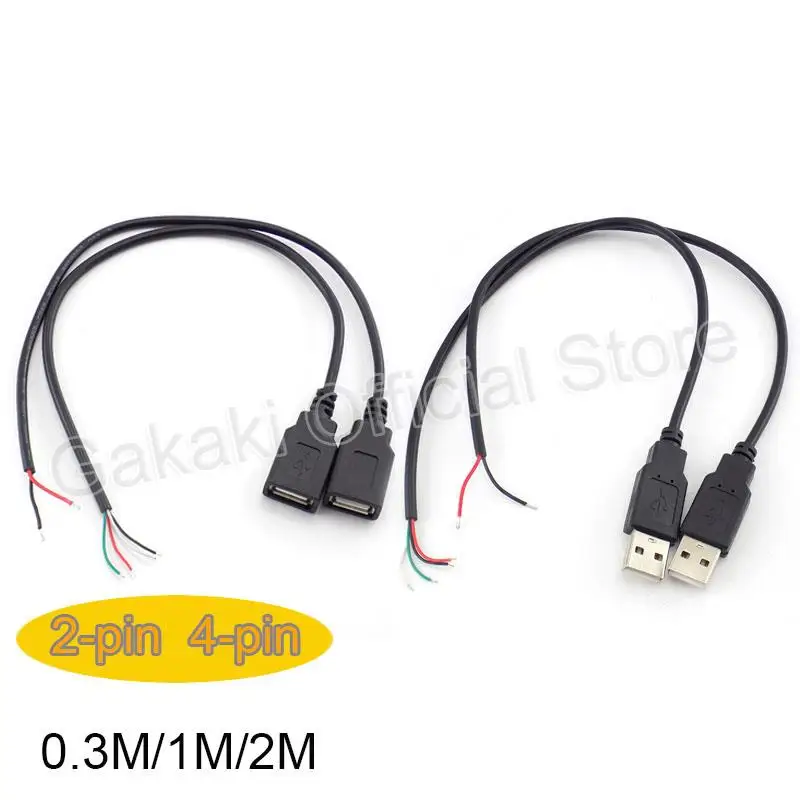
The product line offers distinct USB 2.0 A connectors, available in both male and female configurations. These are presented with either a 2-pin or a full 4-pin exposed wire termination. The visual evidence clearly distinguishes between the two wiring options by the number of individual conductors visible at the stripped ends. A 2-pin variant isolates the essential power delivery lines. The 4-pin option includes the full data transmission pair alongside power.This dual-pinout availability means precise control over circuit integration. For projects requiring only 5V power, such as an LED strip backlight within a custom keyboard case or a simple fan for cooling, the 2-pin cable streamlines connections. It avoids unnecessary data lines and simplifies the wiring process. When a project demands both power and data, like a custom macro pad using a microcontroller or an external drive enclosure, the 4-pin cable provides the complete USB 2.0 interface. This differentiation prevents signal interference from unused data lines.
Standard USB cables arrive as sealed units, necessitating destructive modification to access individual conductors. Such an approach often compromises the cable's integrity and can introduce potential failure points. Unlike these generic, pre-terminated cables, this offering specifically caters to the experimental builder. It provides a clean, factory-prepared interface for direct soldering or terminal block connections. This design eliminates guesswork regarding wire identification and reduces preparation time.
The Conductive Backbone: Material Integrity
The visible construction of these cables indicates a focus on functional reliability. Each connector housing appears to be molded from a durable, standard-grade plastic, providing adequate protection for the internal contacts. The insulated wires themselves exhibit a consistent diameter, suggesting uniform current carrying capacity. The stripped ends are neatly presented, showing the individual copper conductors ready for termination. These materials imply a reasonable degree of resilience for typical indoor DIY applications.Robust cable construction is paramount for projects that endure repeated handling or slight mechanical stress. The integrity of the insulation prevents short circuits, a critical factor when dealing with exposed wires in compact enclosures. A secure connection to the PCB or terminal block ensures consistent power and data flow, preventing intermittent failures that plague less robust setups. This detail is crucial for long-term project stability.
Many budget-oriented DIY cables can suffer from inconsistent wire gauges or brittle insulation, leading to premature failure. This product appears to use materials that meet a baseline of acceptability for hobbyist and enthusiast projects. The visible quality suggests a step above the absolute cheapest alternatives, offering a better foundation for reliable custom builds. It handles typical workshop environments.
Tailoring the Reach: Lengths for Every Project
The cables are available in three practical lengths: 0.3 meters, 1 meter, and 2 meters. This range allows for considerable flexibility in project design and implementation. The shorter 0.3-meter option is ideal for internal connections within a chassis or for very compact external setups where excess cable length would be cumbersome. The 1-meter cable serves as a versatile standard for moderate distances. The 2-meter variant provides extended reach for less constrained environments.Selecting the appropriate cable length is more than a convenience; it affects signal integrity and aesthetic presentation. A shorter cable minimizes signal degradation over distance, which can be a subtle but real factor in USB 2.0 data transmission. Longer cables, while offering flexibility, can introduce resistance, especially for power delivery, potentially impacting voltage stability for sensitive components. The availability of multiple lengths allows builders to optimize for both performance and physical layout.
Generic USB cables often come in a limited set of lengths, forcing builders to coil excess cable or use extension cords, both of which can be unsightly and introduce potential points of failure. This product's varied length options empower the creator to choose precisely what is needed. It avoids unnecessary bulk. This choice directly contributes to a cleaner, more professional final product.
The Current and the Stream: Performance Under Load
These cables are designed to operate within the 5V USB power standard, supporting the typical current draw of USB 2.0 devices. The 4-pin versions facilitate USB 2.0 data transmission, which has a theoretical maximum speed of 480 Mbps. This specification is suitable for a vast array of peripherals, including keyboards, mice, low-speed external storage, and microcontrollers. The power lines are robust enough for standard charging applications.For any custom electronic project, stable power delivery is non-negotiable. A consistent 5V supply ensures microcontrollers function correctly and prevents brownouts in power-hungry components like LED arrays. The USB 2.0 data rate, while not the fastest modern standard, provides ample bandwidth for most human interface devices and many data logging applications. It is a proven, reliable protocol. This ensures compatibility with a broad ecosystem of devices.
While USB 3.0 and USB-C offer higher speeds and power delivery, they also introduce greater complexity in wiring and often require more sophisticated controllers. For many DIY projects, especially those involving older microcontrollers or custom PCBs, USB 2.0 remains the pragmatic choice. These cables provide a direct, unadulterated connection for this widely adopted standard. They offer a simpler integration path.
Empowering the Creator: Unrestricted Customization
The core value of these cables lies in their 'DIY' designation. They are purpose-built to be integrated into custom electronic assemblies. The stripped wire ends are ready for soldering to circuit boards, connecting to screw terminals, or splicing into existing wiring harnesses. This design principle allows for maximum flexibility in creating unique power and data solutions tailored to specific project needs. Builders can easily modify cable lengths, create custom adapters, or embed USB functionality directly into prototypes.This level of customization is crucial for enthusiasts pushing the boundaries of what is possible with off-the-shelf components. Whether constructing a bespoke mechanical keyboard with integrated RGB lighting and a custom hub, or developing a compact embedded system for home automation, the ability to define the exact wiring path is invaluable. It enables the creation of truly unique and optimized solutions. The customizability reduces design constraints.
Relying solely on pre-fabricated cables severely limits design freedom, forcing compromises in layout, component placement, and even functionality. These DIY cables remove those barriers. They transform a generic USB connection into a flexible resource, allowing the builder to dictate the form and function of their project. This approach fosters innovation.