DALFTECH 4G LTE USB Portable Wi-Fi Hotspot Modem
Official Store Deal
Expert Analysis Overview
Advanced Mobile Connectivity Solutions
The DALFTECH 4G LTE USB Portable Wi-Fi Hotspot Modem series represents a suite of compact, plug-and-play cellular-to-Wi-Fi bridging devices engineered for transient or supplementary network deployments. These dongles, encompassing models like the MF782, UF901, and UF902, are designed to convert a 4G LTE cellular data connection into a localized Wi-Fi hotspot, facilitating internet access for multiple client devices in environments lacking traditional wired infrastructure. Their primary utility lies in providing immediate network access. This is a critical function for mobile professionals.
The core operational principle involves the integration of a cellular modem chipset with a Wi-Fi access point controller within a USB form factor. This architecture allows for power delivery and, in some configurations, data passthrough via the USB interface, while simultaneously broadcasting a Wi-Fi signal. The varying models offer distinct performance profiles, notably in their adherence to Wi-Fi standards and supported LTE frequency bands. Understanding these distinctions is paramount for optimal deployment.
Unlike conventional fixed-line routers, these portable modems prioritize mobility and ease of deployment. They are not intended for high-density, enterprise-grade network segments. However, for individual users or small workgroups requiring on-the-go connectivity, their compact design and integrated functionality offer a compelling alternative to tethering smartphones or deploying larger, battery-powered mobile hotspots. Their small footprint is a major advantage.
Cellular Throughput and Wi-Fi Protocol Adherence
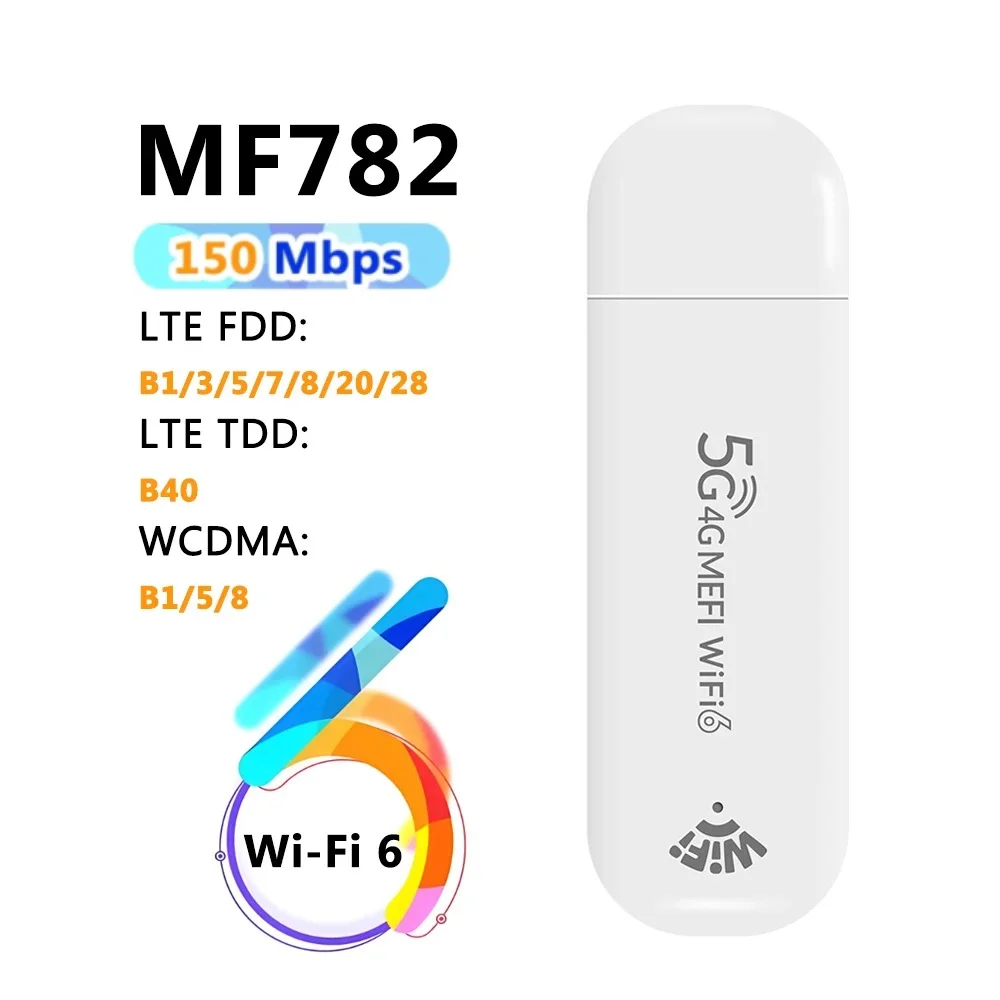
The DALFTECH series presents a spectrum of cellular and Wi-Fi capabilities. The MF782 variant notably supports Wi-Fi 6 (802.11ax), indicating a potential for enhanced spectral efficiency and higher theoretical throughput compared to its Wi-Fi 4 (802.11n) counterparts, the UF901 and UF902. The MF782 is rated for 150 Mbps downlink, aligning with LTE Category 4 specifications. This speed is adequate for most single-user streaming and browsing activities.
For the UF901, also rated at 150 Mbps, and the UF902, specified at 100 Mbps, the reliance on Wi-Fi 4 (802.11n) suggests a more established, albeit less performant, wireless standard. Wi-Fi 4 operates predominantly on the 2.4 GHz band, which is susceptible to interference in congested environments. The maximum theoretical throughput of Wi-Fi 4 is significantly lower than Wi-Fi 6. This impacts multi-device performance.
In practical terms, the 150 Mbps LTE downlink on the MF782 and UF901 models translates to sufficient bandwidth for high-definition video streaming on a single device or standard web browsing across several devices simultaneously. The Wi-Fi 6 implementation on the MF782, while still constrained by the 150 Mbps cellular backhaul, offers benefits in terms of OFDMA (Orthogonal Frequency-Division Multiple Access) and MU-MIMO (Multi-User, Multiple-Input, Multiple-Output) support, which can improve efficiency when multiple Wi-Fi 6-compatible devices are connected. This is a significant upgrade.
Supported Frequency Bands and Global Compatibility
The cellular modem's utility is intrinsically linked to its supported frequency bands. The MF782 model offers extensive LTE FDD support (B1/3/5/7/8/20/28) and LTE TDD (B40), alongside WCDMA (B1/5/8). This broad band coverage suggests a high degree of international compatibility, particularly across European, Asian, and some North American networks. Users can expect reliable connectivity in diverse geographical regions.
Conversely, the UF901 provides a slightly different band configuration, with LTE FDD (B1/3/7/8/20), LTE TDD (B38/39/40/41), and WCDMA (B1/8). The inclusion of TDD bands B38/39/40/41 is particularly relevant for specific markets in Asia. The UF902, with its more limited LTE FDD (B1/3/5) and LTE TDD (B1) and WCDMA (B1) support, appears to target a narrower set of regional deployments. Band compatibility is non-negotiable.
For network engineers deploying these devices, verifying the specific model's band support against the target region's cellular network infrastructure is a critical pre-deployment step. A mismatch in supported bands will result in a complete lack of cellular connectivity. Unlike universal modems, these devices require careful band verification. This ensures operational integrity.
Hardware Architecture and Firmware Considerations
These USB modems typically integrate a System-on-Chip (SoC) that combines the cellular baseband processor, Wi-Fi controller, and a minimal embedded operating system. While specific chipset details are not visually discernible, the performance ratings (e.g., 150 Mbps LTE Cat 4) imply the use of standard, cost-effective modem chipsets from manufacturers like Qualcomm, MediaTek, or Spreadtrum. The compact form factor necessitates highly integrated components. Power consumption is minimal.
The firmware running on these devices is generally proprietary, offering a web-based interface for basic configuration such as Wi-Fi SSID, password, APN settings, and possibly some rudimentary firewall rules. Advanced networking features like VLAN tagging, VPN client/server functionality, or custom routing tables are typically absent. These are consumer-grade devices.
For users accustomed to the flexibility of OpenWRT or similar open-source router firmware, these dongles present a more constrained environment. The likelihood of third-party firmware support is low due to the specialized nature of the cellular modem integration and the limited hardware resources. This means customization options are limited. Network segmentation via VLANs, for instance, would require an upstream managed switch or router. This is a design constraint.
Power Delivery and Physical Interface
All models presented utilize a USB-A connector for power and data. This universal interface allows the dongles to be powered by a wide array of sources, including laptop USB ports, USB wall adapters, power banks, or even car chargers. The simplicity of the power delivery mechanism enhances their portability and ease of use. A standard USB port provides sufficient current.
The physical design is a compact, stick-like form factor, reminiscent of a USB flash drive. The UF901 model distinguishes itself with an external antenna connector, suggesting potential for improved signal reception in areas with weak cellular coverage. This is a notable design choice. The MF782 and UF902 models rely on internal antennas, which are convenient but may offer less gain. Signal integrity is crucial.
For deployments in challenging RF environments, the UF901's external antenna option provides a tangible advantage, allowing for the use of higher-gain directional antennas to optimize signal strength and stability. The internal antenna designs, while sleek, are inherently limited by their physical dimensions. This impacts range and reliability. Users should consider their deployment environment.
Security Protocols and Network Management
Standard Wi-Fi security protocols such as WPA2-PSK and likely WPA3-PSK (for the Wi-Fi 6 MF782) are expected to be supported, ensuring encrypted wireless communication. The web interface typically allows for changing the default Wi-Fi password and administrative login credentials. Implementing strong, unique passwords is a fundamental security practice.
Network management capabilities are basic. Users can monitor connected devices, view cellular signal strength, and manage SMS messages (if supported by the modem's firmware). There is no expectation of advanced traffic shaping, QoS (Quality of Service) controls, or detailed logging features found in more sophisticated network appliances. These are not enterprise solutions. Their function is straightforward connectivity.
For scenarios requiring more granular control over network traffic or enhanced security features, these dongles would need to be integrated into a larger network architecture, perhaps behind a dedicated firewall or router. They serve as the initial cellular gateway. This simplifies the network edge.
Value Proposition and Deployment Scenarios
The DALFTECH 4G LTE USB Portable Modems offer a compelling value proposition for users prioritizing portability, simplicity, and cost-effectiveness in their mobile networking solutions. The price point, around 44.24 USD, positions them as an accessible option for personal use, travel, or as a backup internet connection. Their low cost makes them attractive.
Typical deployment scenarios include: providing internet access in vehicles, temporary offices, remote work locations, or during travel where local Wi-Fi is unavailable or insecure. The ability to power them from any USB source adds to their versatility. They are ideal for quick setup. Imagine seamless connectivity during a cross-country road trip, allowing passengers to stream content and stay productive without draining smartphone batteries. Consider a field technician needing immediate internet access for diagnostics. This device provides that critical link, ensuring operational continuity and efficient data transfer from any location with cellular coverage. The convenience of a dedicated hotspot frees up personal devices, maintaining their battery life and performance for other tasks. This ensures uninterrupted workflow and entertainment, transforming any location into a connected workspace or leisure hub. The ability to share a single cellular data plan across multiple devices without complex configurations streamlines mobile productivity for small teams or families. This is a significant advantage for remote work or travel. This device empowers users to establish a reliable network perimeter, even in the most challenging environments, ensuring critical data flows remain accessible and secure. It is a tool for digital independence.
```