Creality K2 Plus Quick-Swap Hardened Steel Nozzle Kit
Official Store Deal
Expert Analysis Overview
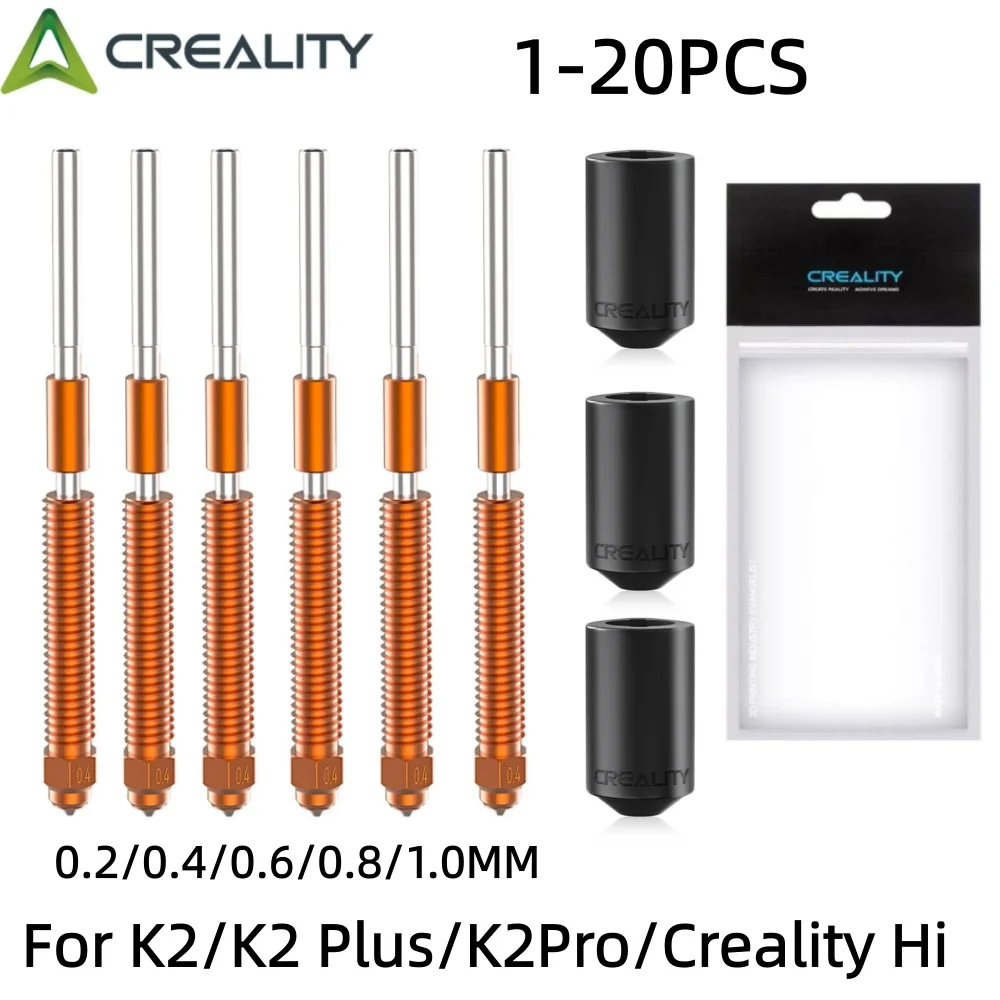
The Creality K2 Plus Quick-Swap Nozzle Kit is a high-performance extrusion component engineered for advanced 3D printing applications, specifically targeting users of Creality K2, K2 Pro, K2 Plus, and Hi Combo printers who demand precision, speed, and material versatility.
This nozzle kit features an integrated design, combining a hardened steel nozzle tip, a copper alloy heating block, and a titanium alloy heat break. This multi-material construction is not arbitrary; it addresses specific thermal and mechanical challenges inherent in high-speed and high-temperature 3D printing. The hardened steel tip provides exceptional wear resistance, a critical factor when processing abrasive filaments. Standard brass nozzles, while cost-effective, rapidly degrade when exposed to materials like carbon fiber or glass fiber composites, leading to inconsistent extrusion and premature replacement. This hardened steel variant mitigates that wear.
The copper alloy body functions as an efficient heat conductor, ensuring uniform heat distribution to the filament. Consistent thermal management is paramount for stable melt flow, directly impacting layer adhesion and surface finish. Without this uniform heating, localized temperature fluctuations can cause filament degradation or inconsistent viscosity, resulting in print artifacts. The thermal properties of copper are superior to many common heating block materials, facilitating rapid temperature changes and maintaining set points with greater accuracy. This allows for more precise control over the melt zone.
The titanium alloy pipe serves as an effective heat break, minimizing heat creep from the heating block towards the cold end of the extruder. Heat creep is a common issue where heat migrates up the filament path, causing premature softening and potential clogs. Titanium's low thermal conductivity is ideal for this application, creating a sharp thermal gradient. This design ensures that the filament remains solid until it reaches the melt zone, preventing jams and promoting reliable filament feeding. Many generic nozzles utilize stainless steel heat breaks, which, while functional, do not offer the same thermal isolation as titanium, especially under sustained high-temperature operations.
Designed for high-flow, high-speed printing, this nozzle kit supports maximum flow rates of up to 30 mm³/s and printing speeds reaching 600 mm/s. These specifications are indicative of a system optimized for rapid prototyping and production, significantly reducing print times for large or complex models. Achieving such speeds requires not only efficient heating but also a precisely machined internal geometry to minimize back pressure and ensure smooth filament passage. The internal bore is smooth, reducing friction and preventing filament accumulation that can lead to clogs.
In a scenario where production deadlines are tight, the ability to print at 600 mm/s translates directly into increased throughput. This capability is a direct upgrade from standard nozzles, which typically struggle to maintain consistent extrusion quality above 100-150 mm/s without significant compromises. The optimized melt zone and heat break design work in concert to prepare the filament for rapid deposition, maintaining material integrity even under extreme flow conditions. This allows for faster iteration cycles in design and manufacturing.
This high-flow capacity is particularly beneficial for industrial applications or users with high-volume printing needs. The efficiency gained from faster print speeds can lead to substantial savings in operational costs and time. Compared to conventional hotends that often bottleneck print speed due to insufficient melt volume, this quick-swap system is engineered to keep pace with the advanced kinematics of modern high-speed 3D printers, ensuring the extruder does not become the limiting factor in print performance.
The upgraded material integration of this K2 Plus nozzle supports a wide array of filaments, including PLA, ABS, TPU, PETG, PP, PC, PLA-CF, PET-CF, and PA-CF. This broad compatibility extends the utility of the 3D printer, allowing users to experiment with and utilize specialized engineering-grade materials. The hardened steel nozzle tip is particularly crucial for abrasive composite filaments like carbon fiber (CF) and glass fiber (GF) reinforced materials, which would rapidly wear down softer brass nozzles.
Printing with materials such as PC (Polycarbonate) or PA-CF (Carbon Fiber Nylon) often requires higher extrusion temperatures and increased wear resistance. The robust construction of this nozzle, featuring hardened steel and a titanium alloy heat break, ensures longevity and consistent performance across these demanding materials. Unlike generic nozzles that might only be suitable for basic PLA or PETG, this kit is built to withstand the rigors of advanced material processing. This means fewer nozzle changes and more reliable prints when working with challenging filaments.
The durability provided by these material choices translates into a lower total cost of ownership over time. While the initial investment might be higher than a single brass nozzle, the extended lifespan and ability to print a wider range of materials without degradation offer significant long-term value. This robust design minimizes print failures caused by nozzle wear or material incompatibility, ensuring that complex projects with engineering filaments can be completed successfully. The integrated design also reduces potential points of failure, enhancing overall system reliability.
One of the most significant features of this kit is its quick-swap design, allowing for rapid nozzle changes. This functionality is invaluable for users who frequently switch between different filament types or nozzle diameters. The ability to quickly swap nozzles minimizes downtime between prints, optimizing the workflow in a busy prototyping environment or production facility. This design simplifies maintenance and reduces the complexity often associated with traditional hotend disassembly.
Traditional nozzle replacement often involves heating the hotend, carefully unscrewing the old nozzle, and screwing in a new one, all while managing hot components and potential filament leaks. The quick-swap mechanism streamlines this process, making it safer and more efficient. This ease of use encourages experimentation with different nozzle sizes (0.2mm, 0.4mm, 0.6mm, 0.8mm, 1.0mm) to achieve desired print resolutions or speeds, without the deterrent of a time-consuming changeover. This is a clear advantage over systems requiring extensive tool use and recalibration.
The tight fit and precision technology employed in the quick-swap mechanism effectively prevent leakage, a common issue with poorly seated nozzles. Leaks can lead to messy hotends, damaged prints, and potential safety hazards. The integrated design ensures a secure connection, maintaining consistent pressure and preventing filament oozing. This reliability is crucial for maintaining print quality and reducing material waste, providing a more stable and predictable printing experience. Imagine effortlessly switching between a fine detail 0.2mm nozzle for intricate models and a robust 0.8mm nozzle for rapid functional prototypes, all within minutes, without the frustration of clogs or leaks.
The integrated design of the nozzle, heat block, and heat break is a testament to optimized thermal management. The copper alloy body ensures efficient and uniform heat transfer, crucial for melting filament consistently. This consistency directly impacts the dimensional accuracy and mechanical properties of printed parts. Without precise temperature control, parts can exhibit warping, poor layer adhesion, or inconsistent extrusion widths. The M6 threading ensures a secure connection to the heating element.
The smooth inner wall of the nozzle minimizes friction and prevents filament from sticking or accumulating, which can lead to clogs. This design choice is critical for maintaining a consistent flow rate, especially with sticky or abrasive materials. A rough inner surface can create turbulence in the melt flow, leading to inconsistent extrusion and surface blemishes on the printed object. The precision technology used in manufacturing these nozzles ensures stable printing, reducing common issues like stringing or blobbing.
This level of thermal and mechanical precision allows for the creation of dimensionally accurate engineering parts. For applications requiring tight tolerances, such as jigs, fixtures, or functional prototypes, the consistent extrusion and minimal thermal variation provided by this nozzle are indispensable. It allows users to reliably print difficult materials, knowing that the nozzle itself will not be a source of print failure. This capability elevates the potential of the 3D printer from a hobbyist tool to a reliable manufacturing instrument.
This Creality K2 Plus Quick-Swap Nozzle Kit represents a significant upgrade for any user of compatible Creality printers. Its hardened steel tip, copper alloy body, and titanium alloy heat break address the core challenges of high-speed, high-temperature, and abrasive material printing. The quick-swap functionality streamlines operations, while the broad material compatibility opens up new possibilities for functional prototyping and end-use part production. This kit is not merely a replacement part; it is an enhancement designed to push the boundaries of what your 3D printer can achieve. Imagine the satisfaction of consistently producing high-quality, dimensionally accurate parts with challenging filaments, all while enjoying the efficiency of rapid nozzle changes. This system empowers you to tackle more ambitious projects, reduce print failures, and significantly accelerate your design and manufacturing cycles, transforming your 3D printing experience into a seamless and productive endeavor.
Precision Extrusion Engineering
This nozzle kit features an integrated design, combining a hardened steel nozzle tip, a copper alloy heating block, and a titanium alloy heat break. This multi-material construction is not arbitrary; it addresses specific thermal and mechanical challenges inherent in high-speed and high-temperature 3D printing. The hardened steel tip provides exceptional wear resistance, a critical factor when processing abrasive filaments. Standard brass nozzles, while cost-effective, rapidly degrade when exposed to materials like carbon fiber or glass fiber composites, leading to inconsistent extrusion and premature replacement. This hardened steel variant mitigates that wear.
The copper alloy body functions as an efficient heat conductor, ensuring uniform heat distribution to the filament. Consistent thermal management is paramount for stable melt flow, directly impacting layer adhesion and surface finish. Without this uniform heating, localized temperature fluctuations can cause filament degradation or inconsistent viscosity, resulting in print artifacts. The thermal properties of copper are superior to many common heating block materials, facilitating rapid temperature changes and maintaining set points with greater accuracy. This allows for more precise control over the melt zone.
The titanium alloy pipe serves as an effective heat break, minimizing heat creep from the heating block towards the cold end of the extruder. Heat creep is a common issue where heat migrates up the filament path, causing premature softening and potential clogs. Titanium's low thermal conductivity is ideal for this application, creating a sharp thermal gradient. This design ensures that the filament remains solid until it reaches the melt zone, preventing jams and promoting reliable filament feeding. Many generic nozzles utilize stainless steel heat breaks, which, while functional, do not offer the same thermal isolation as titanium, especially under sustained high-temperature operations.
High-Flow Dynamics for Accelerated Production
Designed for high-flow, high-speed printing, this nozzle kit supports maximum flow rates of up to 30 mm³/s and printing speeds reaching 600 mm/s. These specifications are indicative of a system optimized for rapid prototyping and production, significantly reducing print times for large or complex models. Achieving such speeds requires not only efficient heating but also a precisely machined internal geometry to minimize back pressure and ensure smooth filament passage. The internal bore is smooth, reducing friction and preventing filament accumulation that can lead to clogs.
In a scenario where production deadlines are tight, the ability to print at 600 mm/s translates directly into increased throughput. This capability is a direct upgrade from standard nozzles, which typically struggle to maintain consistent extrusion quality above 100-150 mm/s without significant compromises. The optimized melt zone and heat break design work in concert to prepare the filament for rapid deposition, maintaining material integrity even under extreme flow conditions. This allows for faster iteration cycles in design and manufacturing.
This high-flow capacity is particularly beneficial for industrial applications or users with high-volume printing needs. The efficiency gained from faster print speeds can lead to substantial savings in operational costs and time. Compared to conventional hotends that often bottleneck print speed due to insufficient melt volume, this quick-swap system is engineered to keep pace with the advanced kinematics of modern high-speed 3D printers, ensuring the extruder does not become the limiting factor in print performance.
Material Compatibility and Durability
The upgraded material integration of this K2 Plus nozzle supports a wide array of filaments, including PLA, ABS, TPU, PETG, PP, PC, PLA-CF, PET-CF, and PA-CF. This broad compatibility extends the utility of the 3D printer, allowing users to experiment with and utilize specialized engineering-grade materials. The hardened steel nozzle tip is particularly crucial for abrasive composite filaments like carbon fiber (CF) and glass fiber (GF) reinforced materials, which would rapidly wear down softer brass nozzles.
Printing with materials such as PC (Polycarbonate) or PA-CF (Carbon Fiber Nylon) often requires higher extrusion temperatures and increased wear resistance. The robust construction of this nozzle, featuring hardened steel and a titanium alloy heat break, ensures longevity and consistent performance across these demanding materials. Unlike generic nozzles that might only be suitable for basic PLA or PETG, this kit is built to withstand the rigors of advanced material processing. This means fewer nozzle changes and more reliable prints when working with challenging filaments.
The durability provided by these material choices translates into a lower total cost of ownership over time. While the initial investment might be higher than a single brass nozzle, the extended lifespan and ability to print a wider range of materials without degradation offer significant long-term value. This robust design minimizes print failures caused by nozzle wear or material incompatibility, ensuring that complex projects with engineering filaments can be completed successfully. The integrated design also reduces potential points of failure, enhancing overall system reliability.
Quick-Swap System for Streamlined Workflow
One of the most significant features of this kit is its quick-swap design, allowing for rapid nozzle changes. This functionality is invaluable for users who frequently switch between different filament types or nozzle diameters. The ability to quickly swap nozzles minimizes downtime between prints, optimizing the workflow in a busy prototyping environment or production facility. This design simplifies maintenance and reduces the complexity often associated with traditional hotend disassembly.
Traditional nozzle replacement often involves heating the hotend, carefully unscrewing the old nozzle, and screwing in a new one, all while managing hot components and potential filament leaks. The quick-swap mechanism streamlines this process, making it safer and more efficient. This ease of use encourages experimentation with different nozzle sizes (0.2mm, 0.4mm, 0.6mm, 0.8mm, 1.0mm) to achieve desired print resolutions or speeds, without the deterrent of a time-consuming changeover. This is a clear advantage over systems requiring extensive tool use and recalibration.
The tight fit and precision technology employed in the quick-swap mechanism effectively prevent leakage, a common issue with poorly seated nozzles. Leaks can lead to messy hotends, damaged prints, and potential safety hazards. The integrated design ensures a secure connection, maintaining consistent pressure and preventing filament oozing. This reliability is crucial for maintaining print quality and reducing material waste, providing a more stable and predictable printing experience. Imagine effortlessly switching between a fine detail 0.2mm nozzle for intricate models and a robust 0.8mm nozzle for rapid functional prototypes, all within minutes, without the frustration of clogs or leaks.
Optimized Thermal Management and Precision
The integrated design of the nozzle, heat block, and heat break is a testament to optimized thermal management. The copper alloy body ensures efficient and uniform heat transfer, crucial for melting filament consistently. This consistency directly impacts the dimensional accuracy and mechanical properties of printed parts. Without precise temperature control, parts can exhibit warping, poor layer adhesion, or inconsistent extrusion widths. The M6 threading ensures a secure connection to the heating element.
The smooth inner wall of the nozzle minimizes friction and prevents filament from sticking or accumulating, which can lead to clogs. This design choice is critical for maintaining a consistent flow rate, especially with sticky or abrasive materials. A rough inner surface can create turbulence in the melt flow, leading to inconsistent extrusion and surface blemishes on the printed object. The precision technology used in manufacturing these nozzles ensures stable printing, reducing common issues like stringing or blobbing.
This level of thermal and mechanical precision allows for the creation of dimensionally accurate engineering parts. For applications requiring tight tolerances, such as jigs, fixtures, or functional prototypes, the consistent extrusion and minimal thermal variation provided by this nozzle are indispensable. It allows users to reliably print difficult materials, knowing that the nozzle itself will not be a source of print failure. This capability elevates the potential of the 3D printer from a hobbyist tool to a reliable manufacturing instrument.
Conclusion: Elevating Your 3D Printing Capabilities
This Creality K2 Plus Quick-Swap Nozzle Kit represents a significant upgrade for any user of compatible Creality printers. Its hardened steel tip, copper alloy body, and titanium alloy heat break address the core challenges of high-speed, high-temperature, and abrasive material printing. The quick-swap functionality streamlines operations, while the broad material compatibility opens up new possibilities for functional prototyping and end-use part production. This kit is not merely a replacement part; it is an enhancement designed to push the boundaries of what your 3D printer can achieve. Imagine the satisfaction of consistently producing high-quality, dimensionally accurate parts with challenging filaments, all while enjoying the efficiency of rapid nozzle changes. This system empowers you to tackle more ambitious projects, reduce print failures, and significantly accelerate your design and manufacturing cycles, transforming your 3D printing experience into a seamless and productive endeavor.