Creality Ender-3 V3 SE 3D Printer
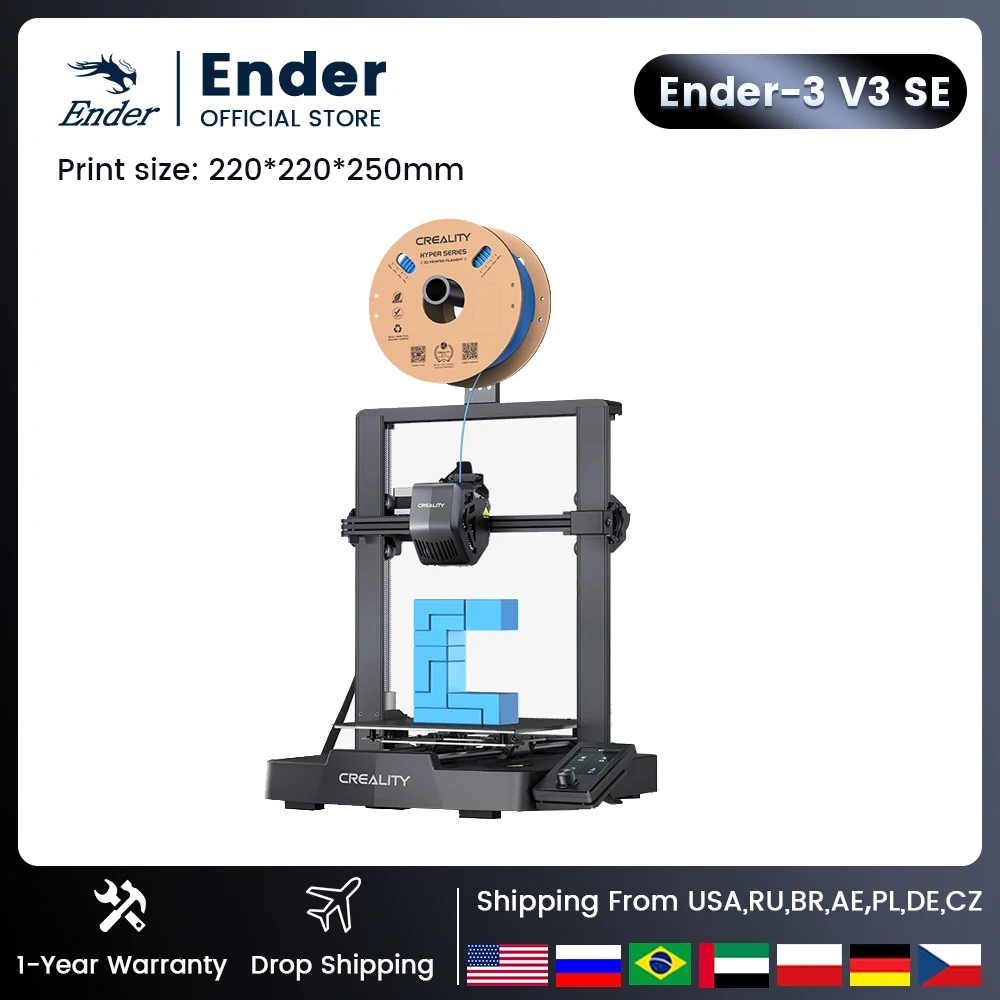
Official Store Deal
Expert Analysis Overview
Precision Prototyping with the Ender-3 V3 SE
The Creality Ender-3 V3 SE is a highly capable entry-level 3D printer engineered for hobbyists and small-scale prototypers seeking reliable, high-quality prints. This machine integrates several advanced features typically found in higher-tier models, making it a compelling option for those upgrading from more basic FDM setups or new users demanding immediate print success. Its design prioritizes ease of use and consistent output.
Extrusion System and Material Handling
Central to the V3 SE's performance is its "Sprite" direct extruder. This extruder design positions the motor directly above the hotend, minimizing the distance filament travels. This short path significantly reduces the likelihood of filament buckling, a common issue with flexible materials like TPU.
The direct drive system provides superior control over filament feeding and retraction. This precision is critical for achieving clean prints with minimal stringing and blobs, especially when working with challenging filaments. Unlike traditional Bowden extruders, which often struggle with soft or abrasive materials due to friction and compression within the PTFE tube, the Sprite direct extruder handles a wider array of filaments with greater reliability. This translates directly to fewer failed prints.
For users aiming to create dimensionally accurate engineering parts, the consistent extrusion offered by a direct drive system is invaluable. It ensures that the exact amount of material is deposited, layer after layer, which is paramount for functional prototypes. This is a significant upgrade from many entry-level printers that still rely on less precise Bowden setups.
Axis Stability and Print Quality
The Ender-3 V3 SE incorporates a dual Z-axis configuration. This design utilizes two lead screws to drive the print head's vertical movement, synchronizing its ascent. This dual-motor setup provides enhanced stability to the gantry, preventing wobble or tilt during printing.
Increased gantry stability directly impacts layer consistency and overall print quality. When the Z-axis is stable, each layer is deposited precisely on top of the previous one, reducing visible layer lines and improving surface finish. This is particularly important for taller prints where even minor gantry instability can lead to significant print defects. The print head moves smoothly.
Compared to single Z-axis printers, which can sometimes exhibit Z-wobble or uneven layer heights, the dual Z-axis system offers a more robust and reliable foundation for the print process. This structural reinforcement minimizes mechanical inaccuracies, allowing for more consistent and repeatable results. It is a key factor in achieving professional-looking prototypes.
Automated Leveling for Worry-Free Operation
This printer features worry-free auto-leveling. The system automatically probes multiple points across the print bed to create a mesh map of its surface. This data is then used to compensate for any minor irregularities in the bed's flatness, ensuring optimal first-layer adhesion.
Automatic bed leveling eliminates one of the most common frustrations for 3D printer users: manual bed calibration. A perfectly leveled bed is fundamental for successful prints, as poor first-layer adhesion often leads to print failures. This automation saves significant time and reduces the learning curve for new users. The process is quick and efficient.
Many entry-level printers require tedious manual adjustments, which can be time-consuming and prone to error. The V3 SE's auto-leveling system streamlines the setup process, allowing users to focus on design and printing rather than calibration. This feature significantly minimizes print failures related to bed adhesion, enhancing overall user experience and productivity.
Enhanced Printing Speed
The Ender-3 V3 SE is designed for faster printing speed. While specific speeds can vary based on filament and print settings, the integrated hardware and optimized firmware contribute to quicker print times without sacrificing quality. This efficiency is crucial for rapid prototyping cycles.
Faster printing speeds mean projects are completed more quickly, allowing for more iterations or a higher volume of finished parts in the same timeframe. For designers and engineers, this accelerates the development process, enabling quicker testing and refinement of prototypes. Time is a valuable resource.
Unlike older generation FDM printers that often operated at slower speeds, the V3 SE leverages advancements in motion control and extrusion to deliver a more efficient printing experience. This capability allows users to maximize their output, making the printer a more productive tool for both hobbyist projects and professional applications. It delivers results faster.
Build Volume and Design
The print size of 220x220x250mm provides a generous build volume for most common prototyping and hobbyist needs. This dimension allows for the creation of moderately sized objects or multiple smaller parts in a single print job. The build plate is removable.
This build volume is standard for many desktop FDM printers, offering a good balance between footprint and capability. It is sufficient for printing a wide range of functional parts, artistic models, and educational projects. Users will find this size adequate for most daily printing tasks.
Compared to micro-sized printers, the 220x220x250mm volume offers greater flexibility without requiring a significantly larger physical footprint. It strikes a practical balance, providing ample space for creativity without becoming unwieldy. This size is a workhorse for many users.
User Interface and Connectivity
The printer likely features a user-friendly interface, possibly a color screen, for intuitive operation. While not explicitly detailed in the title, Creality typically equips its modern printers with accessible controls. This simplifies navigation through menus and print settings. The controls are easy to reach.
An intuitive interface reduces the learning curve and makes the printing process more enjoyable. Users can quickly select files, monitor print progress, and adjust settings without needing extensive technical knowledge. This accessibility is key for a broad user base.
Many older 3D printers had less refined interfaces, often relying on monochrome screens and rotary encoders. Modern interfaces, like those expected on the V3 SE, offer a more streamlined and visually appealing experience, enhancing overall usability. It improves daily interactions.
Value Proposition and Longevity
The Creality Ender-3 V3 SE positions itself as a high-value offering by combining advanced features with an accessible price point. The inclusion of a direct extruder, dual Z-axis, and auto-leveling in an entry-level package represents a significant return on investment for users. This printer is built to last.
Investing in a printer with these capabilities means fewer upgrades will be necessary down the line, saving both money and time. The reliability of its components suggests a longer operational lifespan and consistent performance, reducing the total cost of ownership. It is a smart purchase.
Unlike cheaper, less capable alternatives that might require immediate modifications or frequent troubleshooting, the V3 SE offers a more complete and reliable out-of-the-box experience. This focus on foundational quality ensures that users can spend more time creating and less time fixing. It offers enduring utility.
Imagine the satisfaction of effortlessly producing intricate prototypes with consistent accuracy, knowing your printer handles complex geometries and flexible filaments with ease. Visualize the accelerated design cycles, bringing your ideas to tangible reality faster than ever before. This machine empowers creators to push boundaries, transforming digital concepts into physical objects with precision and confidence, project after project.