Creality Ender-3 V3 SE 3D Printer
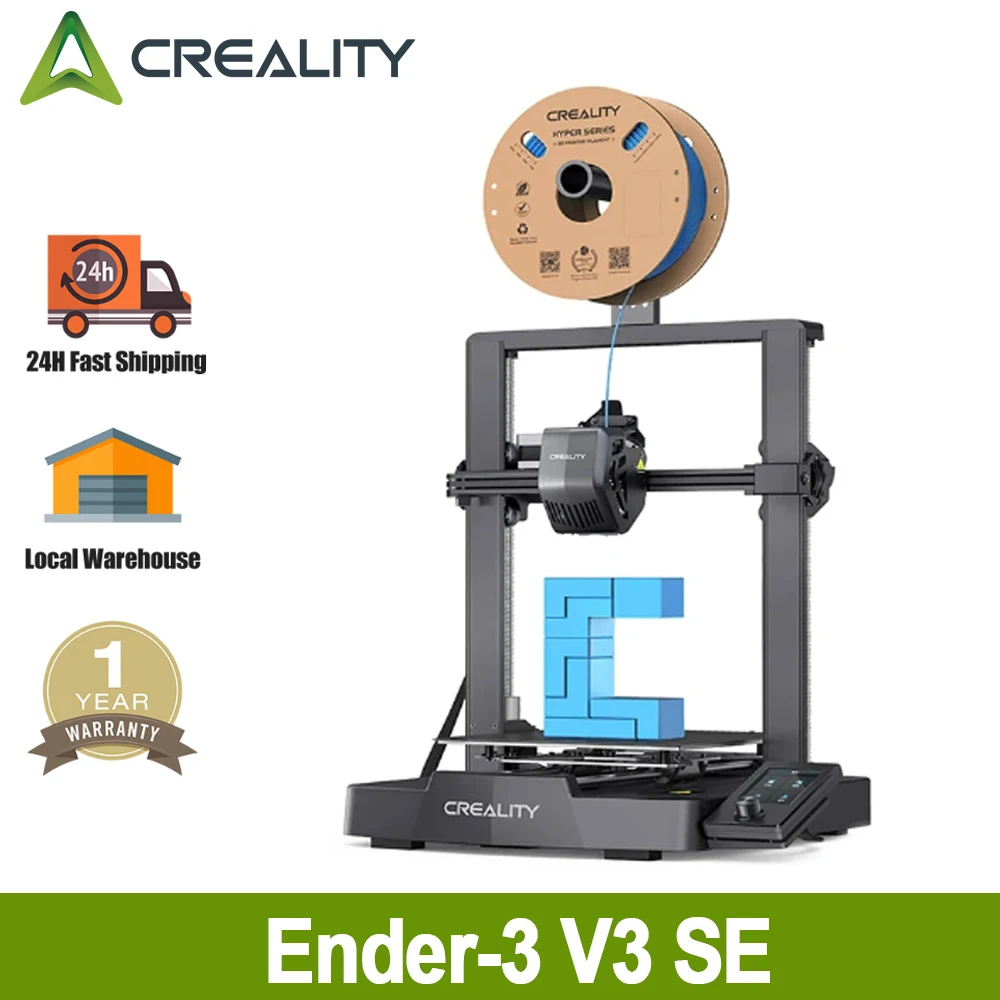
Official Store Deal
Expert Analysis Overview
The Creality Ender-3 V3 SE is an accessible and efficient FDM 3D printer specifically engineered for educational environments and hobbyists seeking a simplified, high-performance additive manufacturing experience. This machine addresses common pain points in 3D printing, such as complex setup and inconsistent results, by integrating advanced automation and robust mechanical design. Its focus on user-friendliness, combined with impressive speed and stability, positions it as a strong contender for classrooms and home workshops where reliability and ease of use are paramount.
Getting started with 3D printing often presents a significant hurdle for new users, particularly in educational settings where time is valuable. The Ender-3 V3 SE significantly reduces this barrier. The printer arrives largely pre-assembled, minimizing the need for intricate mechanical construction. This means less time spent on assembly and more time dedicated to actual printing and learning.
The visual evidence suggests a quick assembly process. Users can expect to have the printer operational within approximately 20 minutes from unboxing. This rapid deployment is a crucial advantage for educators introducing 3D printing to students, as it allows for immediate engagement with the technology rather than prolonged setup procedures. Standard entry-level printers often require hours of assembly, involving numerous small parts and detailed instructions, which can be daunting and frustrating for beginners.
One of the most common frustrations in FDM 3D printing is bed leveling. The Ender-3 V3 SE incorporates CR Touch auto-leveling and a strain sensor for Z-offset calibration. This eliminates the need for manual adjustments, a process that can be both time-consuming and prone to error. Consistent first layers are crucial for successful prints. Without this automation, users frequently encounter failed prints due to improper bed adhesion, leading to wasted material and lost time. Many printers in this segment still rely on manual or semi-manual leveling, which demands a certain level of skill and patience from the operator.
Reliable print quality hinges on the printer's mechanical stability and extrusion system. The Ender-3 V3 SE integrates several design choices that contribute to its consistent performance, making it suitable for repeated use in demanding environments like classrooms.
The printer features a rigid dual Z-axis design. This dual-motor configuration ensures stable vertical movement of the X-gantry, significantly reducing Z-wobbling, a common artifact in single Z-axis setups that can lead to visible layer lines and inconsistent print quality. Furthermore, the Y-axis utilizes a pair of 8mm thick linear shafts made of wear-proof steel. This robust construction provides a stable foundation for the build platform, minimizing vibrations and ensuring precise layer alignment, even during faster print speeds. Less stable printers often exhibit ghosting or ringing, especially at higher speeds, due to frame flex.
At the heart of its material handling is the "Sprite" direct drive extruder. This system positions the extruder motor directly above the hotend, minimizing the distance the filament travels. This short path allows for more precise control over filament extrusion and retraction, which is particularly beneficial when working with flexible filaments like TPU. Direct drive extruders are known for their superior retraction capabilities, reducing stringing and blobs, and offering broader filament compatibility compared to Bowden setups. Bowden extruders, while lighter, often struggle with flexible materials and can introduce more latency in filament control.
Beyond its mechanical capabilities, the Ender-3 V3 SE focuses on simplifying the entire 3D printing workflow, from loading filament to monitoring print progress.
The printer boasts a color user interface that adopts motion graphics. This graphical display provides clear, real-time feedback on the leveling process and other critical printing parameters. A visual representation of the printer's status allows users to grasp what is happening at a glance, reducing confusion and the need to interpret cryptic text-based menus. This modern UI design enhances the learning experience for students, making the technology feel more approachable. Many budget printers still rely on monochromatic LCD screens with limited graphical capabilities, requiring users to navigate complex menu trees.
Changing filament can be a tedious and messy process. The Ender-3 V3 SE simplifies this with auto filament loading and unloading. Users simply tap "Extrude" to smoothly feed filament into the nozzle or "Retract" to quickly exit it. This feature is invaluable in a classroom setting, where multiple students might be swapping materials, as it minimizes potential errors and blockages. Manual filament changes often involve careful manipulation and can be a source of frustration for beginners, sometimes leading to damaged nozzles or clogged extruders.
Efficiency is a key consideration, especially when producing multiple prototypes or teaching a class with limited time. The Ender-3 V3 SE delivers impressive speed without sacrificing quality.
This printer achieves a maximum printing speed of 250mm/s with an acceleration of 2500mm/s². This speed represents a significant time saving compared to conventional entry-level 3D printers, which typically operate at speeds between 50-100mm/s. For example, a print that might take over two hours on a standard machine could be completed in under an hour on the Ender-3 V3 SE. Faster print times mean students can iterate on designs more quickly, and educators can complete more projects within a given timeframe. Slow printing speeds can often limit the scope of projects and the number of iterations possible in an academic setting.
The combination of the stable dual Z-axis, robust linear shafts, and precise direct drive extruder ensures that these higher speeds do not come at the expense of print quality. The printer is designed to maintain accuracy and detail even when operating at its upper speed limits. This capability allows for rapid prototyping and functional part creation, making it a versatile tool for various STEM projects. Achieving both speed and quality simultaneously is a hallmark of well-engineered 3D printers, distinguishing them from models that prioritize one over the other.
The choice of materials and the build surface are critical for successful prints and ease of maintenance.
The direct drive extruder supports a wide range of filaments, including common materials like PLA, PETG, and ABS, as well as more demanding flexible filaments such as TPU. This versatility allows for a broader scope of projects and experimentation, which is ideal for educational purposes where different material properties might need to be explored. Users are not limited to a narrow selection of easy-to-print materials.
The printer utilizes a PC spring steel build plate. This type of build plate offers excellent adhesion for various filaments when heated, and once cooled, prints can be easily removed by simply flexing the plate. This eliminates the need for scrapers or excessive force, which can damage the print or the build surface itself. The PC coating also provides a good surface finish for the bottom of prints. Glass beds, while offering a smooth finish, can be fragile and require more effort for print removal, while magnetic flexible plates without a PC coating might not offer the same level of adhesion or durability.
The Creality Ender-3 V3 SE 3D Printer stands out as a highly capable and user-friendly machine. Its automated features, robust construction, and high-speed printing capabilities make it an excellent choice for anyone looking to enter the world of 3D printing or upgrade from a more basic model. For educators, it offers a reliable and safe platform to introduce students to additive manufacturing, fostering creativity and problem-solving skills without the common frustrations associated with less refined machines. Hobbyists will appreciate the efficiency and consistent results for their personal projects, allowing them to bring ideas to life faster and with greater reliability.
Imagine the satisfaction of effortlessly producing complex prototypes, seeing students confidently operate advanced machinery, and realizing creative visions with unprecedented speed and precision. This printer empowers users to focus on design and innovation, rather than grappling with technical complexities, making the journey of creation truly enjoyable and productive.
Streamlined Setup and First Prints
Getting started with 3D printing often presents a significant hurdle for new users, particularly in educational settings where time is valuable. The Ender-3 V3 SE significantly reduces this barrier. The printer arrives largely pre-assembled, minimizing the need for intricate mechanical construction. This means less time spent on assembly and more time dedicated to actual printing and learning.
Rapid Deployment
The visual evidence suggests a quick assembly process. Users can expect to have the printer operational within approximately 20 minutes from unboxing. This rapid deployment is a crucial advantage for educators introducing 3D printing to students, as it allows for immediate engagement with the technology rather than prolonged setup procedures. Standard entry-level printers often require hours of assembly, involving numerous small parts and detailed instructions, which can be daunting and frustrating for beginners.
Automated Leveling
One of the most common frustrations in FDM 3D printing is bed leveling. The Ender-3 V3 SE incorporates CR Touch auto-leveling and a strain sensor for Z-offset calibration. This eliminates the need for manual adjustments, a process that can be both time-consuming and prone to error. Consistent first layers are crucial for successful prints. Without this automation, users frequently encounter failed prints due to improper bed adhesion, leading to wasted material and lost time. Many printers in this segment still rely on manual or semi-manual leveling, which demands a certain level of skill and patience from the operator.
Precision Engineering for Consistent Results
Reliable print quality hinges on the printer's mechanical stability and extrusion system. The Ender-3 V3 SE integrates several design choices that contribute to its consistent performance, making it suitable for repeated use in demanding environments like classrooms.
Robust Motion System
The printer features a rigid dual Z-axis design. This dual-motor configuration ensures stable vertical movement of the X-gantry, significantly reducing Z-wobbling, a common artifact in single Z-axis setups that can lead to visible layer lines and inconsistent print quality. Furthermore, the Y-axis utilizes a pair of 8mm thick linear shafts made of wear-proof steel. This robust construction provides a stable foundation for the build platform, minimizing vibrations and ensuring precise layer alignment, even during faster print speeds. Less stable printers often exhibit ghosting or ringing, especially at higher speeds, due to frame flex.
Direct Drive Extrusion
At the heart of its material handling is the "Sprite" direct drive extruder. This system positions the extruder motor directly above the hotend, minimizing the distance the filament travels. This short path allows for more precise control over filament extrusion and retraction, which is particularly beneficial when working with flexible filaments like TPU. Direct drive extruders are known for their superior retraction capabilities, reducing stringing and blobs, and offering broader filament compatibility compared to Bowden setups. Bowden extruders, while lighter, often struggle with flexible materials and can introduce more latency in filament control.
Enhanced User Experience and Workflow
Beyond its mechanical capabilities, the Ender-3 V3 SE focuses on simplifying the entire 3D printing workflow, from loading filament to monitoring print progress.
Intuitive User Interface
The printer boasts a color user interface that adopts motion graphics. This graphical display provides clear, real-time feedback on the leveling process and other critical printing parameters. A visual representation of the printer's status allows users to grasp what is happening at a glance, reducing confusion and the need to interpret cryptic text-based menus. This modern UI design enhances the learning experience for students, making the technology feel more approachable. Many budget printers still rely on monochromatic LCD screens with limited graphical capabilities, requiring users to navigate complex menu trees.
Automated Filament Management
Changing filament can be a tedious and messy process. The Ender-3 V3 SE simplifies this with auto filament loading and unloading. Users simply tap "Extrude" to smoothly feed filament into the nozzle or "Retract" to quickly exit it. This feature is invaluable in a classroom setting, where multiple students might be swapping materials, as it minimizes potential errors and blockages. Manual filament changes often involve careful manipulation and can be a source of frustration for beginners, sometimes leading to damaged nozzles or clogged extruders.
High-Speed Printing for Increased Productivity
Efficiency is a key consideration, especially when producing multiple prototypes or teaching a class with limited time. The Ender-3 V3 SE delivers impressive speed without sacrificing quality.
Accelerated Production
This printer achieves a maximum printing speed of 250mm/s with an acceleration of 2500mm/s². This speed represents a significant time saving compared to conventional entry-level 3D printers, which typically operate at speeds between 50-100mm/s. For example, a print that might take over two hours on a standard machine could be completed in under an hour on the Ender-3 V3 SE. Faster print times mean students can iterate on designs more quickly, and educators can complete more projects within a given timeframe. Slow printing speeds can often limit the scope of projects and the number of iterations possible in an academic setting.
Quality at Speed
The combination of the stable dual Z-axis, robust linear shafts, and precise direct drive extruder ensures that these higher speeds do not come at the expense of print quality. The printer is designed to maintain accuracy and detail even when operating at its upper speed limits. This capability allows for rapid prototyping and functional part creation, making it a versatile tool for various STEM projects. Achieving both speed and quality simultaneously is a hallmark of well-engineered 3D printers, distinguishing them from models that prioritize one over the other.
Material Versatility and Build Surface
The choice of materials and the build surface are critical for successful prints and ease of maintenance.
Broad Filament Compatibility
The direct drive extruder supports a wide range of filaments, including common materials like PLA, PETG, and ABS, as well as more demanding flexible filaments such as TPU. This versatility allows for a broader scope of projects and experimentation, which is ideal for educational purposes where different material properties might need to be explored. Users are not limited to a narrow selection of easy-to-print materials.
Durable Build Plate
The printer utilizes a PC spring steel build plate. This type of build plate offers excellent adhesion for various filaments when heated, and once cooled, prints can be easily removed by simply flexing the plate. This eliminates the need for scrapers or excessive force, which can damage the print or the build surface itself. The PC coating also provides a good surface finish for the bottom of prints. Glass beds, while offering a smooth finish, can be fragile and require more effort for print removal, while magnetic flexible plates without a PC coating might not offer the same level of adhesion or durability.
Conclusion: Empowering Creation and Learning
The Creality Ender-3 V3 SE 3D Printer stands out as a highly capable and user-friendly machine. Its automated features, robust construction, and high-speed printing capabilities make it an excellent choice for anyone looking to enter the world of 3D printing or upgrade from a more basic model. For educators, it offers a reliable and safe platform to introduce students to additive manufacturing, fostering creativity and problem-solving skills without the common frustrations associated with less refined machines. Hobbyists will appreciate the efficiency and consistent results for their personal projects, allowing them to bring ideas to life faster and with greater reliability.
Imagine the satisfaction of effortlessly producing complex prototypes, seeing students confidently operate advanced machinery, and realizing creative visions with unprecedented speed and precision. This printer empowers users to focus on design and innovation, rather than grappling with technical complexities, making the journey of creation truly enjoyable and productive.