Creality 4010 24V Extruder & Turbo Fans for Ender 3 Series
Official Store Deal
Expert Analysis Overview
The Creality 4010 24V Extruder & Turbo Fans are essential OEM replacement components engineered to restore and maintain optimal thermal management within Creality Ender 3 series 3D printers. These units are specifically designed to address the critical cooling requirements of both the hot end and the printed part, directly impacting print quality and machine longevity. As precision prototyping relies heavily on consistent material extrusion and rapid solidification, the integrity of these cooling systems is paramount. The visual evidence, combined with the product's stated purpose, positions these fans as a direct solution for common thermal-related print failures.
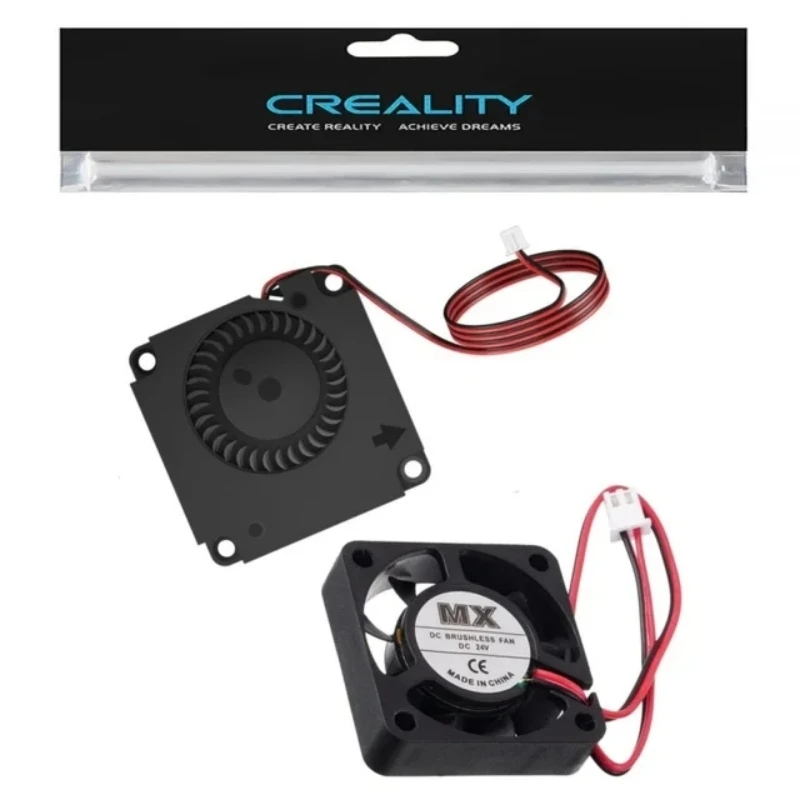
The package includes a 40x40x10mm axial fan, visibly equipped with a standard two-wire connection. This fan is typically designated for the hot end heatsink. Its design features a central hub with radiating blades, optimized for pushing air directly through a heatsink. This is a critical component.
In practical operation, this axial fan's primary role is to dissipate heat from the hot end's cold zone. This prevents a critical issue known as heat creep, where heat travels upwards from the nozzle into the extruder's cold end, causing filament to soften prematurely and jam. Consistent airflow here ensures the filament remains solid until it reaches the melt zone, maintaining a sharp thermal boundary.
Unlike generic, lower-quality axial fans that might offer inconsistent airflow or premature bearing failure, this Creality original component is manufactured to the precise specifications of the Ender 3 series. This ensures not only a perfect physical fit but also the correct airflow volume and static pressure required for effective heat management, a common point of failure with non-OEM replacements. This guarantees reliable performance.
Also included is a 40x40x10mm blower fan, often referred to as a turbo fan, characterized by its squirrel cage design. This fan draws air in from one side and expels it in a concentrated stream from an outlet port. It is also equipped with a two-wire connection. This fan is purpose-built.
This blower fan is critical for directing a focused stream of air onto the freshly extruded filament as it exits the nozzle. Rapid cooling of the molten plastic is essential for layer adhesion, preventing warping, and enabling the successful printing of overhangs and bridges. Without adequate part cooling, prints can suffer from poor dimensional accuracy and structural weakness. This impacts final product quality.
Compared to the broad, less directed airflow of an axial fan, the blower fan's design is superior for targeted part cooling. Many aftermarket solutions might offer higher RPMs but lack the optimized ducting and pressure required for effective cooling in the specific geometry of a 3D printer's print head. This OEM part ensures that the cooling air is delivered precisely where it is needed. Precision is key here.
The visible construction of the axial fan, with its robust plastic housing and clearly marked DC 24V rating, indicates its intended application within the Ender 3's electrical system. The fan's blades appear well-formed, suggesting efficient air movement. This is a vital function.
Effective heat dissipation at the hot end is non-negotiable for reliable 3D printing. If the hot end fan fails or performs inadequately, the filament can soften and expand within the heat break, leading to frustrating clogs and failed prints. This fan maintains the thermal gradient, ensuring the filament transitions from solid to molten only at the nozzle. This prevents costly material waste.
Many users encounter print failures attributed to heat creep, often after prolonged printing sessions or when using materials with lower glass transition temperatures like PLA. Replacing a failing hot end fan with this original unit directly addresses this root cause, ensuring the printer can operate at full speed without head blocking. This is a common maintenance item for consistent output.
The blower fan's compact, square form factor, with its distinct side exhaust, is designed to integrate seamlessly into the print head assembly. Its internal impeller is engineered to generate a focused air stream. This is crucial for print quality.
The ability to rapidly cool extruded plastic is fundamental to achieving high-quality 3D prints, especially for intricate geometries. Without sufficient cooling, layers may not solidify quickly enough, leading to sagging, curling, or poor bridging. This fan ensures the printed model cures quickly, locking in its shape before gravity or subsequent layers can deform it. This improves structural integrity.
Unlike printers with passive cooling or less effective fan designs, the targeted airflow from this blower fan allows for sharper details and more stable structures. For operators frequently printing models with complex overhangs or requiring precise dimensional accuracy, a properly functioning part cooling fan is an absolute necessity. It directly influences the aesthetic and structural integrity of the final product. This is a performance enhancer.
The fans are depicted with pre-attached red and black wires, terminating in what appears to be a standard 2-pin JST-XH connector, common in 3D printer electronics. The dimensions are clearly marked as 40mm x 40mm x 10mm. This ensures a direct fit.
Installation of these fans is designed to be straightforward for users familiar with basic 3D printer maintenance. The direct fit and matching voltage (DC 24V) eliminate the need for complex modifications or voltage converters. This ease of replacement minimizes printer downtime, allowing users to quickly resume printing operations. It is a simple swap.
Compared to aftermarket fans that might require soldering, crimping new connectors, or adapting mounting solutions, these Creality original fans offer a plug-and-play experience. This reduces the barrier to entry for maintenance, allowing even novice users to confidently replace worn components. The precise sizing is a key advantage for hassle-free upgrades or repairs.
The "MX" branding visible on the axial fan's label, along with "DC Brushless Fan" and "24V," indicates a standard brushless DC motor. Such motors are known for their longevity and consistent performance. This is a reliable design.
Brushless DC fans are preferred in applications requiring continuous operation, such as 3D printers, due to their lack of brush wear. This design contributes to a longer operational lifespan and more consistent airflow over time compared to brushed alternatives. The "CE" mark suggests compliance with European safety standards, indicating a level of quality assurance. This ensures extended service life.
While all fans eventually wear out, the use of a brushless motor in these Creality original components suggests a design intended for thousands of hours of operation. This contrasts with cheaper, generic fans that might fail prematurely, leading to repeated replacements and increased maintenance costs. Investing in OEM parts often translates to better long-term reliability and fewer interruptions.
The product's price point, at approximately 3.21 USD, positions these fans as an extremely affordable maintenance item. This low cost makes routine replacement feasible. It is a minor investment.
Considering the potential for print failures, filament waste, and lost printing time due to inadequate cooling, the cost of these replacement fans is negligible. Proactive replacement of noisy or underperforming fans can prevent much more expensive issues down the line, such as extruder jams requiring disassembly or print bed adhesion problems. This is a preventative measure, safeguarding larger investments.
Unlike the significant investment required for major printer upgrades or repairs, replacing fans is a small expenditure that yields substantial returns in terms of print reliability and quality. It is a fundamental aspect of maintaining a 3D printer's operational efficiency, ensuring that the machine runs at its full potential without compromise. This ensures optimal ROI.
The visual representation of "Strong Wind" and "Lightweight and sensitive" implies that these fans are designed to move a significant volume of air without excessive bulk or vibration. The promise of "silent and low noise" is also highlighted. This suggests optimized acoustics.
While "silent" is a subjective term, the implication is that these fans will operate at the intended noise level for an Ender 3 series printer, which is generally acceptable for most workshop or home environments. A properly functioning fan contributes to a more pleasant printing experience, free from distracting grinding or rattling noises. The goal is functional quietness.
Compared to the cacophony produced by worn-out or failing fans, which can be a major source of frustration for 3D printer users, these original replacements restore the printer to its baseline operational acoustics. For users who value a stable and less intrusive printing environment, ensuring all cooling components are in good working order is a simple yet effective step. This enhances user comfort.
Imagine the satisfaction of initiating a complex print, confident that your machine's thermal systems are operating flawlessly. Envision consistent, high-quality output, free from the frustrations of heat creep or poor layer adhesion, all while your printer hums along with its intended, unobtrusive operational sound. These Creality 4010 fans provide the foundational reliability that allows you to focus on design and creation, rather than troubleshooting hardware. They ensure your Ender 3 series printer remains a dependable tool for bringing your digital models to life with precision and consistency.
Precision Airflow Engineering
The Extruder's Guardian
The package includes a 40x40x10mm axial fan, visibly equipped with a standard two-wire connection. This fan is typically designated for the hot end heatsink. Its design features a central hub with radiating blades, optimized for pushing air directly through a heatsink. This is a critical component.
In practical operation, this axial fan's primary role is to dissipate heat from the hot end's cold zone. This prevents a critical issue known as heat creep, where heat travels upwards from the nozzle into the extruder's cold end, causing filament to soften prematurely and jam. Consistent airflow here ensures the filament remains solid until it reaches the melt zone, maintaining a sharp thermal boundary.
Unlike generic, lower-quality axial fans that might offer inconsistent airflow or premature bearing failure, this Creality original component is manufactured to the precise specifications of the Ender 3 series. This ensures not only a perfect physical fit but also the correct airflow volume and static pressure required for effective heat management, a common point of failure with non-OEM replacements. This guarantees reliable performance.
The Part Cooling Dynamo
Also included is a 40x40x10mm blower fan, often referred to as a turbo fan, characterized by its squirrel cage design. This fan draws air in from one side and expels it in a concentrated stream from an outlet port. It is also equipped with a two-wire connection. This fan is purpose-built.
This blower fan is critical for directing a focused stream of air onto the freshly extruded filament as it exits the nozzle. Rapid cooling of the molten plastic is essential for layer adhesion, preventing warping, and enabling the successful printing of overhangs and bridges. Without adequate part cooling, prints can suffer from poor dimensional accuracy and structural weakness. This impacts final product quality.
Compared to the broad, less directed airflow of an axial fan, the blower fan's design is superior for targeted part cooling. Many aftermarket solutions might offer higher RPMs but lack the optimized ducting and pressure required for effective cooling in the specific geometry of a 3D printer's print head. This OEM part ensures that the cooling air is delivered precisely where it is needed. Precision is key here.
Thermal Management Integrity
Preventing Heat Creep
The visible construction of the axial fan, with its robust plastic housing and clearly marked DC 24V rating, indicates its intended application within the Ender 3's electrical system. The fan's blades appear well-formed, suggesting efficient air movement. This is a vital function.
Effective heat dissipation at the hot end is non-negotiable for reliable 3D printing. If the hot end fan fails or performs inadequately, the filament can soften and expand within the heat break, leading to frustrating clogs and failed prints. This fan maintains the thermal gradient, ensuring the filament transitions from solid to molten only at the nozzle. This prevents costly material waste.
Many users encounter print failures attributed to heat creep, often after prolonged printing sessions or when using materials with lower glass transition temperatures like PLA. Replacing a failing hot end fan with this original unit directly addresses this root cause, ensuring the printer can operate at full speed without head blocking. This is a common maintenance item for consistent output.
Enhancing Print Adhesion and Overhangs
The blower fan's compact, square form factor, with its distinct side exhaust, is designed to integrate seamlessly into the print head assembly. Its internal impeller is engineered to generate a focused air stream. This is crucial for print quality.
The ability to rapidly cool extruded plastic is fundamental to achieving high-quality 3D prints, especially for intricate geometries. Without sufficient cooling, layers may not solidify quickly enough, leading to sagging, curling, or poor bridging. This fan ensures the printed model cures quickly, locking in its shape before gravity or subsequent layers can deform it. This improves structural integrity.
Unlike printers with passive cooling or less effective fan designs, the targeted airflow from this blower fan allows for sharper details and more stable structures. For operators frequently printing models with complex overhangs or requiring precise dimensional accuracy, a properly functioning part cooling fan is an absolute necessity. It directly influences the aesthetic and structural integrity of the final product. This is a performance enhancer.
Installation and Longevity
Seamless Integration
The fans are depicted with pre-attached red and black wires, terminating in what appears to be a standard 2-pin JST-XH connector, common in 3D printer electronics. The dimensions are clearly marked as 40mm x 40mm x 10mm. This ensures a direct fit.
Installation of these fans is designed to be straightforward for users familiar with basic 3D printer maintenance. The direct fit and matching voltage (DC 24V) eliminate the need for complex modifications or voltage converters. This ease of replacement minimizes printer downtime, allowing users to quickly resume printing operations. It is a simple swap.
Compared to aftermarket fans that might require soldering, crimping new connectors, or adapting mounting solutions, these Creality original fans offer a plug-and-play experience. This reduces the barrier to entry for maintenance, allowing even novice users to confidently replace worn components. The precise sizing is a key advantage for hassle-free upgrades or repairs.
Durability Under Load
The "MX" branding visible on the axial fan's label, along with "DC Brushless Fan" and "24V," indicates a standard brushless DC motor. Such motors are known for their longevity and consistent performance. This is a reliable design.
Brushless DC fans are preferred in applications requiring continuous operation, such as 3D printers, due to their lack of brush wear. This design contributes to a longer operational lifespan and more consistent airflow over time compared to brushed alternatives. The "CE" mark suggests compliance with European safety standards, indicating a level of quality assurance. This ensures extended service life.
While all fans eventually wear out, the use of a brushless motor in these Creality original components suggests a design intended for thousands of hours of operation. This contrasts with cheaper, generic fans that might fail prematurely, leading to repeated replacements and increased maintenance costs. Investing in OEM parts often translates to better long-term reliability and fewer interruptions.
Value Proposition and Operational Impact
Cost-Effectiveness in Maintenance
The product's price point, at approximately 3.21 USD, positions these fans as an extremely affordable maintenance item. This low cost makes routine replacement feasible. It is a minor investment.
Considering the potential for print failures, filament waste, and lost printing time due to inadequate cooling, the cost of these replacement fans is negligible. Proactive replacement of noisy or underperforming fans can prevent much more expensive issues down the line, such as extruder jams requiring disassembly or print bed adhesion problems. This is a preventative measure, safeguarding larger investments.
Unlike the significant investment required for major printer upgrades or repairs, replacing fans is a small expenditure that yields substantial returns in terms of print reliability and quality. It is a fundamental aspect of maintaining a 3D printer's operational efficiency, ensuring that the machine runs at its full potential without compromise. This ensures optimal ROI.
The Silent Contributor to Quality
The visual representation of "Strong Wind" and "Lightweight and sensitive" implies that these fans are designed to move a significant volume of air without excessive bulk or vibration. The promise of "silent and low noise" is also highlighted. This suggests optimized acoustics.
While "silent" is a subjective term, the implication is that these fans will operate at the intended noise level for an Ender 3 series printer, which is generally acceptable for most workshop or home environments. A properly functioning fan contributes to a more pleasant printing experience, free from distracting grinding or rattling noises. The goal is functional quietness.
Compared to the cacophony produced by worn-out or failing fans, which can be a major source of frustration for 3D printer users, these original replacements restore the printer to its baseline operational acoustics. For users who value a stable and less intrusive printing environment, ensuring all cooling components are in good working order is a simple yet effective step. This enhances user comfort.
Imagine the satisfaction of initiating a complex print, confident that your machine's thermal systems are operating flawlessly. Envision consistent, high-quality output, free from the frustrations of heat creep or poor layer adhesion, all while your printer hums along with its intended, unobtrusive operational sound. These Creality 4010 fans provide the foundational reliability that allows you to focus on design and creation, rather than troubleshooting hardware. They ensure your Ender 3 series printer remains a dependable tool for bringing your digital models to life with precision and consistency.