Creality 3D Scanning Reference Markers
Official Store Deal
Expert Analysis Overview
Precision Tracking for Digital Replication
Creality 3D Scanning Reference Markers are an essential, high-precision consumable designed for educators and professionals seeking reliable data acquisition in 3D scanning applications. These markers address the common frustration of acquiring accurate 3D models from objects that lack distinct geometric features or exhibit highly reflective surfaces. By providing consistent, non-reflective reference points, these markers significantly enhance the capability of structured light and photogrammetry 3D scanners, ensuring a smoother, more accurate digital replication process.The Science Behind Accurate Scans
At its core, 3D scanning relies on identifying unique points in space to reconstruct an object's geometry. For many objects, especially those with smooth, uniform, or reflective surfaces, scanners struggle to find enough distinct points for accurate tracking. This leads to incomplete data, misalignments, and ultimately, a flawed 3D model. The Creality markers mitigate this issue by acting as artificial, highly visible landmarks.These markers feature a diffuse reflection surface. Unlike specular reflection, which bounces light off in a single direction (think of a mirror or a glossy car finish), diffuse reflection scatters light evenly in many directions. This property is crucial for 3D scanning. It ensures that regardless of the scanner's angle, the marker consistently appears as a clear, detectable point, preventing data dropouts and improving the overall integrity of the scan. Imagine trying to scan a polished chrome sphere without any reference points; the scanner would simply see a distorted reflection of its own light. With these markers, the scanner gains stable, trackable targets.
Compared to simply using a matte spray, which can alter the object's surface and require post-cleaning, these markers offer a non-invasive and temporary solution. They provide a predictable optical target that generic surfaces cannot replicate, allowing for superior data stitching and alignment in the scanning software. This precision saves considerable time in post-processing, as fewer manual adjustments are needed to correct misaligned scans.
Enhancing Educational and Professional Workflows
For STEM educators, these markers are invaluable tools for teaching the principles of 3D scanning. Students often encounter difficulties when scanning complex or featureless objects. Introducing these markers simplifies the practical application of scanning, allowing students to focus on the scanning process and data interpretation rather than struggling with scanner tracking. The clear visual feedback from the markers helps students understand how a scanner perceives an object and builds its digital representation. This hands-on experience is vital for developing practical skills.Consider a classroom scenario where students are tasked with scanning a smooth, untextured prototype. Without markers, the scanner might lose tracking, leading to fragmented scans and frustration. With Creality markers, students can quickly apply them, achieve a stable scan, and then analyze the resulting high-quality mesh. This direct demonstration of problem-solving through targeted tools reinforces learning objectives. It transforms a potentially frustrating exercise into a clear, successful learning opportunity.
Professionals in fields such as reverse engineering, quality inspection, or product design also benefit immensely. Scanning large, featureless components like engine blocks or car panels becomes significantly more efficient and accurate. The ability to quickly apply markers and achieve a reliable scan reduces project timelines and ensures the captured data meets stringent industry standards. This is a clear upgrade over relying solely on the object's inherent geometry, which may not always be sufficient for high-precision demands.
Durability and Adhesion: Sticking with Quality
The physical construction of these markers is designed for practical application. Each marker features a strong, yet manageable, adhesive backing. This ensures that once placed, the markers remain securely attached throughout the scanning process, even on moderately curved or vertical surfaces. The adhesive strength is sufficient to prevent accidental detachment, which could otherwise invalidate an entire scanning session and force a restart.Despite their firm grip, the markers are engineered for non-destructive removal. This is a critical consideration, especially when scanning delicate or valuable objects where surface integrity is paramount. Users can gently peel off the markers post-scan, typically leaving no residue or damage. This thoughtful design element prevents the frustration and potential cost associated with cleaning sticky remnants or repairing surface imperfections.
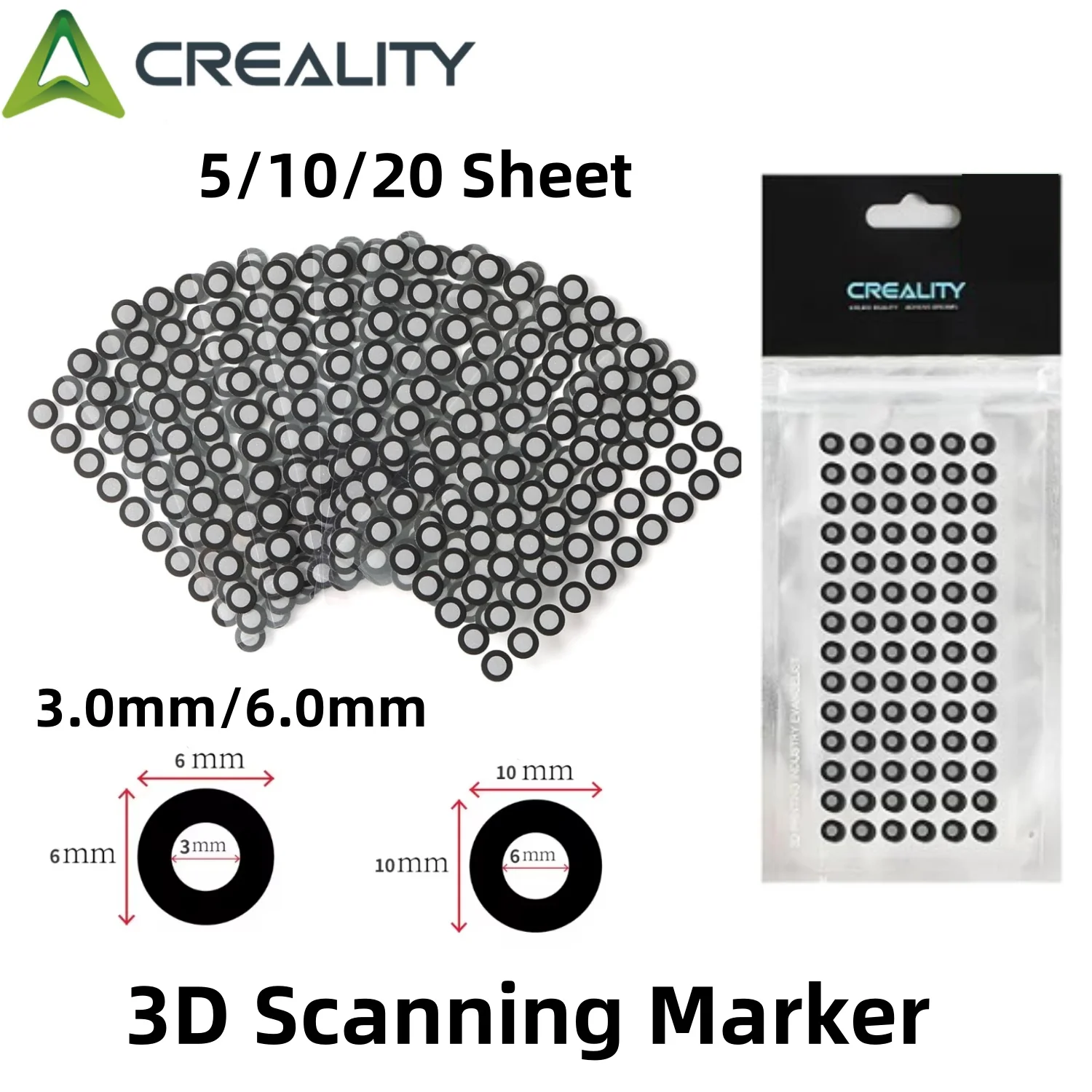
Visually, the markers present a clear, high-contrast design – a black ring around a white center. This contrast is optimized for optical scanners, providing a sharp differentiation from the surrounding object surface. The crisp edges and consistent sizing (available in 3.0mm and 6.0mm diameters) ensure that the scanner's algorithms can precisely identify the center of each marker, contributing directly to the accuracy of the spatial data. This meticulous design ensures reliable performance every time.
Optimizing Scan Data Acquisition
Effective 3D scanning is not just about the scanner itself; it's about the entire ecosystem, including consumables like these markers. The use of diffuse reflection markers directly translates into higher quality point clouds and mesh models. When a scanner has a stable set of reference points, it can more accurately align individual scan frames, reducing cumulative errors that often plague scans of large or complex objects.This improved alignment capability means less time spent in post-processing software manually stitching together misaligned data. Imagine the efficiency gains for a project requiring dozens of individual scans to cover a large object. Each perfectly aligned frame contributes to a seamless final model, drastically cutting down on labor hours. This represents a significant return on investment, making the markers a cost-effective solution for professional environments where time is money.
Compared to attempting to scan challenging objects without any markers, which often results in frustrating tracking loss and incomplete data, these markers provide a foundational stability. They allow the scanner to maintain its position relative to the object, even if the object itself is moved or the scanner's path is interrupted. This robustness in data acquisition is a major advantage, particularly in dynamic scanning environments or when working with less experienced operators.
Value in Every Dot: A Consumable Investment
While these markers are a consumable item, their impact on overall project efficiency and data quality frames them as a valuable investment rather than a mere expense. The cost per marker is minimal, especially when purchased in bulk sheets, yet the value they add in terms of saved time, reduced rescans, and improved accuracy is substantial. This is a classic example of a small input yielding a disproportionately large output in terms of project success.For educational institutions, the affordability of these markers makes them accessible for student projects, allowing widespread practical application without straining departmental budgets. Students learn the importance of proper setup and the role of calibration aids in achieving professional-grade results. This practical understanding is far more valuable than the nominal cost of the markers themselves.
Unlike makeshift solutions like drawing dots with a marker, which can be inconsistent in size, reflectivity, and potentially damage the object, these purpose-built markers offer a standardized and reliable solution. Their consistent optical properties ensure predictable performance across different scanning sessions and operators. This standardization is key for repeatable results and for maintaining high quality control in professional workflows.
Integrating Markers into the Scanning Ecosystem
Integrating these markers into a 3D scanning workflow is straightforward. The user simply peels them off the sheet and applies them strategically to the object's surface. For optimal results, markers should be distributed evenly across the object, ensuring that the scanner always has at least three to five markers in its field of view at any given time. This provides the necessary geometric constraints for accurate positional tracking.Consider the process of scanning a car door. The smooth, often reflective paint surface would be difficult for a scanner to track reliably. By placing markers in a grid pattern, the scanner gains consistent reference points, allowing it to accurately capture the door's contours and details. The ease of application means minimal setup time, allowing projects to commence quickly.
These markers are designed to be scanner-agnostic, meaning they work effectively with a broad spectrum of 3D scanning technologies, including those from Creality and other manufacturers. Their universal utility stems from their fundamental optical property – diffuse reflection – which is a core requirement for many optical tracking systems. This broad compatibility ensures that they are a versatile addition to any 3D scanning toolkit, regardless of the specific hardware in use.
Considerations for Diverse Scanning Environments
While highly effective, certain environmental factors or object characteristics warrant consideration. Extremely dusty or oily surfaces can compromise the adhesive, leading to markers detaching during a scan. Proper surface preparation is always recommended to ensure maximum adhesion and prevent interruptions.In scenarios involving very high temperatures or direct exposure to certain chemicals, the adhesive or marker material might be affected. Users should assess the environment and object properties before extensive application. For most standard indoor scanning environments and common object materials, these markers perform without issue.
Furthermore, the selection between 3.0mm and 6.0mm markers is a strategic decision. For intricate details or smaller objects, the 3.0mm markers offer a finer granularity of reference points. For larger objects or when a quicker setup is desired, the 6.0mm markers can cover more area with fewer individual applications. This flexibility allows users to tailor their marker strategy to the specific demands of each scanning project, optimizing both accuracy and efficiency.
Imagine completing a complex reverse engineering project, effortlessly capturing every curve and detail of a legacy part, knowing that the digital model is a perfect replica of the physical. These Creality 3D Scanning Reference Markers empower users to achieve such precision, transforming challenging scanning tasks into seamless, successful endeavors. The resulting high-fidelity 3D models open new possibilities for design, analysis, and manufacturing, making every project a testament to digital accuracy.