Creality 3D Scanning Markers: High-Reflectivity Tracking Dots (3mm & 6mm)
Official Store Deal
Expert Analysis Overview
The Creality 3D Scanning Markers are an essential precision accessory, meticulously engineered for professionals and enthusiasts who demand uncompromised accuracy and repeatability in their 3D scanning workflows. These markers are not merely stickers; they are critical anchors for digital fidelity, enabling scanners to capture complex geometries with exceptional detail and consistency. Their design addresses fundamental challenges in 3D data acquisition, particularly on surfaces that traditionally prove difficult for optical scanning technologies. This product directly supports the creation of highly accurate digital models, which is foundational for precise manufacturing and rapid prototyping.
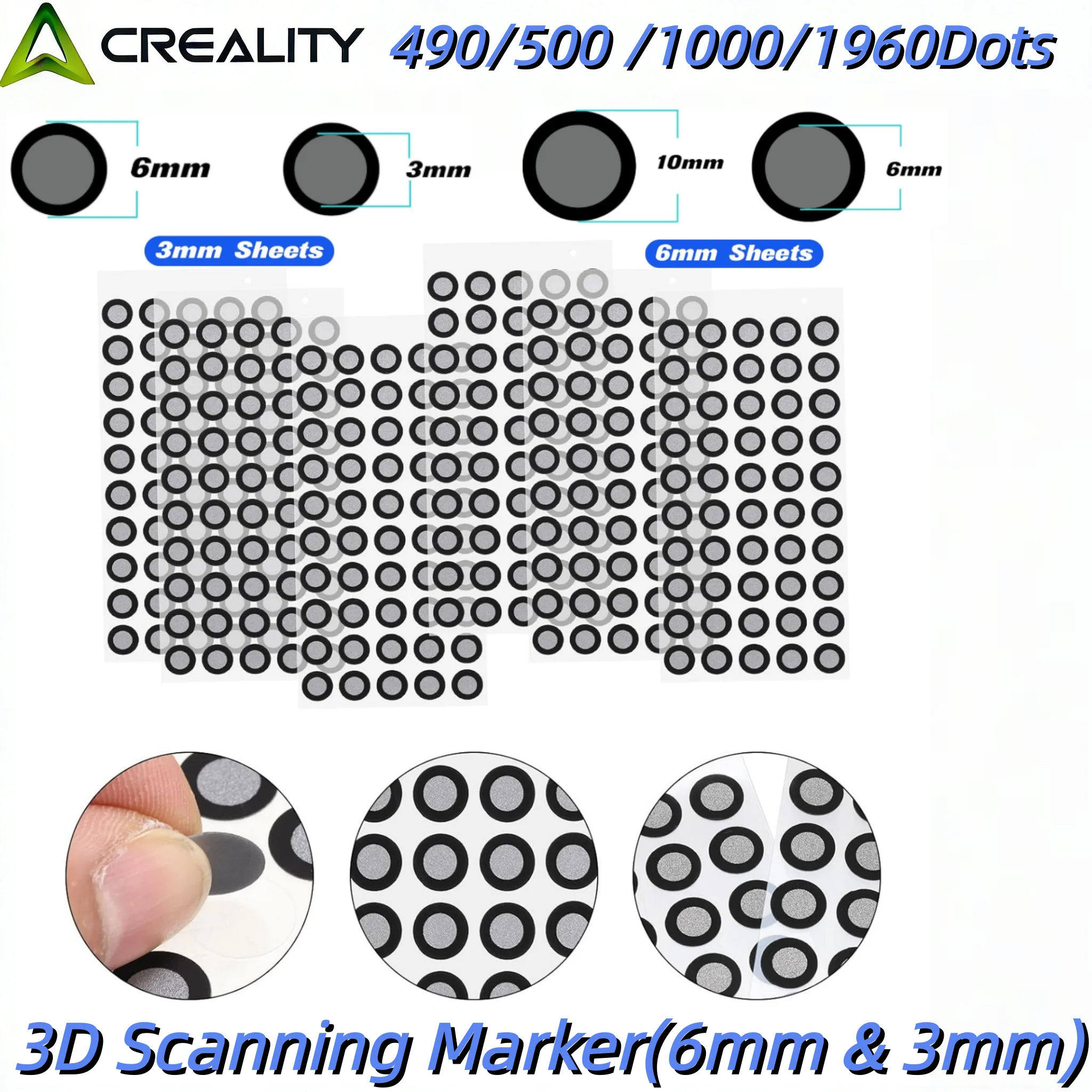
The product offers high-reflective target points in two critical sizes: 3mm and 6mm. These are supplied in bulk quantities, ranging from 490 to 1960 dots per pack, ensuring ample supply for extensive projects. The markers feature a distinct black outer ring with a bright white reflective center, designed for maximum contrast and visibility to optical sensors. This visual contrast is paramount. The material composition is engineered to scatter light efficiently back to the scanner, optimizing signal strength.
This dual-size approach allows for granular control over scan resolution and tracking stability. The smaller 3mm markers excel in capturing intricate details on compact objects, such as small mechanical parts or jewelry, where precision is paramount and larger markers might obscure critical features. Conversely, the larger 6mm markers provide robust tracking across expansive, featureless surfaces like automotive body panels or large industrial components, ensuring the scanner maintains a consistent reference frame over broader areas. High reflectivity ensures the scanner's optical sensors consistently detect each point, even under varying lighting conditions. This directly contributes to the ability to create dimensionally accurate engineering parts by providing a stable, unambiguous reference frame for the scanner's algorithms.
Unlike scanning without reference points, which often leads to frame misalignment and data drift, these markers establish a fixed coordinate system that the scanner can reliably track. Generic, low-quality markers often suffer from inconsistent reflectivity, poor adhesion, or irregular shapes, leading to dropped frames, compromised data integrity, and increased post-processing time. Creality's specific design mitigates these common pitfalls, offering a dependable solution that enhances the overall reliability of the scanning process. It's a significant upgrade.
Each marker features a precision-cut circular design, ensuring uniform dimensions and consistent reflective properties across every single dot. They are backed with an adhesive layer, designed for temporary but secure application on a wide array of surfaces. The images display sheets of these markers, highlighting their organized presentation and ease of access. This meticulous manufacturing process is evident.
The precise manufacturing of these markers is paramount for accurate data acquisition. Irregularly shaped or poorly cut markers introduce noise into the scan data, making post-processing more challenging and potentially compromising the accuracy of the final digital model. The adhesive backing allows for quick deployment on a variety of object geometries, from flat panels to complex curves, without requiring specialized fixtures or extensive surface preparation. This secure adhesion prevents markers from shifting during the scanning process, which is critical for maintaining data integrity. This precision helps minimize print failures by ensuring the initial scan data is clean, accurate, and free from tracking errors, leading to better-fitting and more functional printed parts.
Manual application of makeshift markers, such as painted dots or paper cutouts, rarely achieves the uniformity and consistent reflectivity required for professional-grade scanning. Such improvised methods frequently result in tracking instability, requiring frequent rescans and necessitating extensive data cleanup, adding significant time and cost to a project. These engineered markers offer a streamlined, reliable, and repeatable alternative, saving valuable time and ensuring higher quality results. They are purpose-built.
The product is explicitly marketed for compatibility with Creality's CR-Scan series, including the Raptor, Otter, and Ferret Pro 3D scanners. This indicates an optimized integration within the Creality ecosystem, suggesting a synergy between the hardware and these consumable accessories. This compatibility is a key selling point.
This specific compatibility suggests that the markers' reflective properties, adhesive strength, and dimensions are calibrated to work seamlessly with Creality's scanner algorithms. Users can expect enhanced tracking performance, reduced calibration efforts, and a more efficient workflow, as the scanner is specifically designed to quickly and accurately identify these reference points. This optimized interaction minimizes the chances of tracking loss, even during rapid scanning movements. The scanner quickly identifies these points, ensuring continuous data capture.
While many 3D scanners can utilize generic markers, optimal performance is often achieved with manufacturer-recommended accessories. Using unverified markers can sometimes lead to reduced tracking speed, increased processing load on the scanner, or even outright failure to register points, especially with advanced structured-light or photogrammetry systems that rely on precise geometric calculations. This integrated approach ensures reliable performance and maximizes the capabilities of the Creality scanner hardware, providing a cohesive and dependable scanning solution.
The availability of both 3mm and 6mm markers is a key feature, providing users with strategic flexibility. The images clearly differentiate between the two sizes and illustrate their respective applications, emphasizing the thought put into diverse scanning needs. This dual offering is highly beneficial.
This dual-size offering provides strategic flexibility for diverse scanning tasks. For small, intricate components like jewelry, dental impressions, or miniature prototypes, the 3mm markers offer the necessary resolution without obscuring fine details or interfering with the object's geometry. Conversely, for large automotive panels, industrial components, or architectural elements, the 6mm markers provide sufficient visual targets for stable, rapid scanning across broad areas, minimizing the number of markers required while maintaining robust tracking. This adaptability is crucial for optimizing both speed and accuracy across a spectrum of projects.
A single-size marker kit often forces compromises. Using large markers on small objects can obscure critical features, leading to incomplete data or requiring difficult manual cleanup. Conversely, relying solely on small markers for large objects may necessitate an impractical density of markers to maintain consistent tracking, significantly increasing setup time and material consumption. The Creality solution eliminates this trade-off, allowing users to select the optimal marker size for each specific application, thereby improving overall scan quality and efficiency. It offers true versatility.
The product details explicitly state suitability for various materials: wood, plastic, metal, and ceramic. This broad compatibility is visually reinforced by example images of these materials, demonstrating the markers' effectiveness across diverse surface types. This wide range of application is impressive.
Many materials present significant challenges for 3D scanning. Highly reflective surfaces like polished metal or glass can cause glare and data noise, leading to incomplete or distorted scan data. Featureless surfaces like plain plastic or painted wood lack the distinct geometric anchors needed for stable tracking, causing scanners to lose their position. These markers provide distinct, high-contrast reference points, enabling accurate data capture on these otherwise difficult substrates by giving the scanner clear, consistent targets. This capability allows users to print difficult materials reliably by first acquiring accurate, complete scan data, ensuring that the digital model faithfully represents the physical object.
Without such markers, scanning reflective or featureless objects often requires applying a temporary matte spray, which can be messy, time-consuming, and potentially damaging to the object's original finish. The use of dedicated tracking markers offers a cleaner, non-invasive, and more efficient method for achieving high-quality scans on a wide array of materials, preserving the object's integrity. It's a superior approach.
The markers are offered in quantities of 500 or 1000 points, with some packs even reaching 1960 dots, as indicated by the product visuals. This bulk packaging is evident in the product imagery, showcasing multiple sheets of markers. This volume is a practical consideration.
For users engaged in frequent or large-scale 3D scanning projects, the availability of markers in significant quantities translates directly into operational efficiency and cost savings. Stocking up on these consumables minimizes downtime due to running out of supplies mid-project and ensures continuity in the scanning workflow. The cost per marker is low, making it an economical choice for ongoing operations. This reduces overall project expenditure.
Purchasing markers in smaller, more expensive packs can quickly escalate project costs, especially for professional applications where numerous objects need to be scanned. The bulk options provided by Creality offer a more economical solution, framing the initial investment as a long-term value proposition rather than a recurring expense. This approach reduces the
The Foundation of Digital Fidelity
The product offers high-reflective target points in two critical sizes: 3mm and 6mm. These are supplied in bulk quantities, ranging from 490 to 1960 dots per pack, ensuring ample supply for extensive projects. The markers feature a distinct black outer ring with a bright white reflective center, designed for maximum contrast and visibility to optical sensors. This visual contrast is paramount. The material composition is engineered to scatter light efficiently back to the scanner, optimizing signal strength.
This dual-size approach allows for granular control over scan resolution and tracking stability. The smaller 3mm markers excel in capturing intricate details on compact objects, such as small mechanical parts or jewelry, where precision is paramount and larger markers might obscure critical features. Conversely, the larger 6mm markers provide robust tracking across expansive, featureless surfaces like automotive body panels or large industrial components, ensuring the scanner maintains a consistent reference frame over broader areas. High reflectivity ensures the scanner's optical sensors consistently detect each point, even under varying lighting conditions. This directly contributes to the ability to create dimensionally accurate engineering parts by providing a stable, unambiguous reference frame for the scanner's algorithms.
Unlike scanning without reference points, which often leads to frame misalignment and data drift, these markers establish a fixed coordinate system that the scanner can reliably track. Generic, low-quality markers often suffer from inconsistent reflectivity, poor adhesion, or irregular shapes, leading to dropped frames, compromised data integrity, and increased post-processing time. Creality's specific design mitigates these common pitfalls, offering a dependable solution that enhances the overall reliability of the scanning process. It's a significant upgrade.
Engineering for Unseen Geometries
Each marker features a precision-cut circular design, ensuring uniform dimensions and consistent reflective properties across every single dot. They are backed with an adhesive layer, designed for temporary but secure application on a wide array of surfaces. The images display sheets of these markers, highlighting their organized presentation and ease of access. This meticulous manufacturing process is evident.
The precise manufacturing of these markers is paramount for accurate data acquisition. Irregularly shaped or poorly cut markers introduce noise into the scan data, making post-processing more challenging and potentially compromising the accuracy of the final digital model. The adhesive backing allows for quick deployment on a variety of object geometries, from flat panels to complex curves, without requiring specialized fixtures or extensive surface preparation. This secure adhesion prevents markers from shifting during the scanning process, which is critical for maintaining data integrity. This precision helps minimize print failures by ensuring the initial scan data is clean, accurate, and free from tracking errors, leading to better-fitting and more functional printed parts.
Manual application of makeshift markers, such as painted dots or paper cutouts, rarely achieves the uniformity and consistent reflectivity required for professional-grade scanning. Such improvised methods frequently result in tracking instability, requiring frequent rescans and necessitating extensive data cleanup, adding significant time and cost to a project. These engineered markers offer a streamlined, reliable, and repeatable alternative, saving valuable time and ensuring higher quality results. They are purpose-built.
Bridging the Physical-Digital Divide
The product is explicitly marketed for compatibility with Creality's CR-Scan series, including the Raptor, Otter, and Ferret Pro 3D scanners. This indicates an optimized integration within the Creality ecosystem, suggesting a synergy between the hardware and these consumable accessories. This compatibility is a key selling point.
This specific compatibility suggests that the markers' reflective properties, adhesive strength, and dimensions are calibrated to work seamlessly with Creality's scanner algorithms. Users can expect enhanced tracking performance, reduced calibration efforts, and a more efficient workflow, as the scanner is specifically designed to quickly and accurately identify these reference points. This optimized interaction minimizes the chances of tracking loss, even during rapid scanning movements. The scanner quickly identifies these points, ensuring continuous data capture.
While many 3D scanners can utilize generic markers, optimal performance is often achieved with manufacturer-recommended accessories. Using unverified markers can sometimes lead to reduced tracking speed, increased processing load on the scanner, or even outright failure to register points, especially with advanced structured-light or photogrammetry systems that rely on precise geometric calculations. This integrated approach ensures reliable performance and maximizes the capabilities of the Creality scanner hardware, providing a cohesive and dependable scanning solution.
The Strategic Deployment of Reference Points
The availability of both 3mm and 6mm markers is a key feature, providing users with strategic flexibility. The images clearly differentiate between the two sizes and illustrate their respective applications, emphasizing the thought put into diverse scanning needs. This dual offering is highly beneficial.
This dual-size offering provides strategic flexibility for diverse scanning tasks. For small, intricate components like jewelry, dental impressions, or miniature prototypes, the 3mm markers offer the necessary resolution without obscuring fine details or interfering with the object's geometry. Conversely, for large automotive panels, industrial components, or architectural elements, the 6mm markers provide sufficient visual targets for stable, rapid scanning across broad areas, minimizing the number of markers required while maintaining robust tracking. This adaptability is crucial for optimizing both speed and accuracy across a spectrum of projects.
A single-size marker kit often forces compromises. Using large markers on small objects can obscure critical features, leading to incomplete data or requiring difficult manual cleanup. Conversely, relying solely on small markers for large objects may necessitate an impractical density of markers to maintain consistent tracking, significantly increasing setup time and material consumption. The Creality solution eliminates this trade-off, allowing users to select the optimal marker size for each specific application, thereby improving overall scan quality and efficiency. It offers true versatility.
Beyond the Surface: Material Versatility
The product details explicitly state suitability for various materials: wood, plastic, metal, and ceramic. This broad compatibility is visually reinforced by example images of these materials, demonstrating the markers' effectiveness across diverse surface types. This wide range of application is impressive.
Many materials present significant challenges for 3D scanning. Highly reflective surfaces like polished metal or glass can cause glare and data noise, leading to incomplete or distorted scan data. Featureless surfaces like plain plastic or painted wood lack the distinct geometric anchors needed for stable tracking, causing scanners to lose their position. These markers provide distinct, high-contrast reference points, enabling accurate data capture on these otherwise difficult substrates by giving the scanner clear, consistent targets. This capability allows users to print difficult materials reliably by first acquiring accurate, complete scan data, ensuring that the digital model faithfully represents the physical object.
Without such markers, scanning reflective or featureless objects often requires applying a temporary matte spray, which can be messy, time-consuming, and potentially damaging to the object's original finish. The use of dedicated tracking markers offers a cleaner, non-invasive, and more efficient method for achieving high-quality scans on a wide array of materials, preserving the object's integrity. It's a superior approach.
The Economics of Precision
The markers are offered in quantities of 500 or 1000 points, with some packs even reaching 1960 dots, as indicated by the product visuals. This bulk packaging is evident in the product imagery, showcasing multiple sheets of markers. This volume is a practical consideration.
For users engaged in frequent or large-scale 3D scanning projects, the availability of markers in significant quantities translates directly into operational efficiency and cost savings. Stocking up on these consumables minimizes downtime due to running out of supplies mid-project and ensures continuity in the scanning workflow. The cost per marker is low, making it an economical choice for ongoing operations. This reduces overall project expenditure.
Purchasing markers in smaller, more expensive packs can quickly escalate project costs, especially for professional applications where numerous objects need to be scanned. The bulk options provided by Creality offer a more economical solution, framing the initial investment as a long-term value proposition rather than a recurring expense. This approach reduces the