Compact Digital Hygrometer Thermometer for 3D Printer Filament Dry Boxes
Official Store Deal
Expert Analysis Overview
The Imperative of Atmospheric Stewardship for 3D Printing
The Compact Digital Hygrometer Thermometer is a critical environmental monitoring device engineered for precise atmospheric control within 3D printer filament dry boxes. This instrument addresses the fundamental challenge of filament hygroscopy, where materials like Nylon, PETG, and even PLA readily absorb ambient moisture. Uncontrolled moisture absorption leads directly to compromised print quality, manifesting as stringing, bubbling, poor layer adhesion, and ultimately, failed prints. Preventing these issues is paramount.Visible evidence from various 3D printing communities consistently highlights the detrimental effects of moisture-laden filament. The material's internal structure changes. This device provides a direct, quantifiable metric for the storage environment. It offers immediate feedback on conditions that directly impact print success. This is a simple, yet powerful, diagnostic tool.
Unlike relying on subjective assessments or the general ambient room conditions, this dedicated hygrometer provides localized data. Standard room humidifiers or dehumidifiers often fail to create the microclimate necessary within a filament storage solution. This focused monitoring ensures that the specific environment surrounding the filament spools remains within optimal parameters, a crucial distinction for high-quality additive manufacturing.
Miniaturized Monitoring: Form and Function
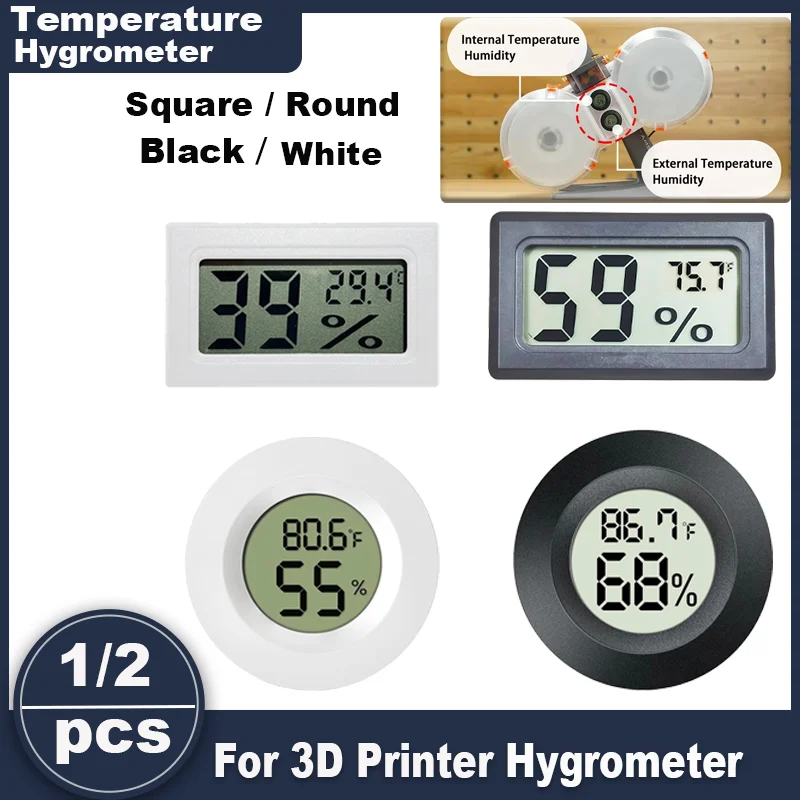
The device presents itself in both rectangular and circular form factors, available in black or white finishes. Its compact dimensions, notably 48mm x 28mm x 15mm for the rectangular variant, allow for discreet and efficient integration into various filament storage solutions. The LCD display is clear and legible. This small footprint is a key design consideration.This miniaturization directly implies ease of placement within constrained spaces, such as dedicated filament dry boxes, Bambu Lab AMS units, or custom-built enclosures. The ability to embed the sensor directly where the filament resides ensures that the readings are representative of the actual storage conditions, not merely the general room environment. This direct measurement capability is vital. It eliminates guesswork.
Compared to bulkier, general-purpose environmental sensors, these compact units are purpose-built for the tight confines of 3D printing accessories. Their design prioritizes integration over standalone functionality, making them a seamless addition to any filament management strategy. The form factor is optimized for utility.
Clarity at a Glance: Operational Dynamics
Operation is straightforward, featuring a clear digital LCD display that simultaneously presents both temperature and relative humidity. The temperature unit is user-selectable between Celsius and Fahrenheit, typically via a small button or pinhole switch on the rear of the unit. Readings are updated in real-time. This ensures immediate data availability.The immediate visual feedback allows operators to quickly assess the filament's storage conditions and take corrective action if necessary. A quick glance confirms environmental stability or signals a need for desiccant replacement or a dryer cycle. This direct, unambiguous display minimizes the time spent on environmental checks. It simplifies workflow.
Unlike analog gauges, which can be difficult to read precisely, or systems requiring app-based interaction, this digital display offers instant, precise data. The absence of complex features means a lower barrier to entry and reliable performance without software dependencies. Its simplicity is a strength.
Safeguarding Material Integrity: The Economic Edge
Positioned at a highly accessible price point, this digital hygrometer represents a minimal investment with significant potential returns. The primary function is to prevent filament degradation caused by moisture absorption. This directly translates into fewer failed prints, reduced material waste, and extended shelf life for expensive or specialized filaments. The cost-benefit ratio is compelling.Consider the financial implications of even a single failed print due to moisture-related defects. The wasted filament, the lost printing time, and the potential need to re-print a part can quickly eclipse the cost of this monitoring device. By providing the data needed to maintain optimal storage, the hygrometer acts as a preventative measure, safeguarding both materials and production schedules. It saves resources.
Compared to the recurring costs associated with replacing spoiled filament or the time investment in troubleshooting moisture-induced print issues, this device offers a clear long-term value. It is a proactive tool that pays for itself by preventing costly reactive measures. This is a smart investment.
Seamless Integration: A Workshop Essential
The product is explicitly marketed for integration with popular 3D printer accessories, including the Bambu Lab X1 P1 AMS (Automatic Material System) and general filament dry boxes. Its versatility extends to any enclosed space where environmental control is critical. The images demonstrate its application in multi-spool dry boxes and directly on AMS units. This broadens its utility.For users of advanced 3D printing systems like the Bambu Lab AMS, maintaining dry filament is not just a recommendation, it is a prerequisite for consistent, high-quality multi-material prints. The hygrometer ensures that the AMS's internal environment is suitable, preventing issues that could otherwise lead to filament jams or poor print adhesion. It supports complex setups.
Unlike generic room hygrometers that provide broad environmental data, these units are designed for the specific, localized needs of 3D printing filament storage. Their small size and focused functionality make them an ideal complement to any 3D printing workshop, from hobbyist setups to professional prototyping labs. They are purpose-fit.
Imagine a workshop where every print starts with confidence, knowing your filament is perfectly conditioned. The days of troubleshooting mysterious print failures due to unseen moisture are over. This compact device ensures consistent material quality, enabling you to achieve dimensionally accurate engineering parts and reliably print even the most difficult materials, minimizing print failures and maximizing your creative output. It streamlines your entire additive manufacturing process, allowing you to focus on innovation rather than frustration.