Comgrow Dual Spool Filament Dehydrator for 3D Printing
Official Store Deal
Expert Analysis Overview
The Comgrow Filament Dehydrator is a crucial environmental control unit engineered for serious 3D printing enthusiasts and professionals who demand consistent material quality and print reliability. This device directly addresses the pervasive issue of moisture absorption in 3D printing filaments, a common cause of print failures, poor layer adhesion, and compromised part strength. By actively drying and maintaining optimal filament conditions, it ensures that even hygroscopic materials perform at their peak, leading to dimensionally accurate and structurally sound prototypes.
Filament moisture content directly impacts print quality. Wet filament can lead to stringing, bubbling, and weak layer bonds. This dehydrator actively removes excess moisture.
The integrated heating element and controlled environment work to extract water molecules from the filament, restoring it to its optimal dry state. This process is critical for materials like ABS, Nylon, and PETG, which are particularly susceptible to moisture degradation. Users will observe a marked improvement in print surface finish and mechanical properties.
Unlike passive storage solutions, which merely slow down moisture absorption, this unit provides active dehydration. It's a proactive measure against print defects.
The unit offers a selectable temperature range, specifically 40-50°C for PLA, PLA+, and Wood filaments, and 50-55°C for ABS, ABS+, PVA, and PA (Nylon). This targeted thermal control is essential.
This dual-range temperature capability allows for precise conditioning tailored to the specific thermal properties of various filament types. Applying the correct temperature ensures effective drying without risking material degradation or premature softening. The digital display provides clear feedback on the current operating temperature and remaining drying time.
Generic filament dryers often provide a single, broad temperature setting, which can be suboptimal for sensitive materials or insufficient for highly hygroscopic ones. This precise control offers a significant advantage.
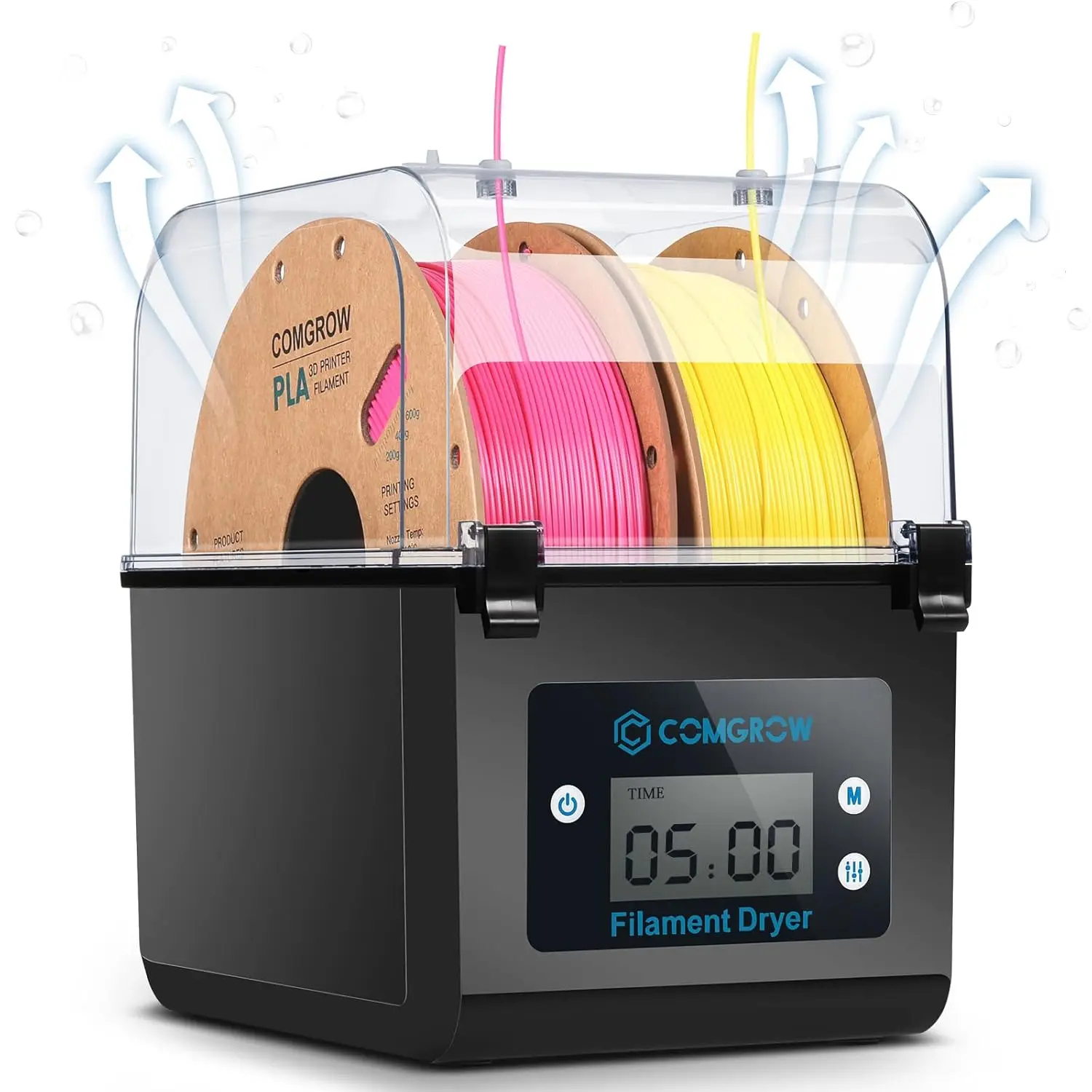
The Comgrow dryer box is designed with a substantial inner size of 9.29 x 6.49 x 9.13 inches (236 x 165 x 232 mm). It can store two rolls of 1kg spools simultaneously.
This generous capacity allows users to dry multiple spools at once or keep two active spools conditioned for a dual-extrusion setup or continuous printing. The ability to accommodate two 1kg spools is a practical benefit for workflows that involve larger prints or frequent material changes. It saves time and ensures readiness.
Many entry-level filament dryers are limited to a single spool, necessitating pauses in production to swap and dry additional materials. The dual-spool capacity enhances workflow efficiency.
The dehydrator is compatible with 99% of 3D filament spools, supporting filament diameters of 1.75mm and 2.85mm. This broad compatibility is a key feature.
This wide range of supported filament types and diameters means the unit integrates seamlessly into almost any 3D printing setup, regardless of the printer model or material preference. From common PLA to more demanding engineering plastics like Nylon and ABS, the system is designed to handle diverse material requirements. It works perfectly with PLA and Silk filament.
Some specialized dryers are restricted to specific filament brands or sizes, limiting their utility across a varied material inventory. This unit offers universal application.
The front panel features a clear digital display showing the set time and temperature, along with a "WORK" indicator. Operation is straightforward.
Users can easily set the desired drying duration and temperature using the intuitive controls. The visual feedback on the screen confirms the operational status, ensuring the drying process is active and proceeding as intended. This direct interface minimizes guesswork and streamlines the preparation phase of printing.
Simpler dryers often lack a digital display, leaving users to estimate drying times or temperatures, which can lead to under-drying or over-drying filament. The Comgrow unit provides precise control.
Beyond drying, the unit also functions as a sealed storage container and a filament holder during printing. This multi-functionality adds value.
By keeping the filament within the heated and sealed environment even while printing, the dehydrator ensures continuous protection against ambient moisture. This is particularly beneficial for long prints where exposure to humidity over several hours could reintroduce moisture into the filament. The integrated filament outlet guides the material directly to the printer.
Many users rely on separate dry boxes for storage and then transfer filament to a printer-mounted holder, exposing it to air. This integrated solution offers an uninterrupted dry path.
The construction appears robust, designed for repeated use in a workshop environment. The clear lid allows for visual inspection of spools.
The unit's design prioritates longevity, with components selected to withstand the thermal cycles of filament drying. The transparent cover is not just for aesthetics; it allows users to quickly ascertain the remaining filament on spools without interrupting the drying process. This thoughtful design enhances usability.
Some budget dryers use thinner plastics that can warp over time, compromising the seal and drying effectiveness. The Comgrow unit presents a more substantial build.
If high humidity persists inside the box, it is recommended to open the lid periodically or insert desiccant bags. Fan noise can occur due to cable interference.
These are minor operational considerations rather than fundamental design flaws. The ability to mitigate internal humidity with desiccant bags or by venting demonstrates a practical approach to environmental control. Addressing fan noise involves a simple adjustment of internal cables, ensuring optimal airflow and quiet operation. These are manageable aspects of routine maintenance.
Unlike units with sealed, non-venting designs that can trap moisture, the Comgrow unit offers clear guidance for managing internal humidity. The fan noise issue is a common mechanical adjustment, not a defect.
For those engaged in precision prototyping, the Comgrow Filament Dehydrator is not merely an accessory; it is an essential tool. It directly contributes to creating dimensionally accurate engineering parts by preventing the material inconsistencies caused by moisture. Imagine consistently achieving tight tolerances and superior surface finishes, print after print. This unit minimizes print failures, saving both material and valuable production time. It enables reliable printing of difficult materials like Nylon and Polycarbonate, which are notoriously hygroscopic, by ensuring they are always in their optimal state. This translates to fewer wasted prints, stronger parts, and a more efficient workflow, allowing prototypers to focus on innovation rather than troubleshooting material issues. The investment in this dehydrator pays dividends in reduced material waste and increased print success rates, ultimately accelerating design iterations and product development cycles.
Optimizing Filament Integrity
Filament moisture content directly impacts print quality. Wet filament can lead to stringing, bubbling, and weak layer bonds. This dehydrator actively removes excess moisture.
The integrated heating element and controlled environment work to extract water molecules from the filament, restoring it to its optimal dry state. This process is critical for materials like ABS, Nylon, and PETG, which are particularly susceptible to moisture degradation. Users will observe a marked improvement in print surface finish and mechanical properties.
Unlike passive storage solutions, which merely slow down moisture absorption, this unit provides active dehydration. It's a proactive measure against print defects.
Precise Thermal Management
The unit offers a selectable temperature range, specifically 40-50°C for PLA, PLA+, and Wood filaments, and 50-55°C for ABS, ABS+, PVA, and PA (Nylon). This targeted thermal control is essential.
This dual-range temperature capability allows for precise conditioning tailored to the specific thermal properties of various filament types. Applying the correct temperature ensures effective drying without risking material degradation or premature softening. The digital display provides clear feedback on the current operating temperature and remaining drying time.
Generic filament dryers often provide a single, broad temperature setting, which can be suboptimal for sensitive materials or insufficient for highly hygroscopic ones. This precise control offers a significant advantage.
Spool Accommodation and Material Versatility
The Comgrow dryer box is designed with a substantial inner size of 9.29 x 6.49 x 9.13 inches (236 x 165 x 232 mm). It can store two rolls of 1kg spools simultaneously.
This generous capacity allows users to dry multiple spools at once or keep two active spools conditioned for a dual-extrusion setup or continuous printing. The ability to accommodate two 1kg spools is a practical benefit for workflows that involve larger prints or frequent material changes. It saves time and ensures readiness.
Many entry-level filament dryers are limited to a single spool, necessitating pauses in production to swap and dry additional materials. The dual-spool capacity enhances workflow efficiency.
Broad Filament Compatibility
The dehydrator is compatible with 99% of 3D filament spools, supporting filament diameters of 1.75mm and 2.85mm. This broad compatibility is a key feature.
This wide range of supported filament types and diameters means the unit integrates seamlessly into almost any 3D printing setup, regardless of the printer model or material preference. From common PLA to more demanding engineering plastics like Nylon and ABS, the system is designed to handle diverse material requirements. It works perfectly with PLA and Silk filament.
Some specialized dryers are restricted to specific filament brands or sizes, limiting their utility across a varied material inventory. This unit offers universal application.
Operational Control and User Experience
The front panel features a clear digital display showing the set time and temperature, along with a "WORK" indicator. Operation is straightforward.
Users can easily set the desired drying duration and temperature using the intuitive controls. The visual feedback on the screen confirms the operational status, ensuring the drying process is active and proceeding as intended. This direct interface minimizes guesswork and streamlines the preparation phase of printing.
Simpler dryers often lack a digital display, leaving users to estimate drying times or temperatures, which can lead to under-drying or over-drying filament. The Comgrow unit provides precise control.
Integrated Filament Holder Functionality
Beyond drying, the unit also functions as a sealed storage container and a filament holder during printing. This multi-functionality adds value.
By keeping the filament within the heated and sealed environment even while printing, the dehydrator ensures continuous protection against ambient moisture. This is particularly beneficial for long prints where exposure to humidity over several hours could reintroduce moisture into the filament. The integrated filament outlet guides the material directly to the printer.
Many users rely on separate dry boxes for storage and then transfer filament to a printer-mounted holder, exposing it to air. This integrated solution offers an uninterrupted dry path.
Durability and Maintenance Considerations
The construction appears robust, designed for repeated use in a workshop environment. The clear lid allows for visual inspection of spools.
The unit's design prioritates longevity, with components selected to withstand the thermal cycles of filament drying. The transparent cover is not just for aesthetics; it allows users to quickly ascertain the remaining filament on spools without interrupting the drying process. This thoughtful design enhances usability.
Some budget dryers use thinner plastics that can warp over time, compromising the seal and drying effectiveness. The Comgrow unit presents a more substantial build.
Addressing Humidity and Noise
If high humidity persists inside the box, it is recommended to open the lid periodically or insert desiccant bags. Fan noise can occur due to cable interference.
These are minor operational considerations rather than fundamental design flaws. The ability to mitigate internal humidity with desiccant bags or by venting demonstrates a practical approach to environmental control. Addressing fan noise involves a simple adjustment of internal cables, ensuring optimal airflow and quiet operation. These are manageable aspects of routine maintenance.
Unlike units with sealed, non-venting designs that can trap moisture, the Comgrow unit offers clear guidance for managing internal humidity. The fan noise issue is a common mechanical adjustment, not a defect.
The Prototyper's Edge
For those engaged in precision prototyping, the Comgrow Filament Dehydrator is not merely an accessory; it is an essential tool. It directly contributes to creating dimensionally accurate engineering parts by preventing the material inconsistencies caused by moisture. Imagine consistently achieving tight tolerances and superior surface finishes, print after print. This unit minimizes print failures, saving both material and valuable production time. It enables reliable printing of difficult materials like Nylon and Polycarbonate, which are notoriously hygroscopic, by ensuring they are always in their optimal state. This translates to fewer wasted prints, stronger parts, and a more efficient workflow, allowing prototypers to focus on innovation rather than troubleshooting material issues. The investment in this dehydrator pays dividends in reduced material waste and increased print success rates, ultimately accelerating design iterations and product development cycles.