Comfast CF-WU816N 150Mbps Mini USB WiFi Adapter
Official Store Deal
Expert Analysis Overview
Network Interface Analysis: Comfast CF-WU816N
The Comfast CF-WU816N is a compact 2.4GHz USB WiFi adapter, engineered for users requiring fundamental wireless network access with an emphasis on plug-and-play simplicity. This device targets legacy systems and modern desktops alike, offering a straightforward solution for establishing wireless connectivity where integrated options are absent or inadequate. Its design prioritizes minimal physical footprint, making it an unobtrusive addition to any workstation.
Throughput and Protocol Adherence
This adapter operates on the IEEE 802.11n standard, specifying a maximum theoretical throughput of 150Mbps. This data rate is achieved through a single spatial stream (1T1R configuration) over the 2.4GHz frequency band. For typical network operations such as web browsing, email communication, and standard definition video streaming, 150Mbps provides sufficient bandwidth. It is a functional speed.
However, for high-demand applications like concurrent 4K video streaming, online competitive gaming, or large file transfers across a local network, this throughput will present a bottleneck. Modern network environments often demand significantly higher data rates, typically achieved with 802.11ac or 802.11ax standards utilizing multiple spatial streams and wider channels. The CF-WU816N is not designed for such intensive use cases; its performance profile aligns with basic internet access requirements.
Compared to entry-level 300Mbps 802.11n adapters, which often employ 2T2R configurations, the 150Mbps single-stream design inherently limits its peak performance. Users upgrading from older 802.11g (54Mbps) adapters will experience a noticeable improvement in raw speed, but those accustomed to dual-band or gigabit wireless solutions will find this adapter's capabilities restrictive. The 150Mbps rating is a theoretical maximum.
Frequency Spectrum Utilization
The CF-WU816N exclusively operates within the 2.4GHz frequency band. This band is characterized by its superior signal penetration through obstacles and longer range compared to the 5GHz band. These characteristics make it suitable for environments where the access point is not in direct line of sight or is located several rooms away. Signal integrity is often maintained.
Conversely, the 2.4GHz band is highly susceptible to interference from other wireless devices, including Bluetooth peripherals, cordless phones, microwave ovens, and neighboring Wi-Fi networks. This congestion can significantly degrade actual throughput and increase latency, even if the theoretical maximum speed is 150Mbps. Network performance can fluctuate.
In contrast, dual-band adapters offer the flexibility to switch to the less congested 5GHz band, providing higher effective speeds and lower latency in suitable environments. The absence of 5GHz support on the CF-WU816N means users are entirely reliant on the often crowded 2.4GHz spectrum. This is a design trade-off for cost and simplicity.
Driver Management and Operating System Compatibility
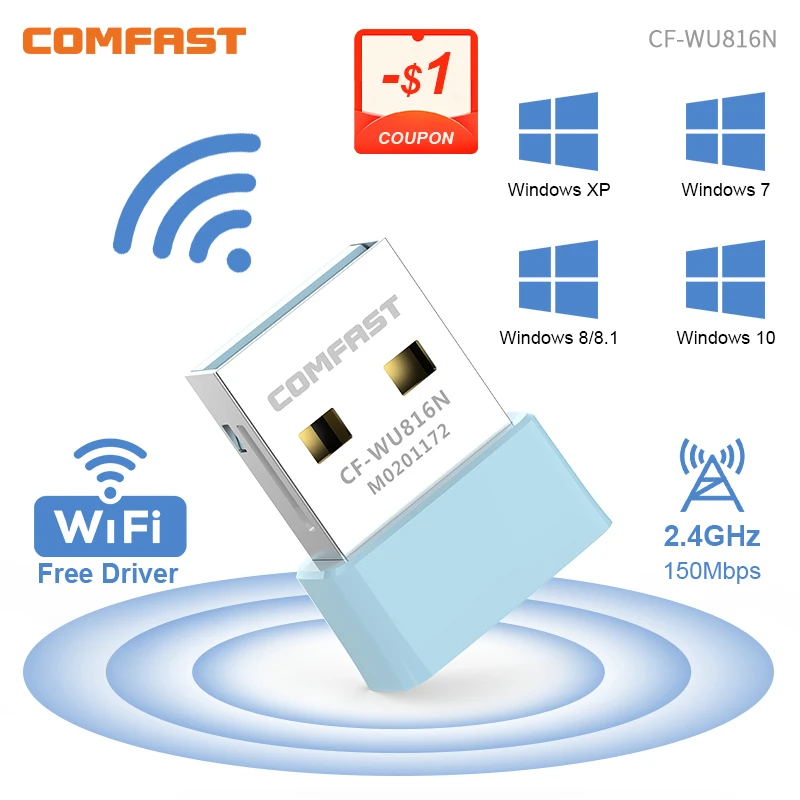
A key advertised feature is its "driver-free" operation, implying native support across a broad range of Windows operating systems. The product explicitly lists compatibility with Windows XP, 7, 8/8.1, and 10, with visual cues suggesting Windows 11 support. This indicates the adapter leverages standard USB network device classes, allowing the OS to automatically install a generic driver upon insertion. Installation is simplified.
This driver-free approach significantly reduces setup complexity, eliminating the need for optical drives or manual driver downloads. For users less technically inclined or those working with systems lacking internet access for driver acquisition, this is a substantial convenience. It streamlines deployment.
However, relying solely on generic OS drivers can sometimes limit access to advanced features or optimizations that a manufacturer-specific driver might provide. While basic connectivity is assured, fine-tuning options for power management, advanced security protocols, or specific antenna configurations might be absent. Most users will not notice this.
Physical Form Factor and Integration
The adapter features a "Mini Stealth Shape Design," indicating an ultra-compact USB dongle. Its diminutive size allows it to remain largely flush with the USB port, minimizing protrusion and reducing the risk of accidental damage when installed in laptops or desktop PCs. This form factor is ideal for portable devices.
This low-profile design is particularly beneficial for notebooks, where larger adapters can be cumbersome or easily dislodged. For desktop users, it ensures the adapter does not obstruct adjacent USB ports or create an unsightly extension. Space efficiency is paramount.
Compared to adapters with external antennas, the integrated antenna design of the CF-WU816N, while contributing to its compact size, may offer reduced signal gain and range in challenging RF environments. External antennas typically provide greater flexibility for signal optimization, but at the cost of increased physical presence. The trade-off is clear.
Operational Modes: Client and Access Point
The Comfast CF-WU816N supports both WiFi Receive Mode (Client Mode) and WiFi Transmit Function (AP Mode). In client mode, it enables a desktop or laptop to connect to an existing WiFi network, functioning as a standard wireless network interface card. This is its primary function.
Its AP mode functionality allows the adapter to create a wireless hotspot, sharing an existing wired internet connection with other wireless devices such as smartphones or tablets. This feature effectively transforms a wired PC into a temporary wireless access point. It extends network access.
This dual-mode capability adds significant utility, particularly for users who might need to share a single wired internet connection in a pinch. While not a replacement for a dedicated wireless router, it offers a convenient solution for ad-hoc network sharing. The flexibility is a notable advantage.
Enterprise Network Considerations
For enterprise-grade network deployments, the CF-WU816N's capabilities are limited. It lacks support for advanced features such as VLAN tagging, enterprise-grade WPA2/WPA3-Enterprise authentication (802.1X), or OpenWRT/DD-WRT firmware customization. These features are critical for network segmentation, robust security, and granular control in corporate environments. This adapter is not for complex networks.
Its focus on basic connectivity and driver-free operation means it is designed for consumer-level use cases rather than managed network infrastructures. Network administrators typically require adapters with more robust feature sets and management capabilities. Simplicity comes at a cost.
While it can connect to standard WPA2-Personal networks, its lack of advanced security protocols and management interfaces makes it unsuitable for integration into secure, policy-driven corporate networks. This is a fundamental distinction in its design philosophy. It serves a different market segment.
Value Proposition and Target User
At its price point, the Comfast CF-WU816N represents a highly cost-effective solution for basic wireless connectivity. Its primary value lies in providing a simple, unobtrusive way to add Wi-Fi to older PCs, new desktops without integrated Wi-Fi, or as a backup adapter. The investment is minimal.
This adapter is ideal for users who primarily engage in low-bandwidth activities and do not require the higher speeds or advanced features of more expensive dual-band or Wi-Fi 6 adapters. It is a practical choice for students, casual home users, or for specific IoT applications where 2.4GHz connectivity is sufficient. It fulfills a specific need.
Imagine a scenario where an older desktop PC, previously tethered by an Ethernet cable, suddenly gains the freedom of wireless connectivity. Picture a compact home office setup, free from unnecessary cables, with stable internet access for everyday tasks. This adapter provides that fundamental capability, allowing seamless integration into a modern wireless home environment without complex setup procedures or significant financial outlay. It simply works, enabling basic digital interaction and freeing up physical space, ensuring that even legacy hardware can participate in the contemporary wireless landscape with minimal fuss and maximum convenience.