CHUWI MiniBook X 2-in-1 Laptop
Official Store Deal
Expert Analysis Overview
Computational Underpinnings: Performance Metrics
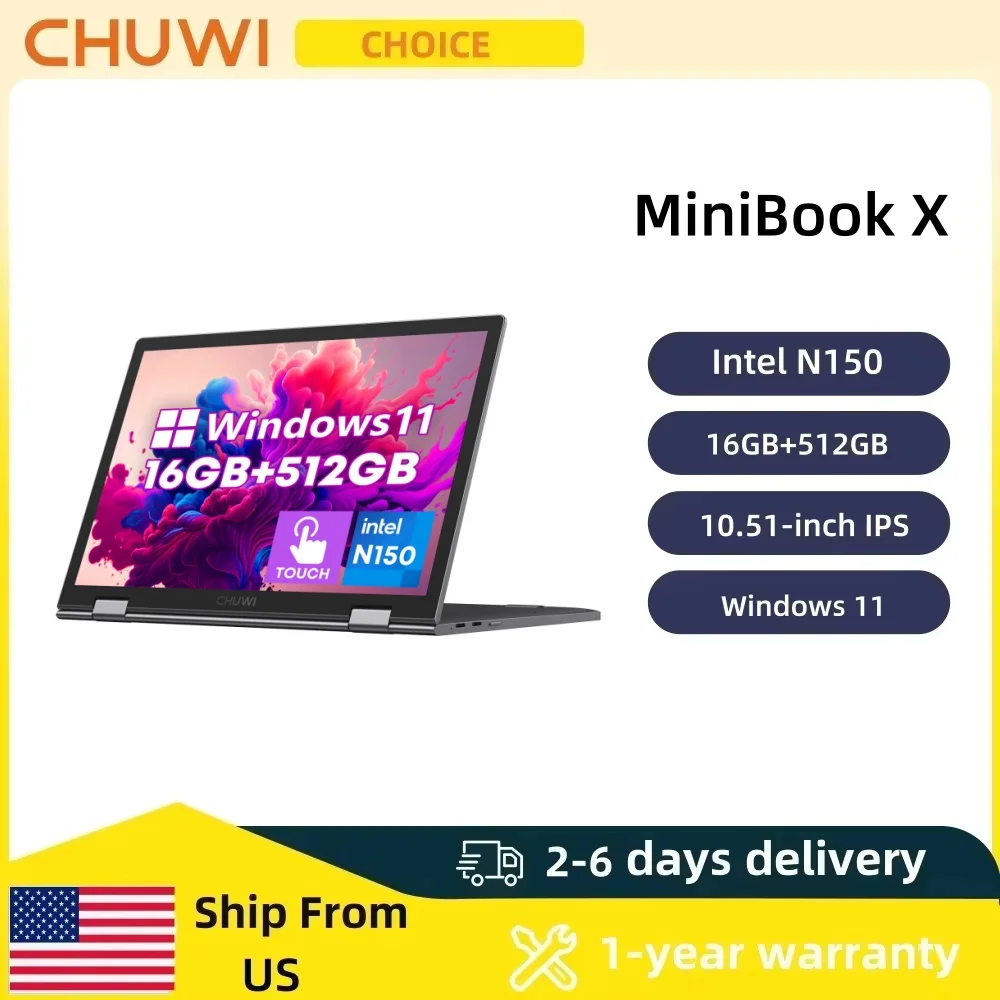
The CHUWI MiniBook X is a compact, convertible productivity device engineered for users prioritizing portability and basic multitasking over raw computational power. This assessment focuses on its hardware capabilities and their real-world implications.At its core, the MiniBook X integrates an Intel N150 processor, paired with 16GB of LPDDR5 RAM and a 512GB NVMe SSD. The Intel N150 is a low-power chip, featuring 4 cores and 4 threads, capable of boosting up to 3.6 GHz. This configuration suggests a system optimized for efficiency rather than peak performance. The 16GB LPDDR5 RAM offers a significant bandwidth advantage over older memory types. The 512GB NVMe SSD ensures rapid data access. These components form a balanced foundation for everyday computing.
The Intel N150, with its 6W Thermal Design Power (TDP), is inherently designed for energy efficiency. This low wattage translates directly into reduced heat generation, often allowing for fanless or passively cooled designs, which is beneficial for a compact, portable device. The LPDDR5 memory operates at higher frequencies than previous generations, contributing to quicker application loading and smoother transitions between tasks. The NVMe SSD, a modern storage solution, provides sequential read and write speeds far exceeding traditional SATA SSDs or eMMC storage, which means faster boot times and quicker file transfers. It is a fast drive.
Compared to standard entry-level laptops often equipped with Intel Celeron or Pentium processors, slower DDR4 RAM, and eMMC storage, the MiniBook X presents a notable upgrade in responsiveness. The advertised Cinebench R23 multi-core score of 2109 and single-core score of 485, showing 33% and 11% improvements over the N100 respectively, indicate a tangible, albeit modest, performance uplift within its class. This is not a powerhouse. For users accustomed to the sluggishness of eMMC-based systems, the NVMe SSD alone represents a substantial improvement in user experience. The LPDDR5 RAM further solidifies its position above basic configurations, allowing for more browser tabs and applications to run concurrently without immediate slowdowns.
Thermal Management Profile
The Intel N150's 6W TDP is a critical factor in its thermal behavior. This low power consumption means the processor generates minimal heat. Consequently, the MiniBook X likely employs a passive cooling solution or a very quiet, small fan. Such a design is ideal for maintaining a thin profile and silent operation, crucial for a device intended for mobile use in quiet environments.Under typical light loads, such as web browsing, document editing, or streaming video, the device is expected to operate well within thermal limits. The low TDP ensures that the processor can sustain its base clock speeds without significant thermal throttling. This is a quiet machine. However, for prolonged, moderately intensive tasks—even those within the N150's capability—the compact chassis and passive cooling might eventually lead to a slight reduction in clock speeds to maintain thermal equilibrium. This is a common characteristic of ultra-portable designs.
In contrast, higher-performance laptops with processors exceeding 15W TDP often rely on active cooling systems with fans that can become audible under load. These systems are designed to dissipate more heat, allowing for sustained peak performance. The MiniBook X's approach prioritizes silence and form factor over raw, sustained computational output. Its thermal profile is suited for bursty, light workloads rather than continuous, demanding computations. Expect quiet operation.
Visual Interface Fidelity: Display and Graphics
The MiniBook X features a 10.51-inch 2K FHD IPS touchscreen. This display specification indicates a high pixel density for its size, promising sharp images and text. The IPS panel technology ensures wide viewing angles and consistent color reproduction across different perspectives. Touchscreen functionality adds an interactive layer, enhancing its 2-in-1 versatility.The 2K FHD resolution (2176 x 1600 pixels, as per the title's implication of 2K) on a 10.51-inch screen results in a very high pixel-per-inch (PPI) count. This delivers exceptional visual clarity, making text crisp and images detailed. The IPS technology is beneficial for collaborative viewing or when using the device in various orientations, as colors do not shift or distort. Touch input facilitates intuitive navigation in tablet mode and supports stylus interaction, which is useful for note-taking or basic sketching. It offers clear visuals.
Many entry-level laptops feature lower resolution HD or Full HD displays, often with TN panels that suffer from poor viewing angles and color inaccuracy. The MiniBook X's IPS panel and high resolution represent a significant upgrade in visual quality for its category. However, the absence of an explicit sRGB color gamut percentage is a notable omission. For creative professionals who rely on accurate color representation for graphic design or photo editing, this lack of data means the display's suitability for such tasks remains unverified. It is not for professional creators without further data.
Integrated Graphics Performance
The Intel N150 processor includes Intel UHD Graphics with 24 Execution Units (EUs) running at up to 1000 MHz. This integrated graphics solution is designed for basic display output and media acceleration.For everyday tasks, these integrated graphics are perfectly adequate. They handle video playback, web browsing, and general user interface rendering smoothly. The 24 EUs provide sufficient power for decoding high-resolution video streams, including 4K content, ensuring a good media consumption experience. Light gaming is possible, but only for older or less graphically demanding titles at low settings. It handles video well.
Compared to dedicated graphics cards or even more powerful integrated solutions found in higher-tier processors, the Intel UHD Graphics in the N150 offers limited computational power. It is not intended for modern gaming, complex 3D rendering, or professional video editing. Its primary role is to provide a competent visual experience for productivity and entertainment, aligning with the device's overall low-power, portable design philosophy. Do not expect gaming performance.
Ergonomic Adaptability: Design and Portability
The MiniBook X's design emphasizes portability and versatility, featuring a 360-degree hinge and a remarkably light 0.92KG chassis. This combination allows it to transform between laptop, tablet, tent, and stand modes.The 360-degree hinge is the cornerstone of its adaptability. This mechanism enables the device to function as a traditional laptop for typing, fold into a tablet for touch-based interaction, or stand in tent/display mode for media consumption or presentations. The 0.92KG weight makes it exceptionally easy to carry, rivaling many tablets in terms of portability. This is a light device. Its compact footprint means it occupies minimal space in a bag, making it an ideal companion for travel or commuting. It is designed for mobility.
Traditional clamshell laptops, even thin-and-light models, typically weigh more and lack the flexibility of a convertible design. Heavier 2-in-1 devices, while offering similar versatility, often compromise on true portability. The MiniBook X distinguishes itself by offering a full Windows 11 experience in a form factor that genuinely competes with dedicated tablets in terms of weight and handling. This makes it a compelling option for users who need a full operating system but demand extreme portability. It offers true portability.
Systemic Architecture: Operating Environment
The device ships with Windows 11 pre-installed. This provides a modern, secure, and feature-rich operating environment for users.Windows 11 offers a refreshed user interface, improved multitasking features like Snap Layouts, and enhanced security protocols. Its broad software compatibility ensures that users can run a vast array of productivity applications, web browsers, and entertainment software. The operating system is optimized for touch input, which complements the MiniBook X's 2-in-1 touchscreen design. It is a modern OS.
Compared to older Windows versions or alternative operating systems like ChromeOS, Windows 11 provides a more contemporary user experience with better integration of Microsoft services and a robust ecosystem of applications. While ChromeOS excels in simplicity and cloud integration, Windows 11 offers greater local processing power and software flexibility, making the MiniBook X a more versatile tool for diverse tasks. It is a flexible platform.