BMAX B5A Pro Mini PC
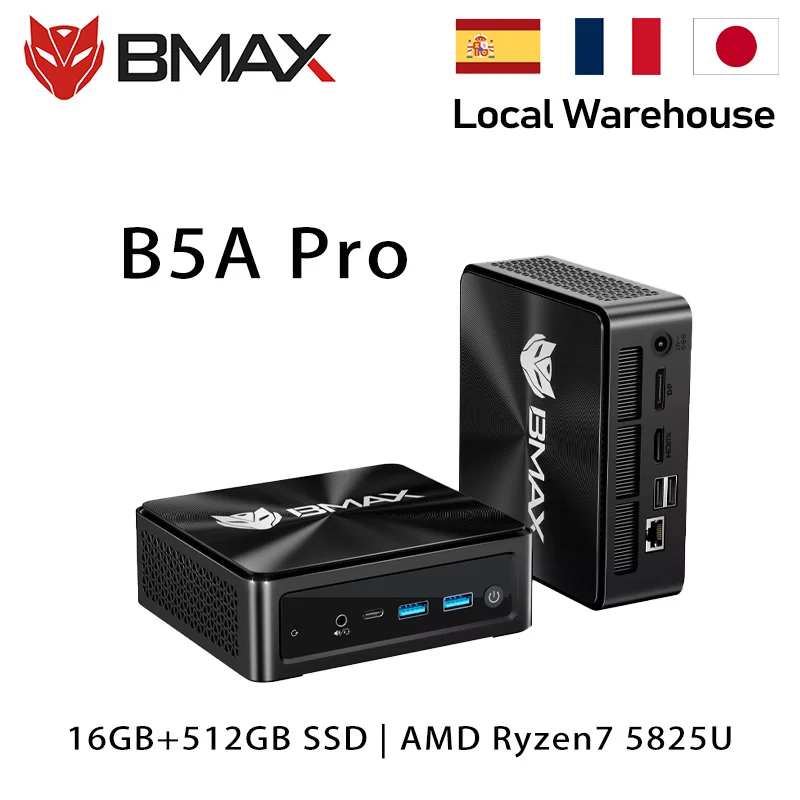
Official Store Deal
Expert Analysis Overview
The BMAX B5A Pro is a compact, high-performance mini PC ideal for home lab enthusiasts seeking efficient virtualization and low-power server operations. This device positions itself as a robust alternative to bulkier server hardware, offering significant processing power in a diminutive footprint. Its design caters to users who prioritize computational capability and energy efficiency for continuous operation, making it a strong contender for a variety of always-on tasks.
The core of the BMAX B5A Pro is the AMD Ryzen 7 5825U processor. This CPU features 8 physical cores and 16 threads, a configuration that excels in parallel processing tasks. It is capable of reaching a turbo frequency of 4.50GHz, providing bursts of speed for demanding applications. Built on a 7nm manufacturing process, this chip offers excellent power efficiency, a critical factor for devices intended for continuous operation. A substantial 16MB of Smart Cache further enhances its ability to handle complex computations quickly. This is a powerful chip.
For the home lab environment, these specifications translate directly into substantial multitasking capabilities. Users can confidently run multiple virtual machines (VMs) concurrently, each with its own operating system and dedicated resources, without significant performance degradation. Deploying numerous Docker containers for microservices or development environments becomes a fluid process. The processor can also handle demanding applications such as media transcoding servers (e.g., Plex Media Server), complex database instances, or even a self-hosted cloud solution like Nextcloud. The high core count and thread capacity ensure that even under heavy load, the system maintains responsiveness, preventing bottlenecks that can frustrate users. It handles parallel tasks well.
Compared to standard entry-level desktop CPUs or even older server-grade processors, the Ryzen 7 5825U in this mini PC offers a compelling blend of modern architecture and power efficiency. Traditional tower servers, while offering more expansion, often consume significantly more power at idle and under load, creating higher operational costs and requiring more substantial cooling infrastructure. This mini PC provides a powerful, low-TDP alternative, reducing the overall energy footprint of a home lab. Its efficiency is notable.
Memory configuration on the BMAX B5A Pro includes 16GB of DDR4 RAM, operating in a dual-channel configuration for enhanced bandwidth. This is a solid starting point. The system also supports expansion up to 64GB of RAM, a crucial detail for virtualization where each VM requires its own allocated memory. Storage is handled by a 512GB NVMe SSD, providing rapid data access with significantly faster read and write speeds compared to traditional SATA SSDs. An additional 2.5-inch notebook hard drive bay is available for further storage expansion, offering flexibility for bulk data or secondary operating systems.
These memory and storage provisions are fundamental for a versatile home lab setup. The initial 16GB RAM allows for several lightweight VMs, such as Linux-based network services or a robust Docker host running numerous containers. Expanding to 64GB unlocks the potential for more memory-intensive virtual environments, such as multiple Windows Server instances, a virtualized firewall, or a Proxmox cluster node managing several guest operating systems simultaneously. The NVMe SSD ensures that operating systems boot quickly, applications launch without delay, and frequently accessed data is retrieved instantaneously, minimizing downtime for critical services. Data access is fast.
Many typical mini PCs often come with more restrictive memory ceilings, perhaps topping out at 32GB, or rely solely on slower SATA SSDs. The B5A Pro's support for 64GB DDR4 in a dual-channel configuration, combined with its inclusion of a fast NVMe drive and the option for a secondary 2.5-inch drive, provides a level of flexibility and performance often found in larger, more expensive systems. This offers a significant upgrade path for evolving home lab needs.
The mini PC offers a comprehensive suite of connectivity options. It features a DisplayPort, an HDMI port, and a Type-C port, enabling triple display output at up to 4K resolution and 60Hz. This capability is ideal for multi-monitor setups. For high-speed data transfer, a USB4 port is included, which often implies compatibility with Thunderbolt 3/4 devices, alongside other USB-A ports for standard peripherals. Wireless connectivity is robust with Bluetooth 5.0 for connecting accessories and 2.4G/5G dual-band Wi-Fi 6 for fast and reliable network access.
In a home lab context, flexible display configurations are invaluable. Users can set up multiple monitors to simultaneously view server dashboards, manage virtual machines, or use the mini PC as a powerful desktop workstation for development or administrative tasks. The USB4 port provides high-speed data transfer for external NVMe enclosures, high-resolution docking stations, or other demanding peripherals, crucial for quick backups or moving large datasets between systems. Reliable Wi-Fi 6 connectivity, leveraging technologies like OFDMA, simplifies initial setup and remote management, offering better performance and stability on congested wireless networks, a common scenario in many homes. It connects easily.
Compared to older mini PCs, which might offer only a single HDMI port or slower USB 2.0/3.0 connections, the BMAX B5A Pro's modern I/O is a clear advantage. The inclusion of Wi-Fi 6 ensures better performance and stability on congested wireless networks. However, it is worth noting the presence of only a single Gigabit Ethernet port. While sufficient for many applications like a simple media server or a single-node virtualization host, users planning complex network routing, firewall appliances, or multi-NIC server roles will need to consider external USB-to-Ethernet adapters or integrate a managed switch into their network architecture. This is a design choice.
The BMAX B5A Pro incorporates a "Space Capsule Cooling System" designed for efficient heat dissipation. This system includes an enlarged double copper heat pipe, which efficiently transfers heat away from the CPU. A giant turbo smart fan then actively dissipates this heat, with its speed likely adjusting based on thermal load to optimize noise and cooling performance. Furthermore, a top cover cooling design aids in convection, allowing heat to escape upwards. The overall thermal management aims to maintain optimal temperatures, even under sustained loads, preventing thermal throttling and ensuring consistent performance. This allows for higher performance.
For a device intended for continuous operation in a home lab, effective thermal management is paramount. Sustained performance without thermal throttling ensures that server applications run consistently, avoiding slowdowns that can impact service availability or data processing speeds. The "Space Capsule" design suggests a focus on moving heat away from critical components efficiently, which directly contributes to the longevity and reliability of the hardware over years of 24/7 operation. Quiet operation is also a significant benefit for a device running continuously in a living space, preventing it from becoming an audible distraction. It stays cool.
Unlike many passively cooled mini PCs that can struggle with heat under load, leading to reduced performance and potential hardware degradation, the BMAX B5A Pro's active cooling solution is a significant advantage. This active cooling, combined with the relatively low 45W TDP of the Ryzen 7 5825U, allows the system to maintain its advertised turbo frequencies more consistently than less robustly cooled alternatives. This ensures stable performance, even when compiling code, rendering video, or running intensive scientific simulations.
The mini PC comes with Windows 11 Pro pre-installed, offering a familiar and feature-rich environment out of the box. This version of Windows provides advanced features like Hyper-V for virtualization, BitLocker encryption, and Remote Desktop Protocol (RDP) for secure remote management, all beneficial for a home lab setup. Critically for the home lab community, the device also explicitly supports Linux distributions like Ubuntu, making it highly adaptable. This dual-OS compatibility highlights its flexibility.
For home lab enthusiasts, the pre-installed Windows 11 Pro can serve as a powerful desktop workstation for daily tasks, or it can be wiped to install a bare-metal hypervisor like Proxmox VE, VMware ESXi, or even a specialized network operating system. The underlying hardware, particularly the AMD Ryzen processor, is generally well-supported by these virtualization platforms, ensuring compatibility and stable operation. Alternatively, installing a Linux distribution like Ubuntu for a Docker host, a dedicated file server, or a home automation hub (e.g., Home Assistant) is straightforward, leveraging Linux's resource efficiency and vast open-source ecosystem. The system is ready for diverse roles.
Many consumer-grade mini PCs often ship with Windows Home editions, which lack some of the advanced Networking, security, and management features beneficial for server roles. The inclusion of Windows 11 Pro, alongside documented Linux support, positions the BMAX B5A Pro as a more serious contender for advanced users and home lab builders. This broad OS compatibility reduces setup hurdles and provides a solid foundation for complex projects.
The physical design of the BMAX B5A Pro emphasizes a compact and ultra-slim form factor. Its small dimensions allow for discreet placement in various environments, from a desktop to a shelf, or even mounted behind a monitor using a VESA mount (if supported, though not explicitly shown, it's a common feature for mini PCs). The device is unobtrusive, blending into its surroundings.
This compact footprint is a significant advantage for home lab setups where space is often at a premium. Unlike bulky tower servers or even mid-tower desktops, this mini PC can be easily integrated into existing home networks without dominating the physical space. Its small size also contributes to reduced noise pollution, a critical factor for devices operating continuously in a residential setting, especially if placed in a living room or bedroom. The sleek, matte black finish adds to its discreet aesthetic. It fits anywhere.
Traditional server hardware, even small form factor (SFF) PCs, typically requires more physical space, generates more noise, and often produces more heat. The BMAX B5A Pro offers a solution that minimizes these common drawbacks, making it an ideal choice for users who need server-grade capabilities without the server-grade footprint or acoustics. This makes it highly adaptable for various home environments, from dedicated server closets to open-plan living areas.
The BMAX B5A Pro Mini PC is a compelling solution for the modern home lab. Its powerful AMD Ryzen 7 processor, expandable DDR4 RAM, and fast NVMe storage provide a solid foundation for virtualization, containerization, and various network services. The efficient cooling system ensures stable, quiet operation, crucial for a 24/7 device. While the single Gigabit Ethernet port might necessitate workarounds for multi-NIC setups, the overall package offers exceptional value, especially considering its compact size and energy efficiency. It is a capable machine.
Imagine the seamless operation of your home network, the quiet hum of a powerful yet efficient server, and the ease of managing multiple services from a single, compact device. This mini PC empowers users to experiment with new technologies, host personal cloud services, or run media servers without the typical overhead of traditional server hardware. It delivers capability without compromise on space or energy, allowing home lab enthusiasts to build robust, always-on systems with minimal fuss.
Processing Prowess for Persistent Workloads
The core of the BMAX B5A Pro is the AMD Ryzen 7 5825U processor. This CPU features 8 physical cores and 16 threads, a configuration that excels in parallel processing tasks. It is capable of reaching a turbo frequency of 4.50GHz, providing bursts of speed for demanding applications. Built on a 7nm manufacturing process, this chip offers excellent power efficiency, a critical factor for devices intended for continuous operation. A substantial 16MB of Smart Cache further enhances its ability to handle complex computations quickly. This is a powerful chip.
For the home lab environment, these specifications translate directly into substantial multitasking capabilities. Users can confidently run multiple virtual machines (VMs) concurrently, each with its own operating system and dedicated resources, without significant performance degradation. Deploying numerous Docker containers for microservices or development environments becomes a fluid process. The processor can also handle demanding applications such as media transcoding servers (e.g., Plex Media Server), complex database instances, or even a self-hosted cloud solution like Nextcloud. The high core count and thread capacity ensure that even under heavy load, the system maintains responsiveness, preventing bottlenecks that can frustrate users. It handles parallel tasks well.
Compared to standard entry-level desktop CPUs or even older server-grade processors, the Ryzen 7 5825U in this mini PC offers a compelling blend of modern architecture and power efficiency. Traditional tower servers, while offering more expansion, often consume significantly more power at idle and under load, creating higher operational costs and requiring more substantial cooling infrastructure. This mini PC provides a powerful, low-TDP alternative, reducing the overall energy footprint of a home lab. Its efficiency is notable.
Memory and Storage: Foundation for Flexibility
Memory configuration on the BMAX B5A Pro includes 16GB of DDR4 RAM, operating in a dual-channel configuration for enhanced bandwidth. This is a solid starting point. The system also supports expansion up to 64GB of RAM, a crucial detail for virtualization where each VM requires its own allocated memory. Storage is handled by a 512GB NVMe SSD, providing rapid data access with significantly faster read and write speeds compared to traditional SATA SSDs. An additional 2.5-inch notebook hard drive bay is available for further storage expansion, offering flexibility for bulk data or secondary operating systems.
These memory and storage provisions are fundamental for a versatile home lab setup. The initial 16GB RAM allows for several lightweight VMs, such as Linux-based network services or a robust Docker host running numerous containers. Expanding to 64GB unlocks the potential for more memory-intensive virtual environments, such as multiple Windows Server instances, a virtualized firewall, or a Proxmox cluster node managing several guest operating systems simultaneously. The NVMe SSD ensures that operating systems boot quickly, applications launch without delay, and frequently accessed data is retrieved instantaneously, minimizing downtime for critical services. Data access is fast.
Many typical mini PCs often come with more restrictive memory ceilings, perhaps topping out at 32GB, or rely solely on slower SATA SSDs. The B5A Pro's support for 64GB DDR4 in a dual-channel configuration, combined with its inclusion of a fast NVMe drive and the option for a secondary 2.5-inch drive, provides a level of flexibility and performance often found in larger, more expensive systems. This offers a significant upgrade path for evolving home lab needs.
Connectivity: Bridging Your Network and Displays
The mini PC offers a comprehensive suite of connectivity options. It features a DisplayPort, an HDMI port, and a Type-C port, enabling triple display output at up to 4K resolution and 60Hz. This capability is ideal for multi-monitor setups. For high-speed data transfer, a USB4 port is included, which often implies compatibility with Thunderbolt 3/4 devices, alongside other USB-A ports for standard peripherals. Wireless connectivity is robust with Bluetooth 5.0 for connecting accessories and 2.4G/5G dual-band Wi-Fi 6 for fast and reliable network access.
In a home lab context, flexible display configurations are invaluable. Users can set up multiple monitors to simultaneously view server dashboards, manage virtual machines, or use the mini PC as a powerful desktop workstation for development or administrative tasks. The USB4 port provides high-speed data transfer for external NVMe enclosures, high-resolution docking stations, or other demanding peripherals, crucial for quick backups or moving large datasets between systems. Reliable Wi-Fi 6 connectivity, leveraging technologies like OFDMA, simplifies initial setup and remote management, offering better performance and stability on congested wireless networks, a common scenario in many homes. It connects easily.
Compared to older mini PCs, which might offer only a single HDMI port or slower USB 2.0/3.0 connections, the BMAX B5A Pro's modern I/O is a clear advantage. The inclusion of Wi-Fi 6 ensures better performance and stability on congested wireless networks. However, it is worth noting the presence of only a single Gigabit Ethernet port. While sufficient for many applications like a simple media server or a single-node virtualization host, users planning complex network routing, firewall appliances, or multi-NIC server roles will need to consider external USB-to-Ethernet adapters or integrate a managed switch into their network architecture. This is a design choice.
Thermal Engineering for Enduring Operation
The BMAX B5A Pro incorporates a "Space Capsule Cooling System" designed for efficient heat dissipation. This system includes an enlarged double copper heat pipe, which efficiently transfers heat away from the CPU. A giant turbo smart fan then actively dissipates this heat, with its speed likely adjusting based on thermal load to optimize noise and cooling performance. Furthermore, a top cover cooling design aids in convection, allowing heat to escape upwards. The overall thermal management aims to maintain optimal temperatures, even under sustained loads, preventing thermal throttling and ensuring consistent performance. This allows for higher performance.
For a device intended for continuous operation in a home lab, effective thermal management is paramount. Sustained performance without thermal throttling ensures that server applications run consistently, avoiding slowdowns that can impact service availability or data processing speeds. The "Space Capsule" design suggests a focus on moving heat away from critical components efficiently, which directly contributes to the longevity and reliability of the hardware over years of 24/7 operation. Quiet operation is also a significant benefit for a device running continuously in a living space, preventing it from becoming an audible distraction. It stays cool.
Unlike many passively cooled mini PCs that can struggle with heat under load, leading to reduced performance and potential hardware degradation, the BMAX B5A Pro's active cooling solution is a significant advantage. This active cooling, combined with the relatively low 45W TDP of the Ryzen 7 5825U, allows the system to maintain its advertised turbo frequencies more consistently than less robustly cooled alternatives. This ensures stable performance, even when compiling code, rendering video, or running intensive scientific simulations.
Operating System Versatility and Virtualization Readiness
The mini PC comes with Windows 11 Pro pre-installed, offering a familiar and feature-rich environment out of the box. This version of Windows provides advanced features like Hyper-V for virtualization, BitLocker encryption, and Remote Desktop Protocol (RDP) for secure remote management, all beneficial for a home lab setup. Critically for the home lab community, the device also explicitly supports Linux distributions like Ubuntu, making it highly adaptable. This dual-OS compatibility highlights its flexibility.
For home lab enthusiasts, the pre-installed Windows 11 Pro can serve as a powerful desktop workstation for daily tasks, or it can be wiped to install a bare-metal hypervisor like Proxmox VE, VMware ESXi, or even a specialized network operating system. The underlying hardware, particularly the AMD Ryzen processor, is generally well-supported by these virtualization platforms, ensuring compatibility and stable operation. Alternatively, installing a Linux distribution like Ubuntu for a Docker host, a dedicated file server, or a home automation hub (e.g., Home Assistant) is straightforward, leveraging Linux's resource efficiency and vast open-source ecosystem. The system is ready for diverse roles.
Many consumer-grade mini PCs often ship with Windows Home editions, which lack some of the advanced Networking, security, and management features beneficial for server roles. The inclusion of Windows 11 Pro, alongside documented Linux support, positions the BMAX B5A Pro as a more serious contender for advanced users and home lab builders. This broad OS compatibility reduces setup hurdles and provides a solid foundation for complex projects.
Compact Form Factor: Integrating into Any Space
The physical design of the BMAX B5A Pro emphasizes a compact and ultra-slim form factor. Its small dimensions allow for discreet placement in various environments, from a desktop to a shelf, or even mounted behind a monitor using a VESA mount (if supported, though not explicitly shown, it's a common feature for mini PCs). The device is unobtrusive, blending into its surroundings.
This compact footprint is a significant advantage for home lab setups where space is often at a premium. Unlike bulky tower servers or even mid-tower desktops, this mini PC can be easily integrated into existing home networks without dominating the physical space. Its small size also contributes to reduced noise pollution, a critical factor for devices operating continuously in a residential setting, especially if placed in a living room or bedroom. The sleek, matte black finish adds to its discreet aesthetic. It fits anywhere.
Traditional server hardware, even small form factor (SFF) PCs, typically requires more physical space, generates more noise, and often produces more heat. The BMAX B5A Pro offers a solution that minimizes these common drawbacks, making it an ideal choice for users who need server-grade capabilities without the server-grade footprint or acoustics. This makes it highly adaptable for various home environments, from dedicated server closets to open-plan living areas.
The Home Lab Advantage
The BMAX B5A Pro Mini PC is a compelling solution for the modern home lab. Its powerful AMD Ryzen 7 processor, expandable DDR4 RAM, and fast NVMe storage provide a solid foundation for virtualization, containerization, and various network services. The efficient cooling system ensures stable, quiet operation, crucial for a 24/7 device. While the single Gigabit Ethernet port might necessitate workarounds for multi-NIC setups, the overall package offers exceptional value, especially considering its compact size and energy efficiency. It is a capable machine.
Imagine the seamless operation of your home network, the quiet hum of a powerful yet efficient server, and the ease of managing multiple services from a single, compact device. This mini PC empowers users to experiment with new technologies, host personal cloud services, or run media servers without the typical overhead of traditional server hardware. It delivers capability without compromise on space or energy, allowing home lab enthusiasts to build robust, always-on systems with minimal fuss.