BIGTREETECH TMC2209 V1.3 Stepper Motor Driver for 3D Printers
Official Store Deal
Expert Analysis Overview
The BIGTREETECH TMC2209 V1.3 Stepper Motor Driver is a premium motion control solution engineered for 3D printer enthusiasts and educational institutions prioritizing silent operation and exceptional print quality. This component elevates the standard for axis movement, ensuring a smoother, quieter, and more precise printing experience. Its design directly addresses common frustrations associated with noisy and less accurate stepper drivers, providing a definitive upgrade for modern additive manufacturing systems.
The TMC2209 V1.3 driver integrates the Trinamic TMC2209 chip, a sophisticated piece of silicon designed specifically for quiet and efficient stepper motor control. This chip supports up to 1/256 native microsteps, a significant leap in granularity for motor positioning. It's incredibly precise. The driver operates using a standard STEP/DIR interface but also boasts full UART communication capabilities.
When integrated into a 3D printer, the impact is immediately noticeable: the typically loud buzzing and grinding of stepper motors are dramatically reduced, often to near-inaudible levels. Imagine a classroom environment where multiple 3D printers are running simultaneously; the absence of constant motor noise allows for focused learning and instruction without distraction. This quietness is not just a comfort; it minimizes vibrations, contributing directly to smoother print surfaces and reduced artifacting. The printer simply purrs.
Compared to older generation drivers like the A4988 or even the popular DRV8825, the TMC2209 V1.3 offers a substantial upgrade. While those older drivers were functional, they often produced audible noise and lacked the advanced features for fine-tuning. The TMC2209, by contrast, brings a level of sophistication previously reserved for industrial applications, making high-quality, silent printing accessible to the consumer and educational market. This is a clear step forward.
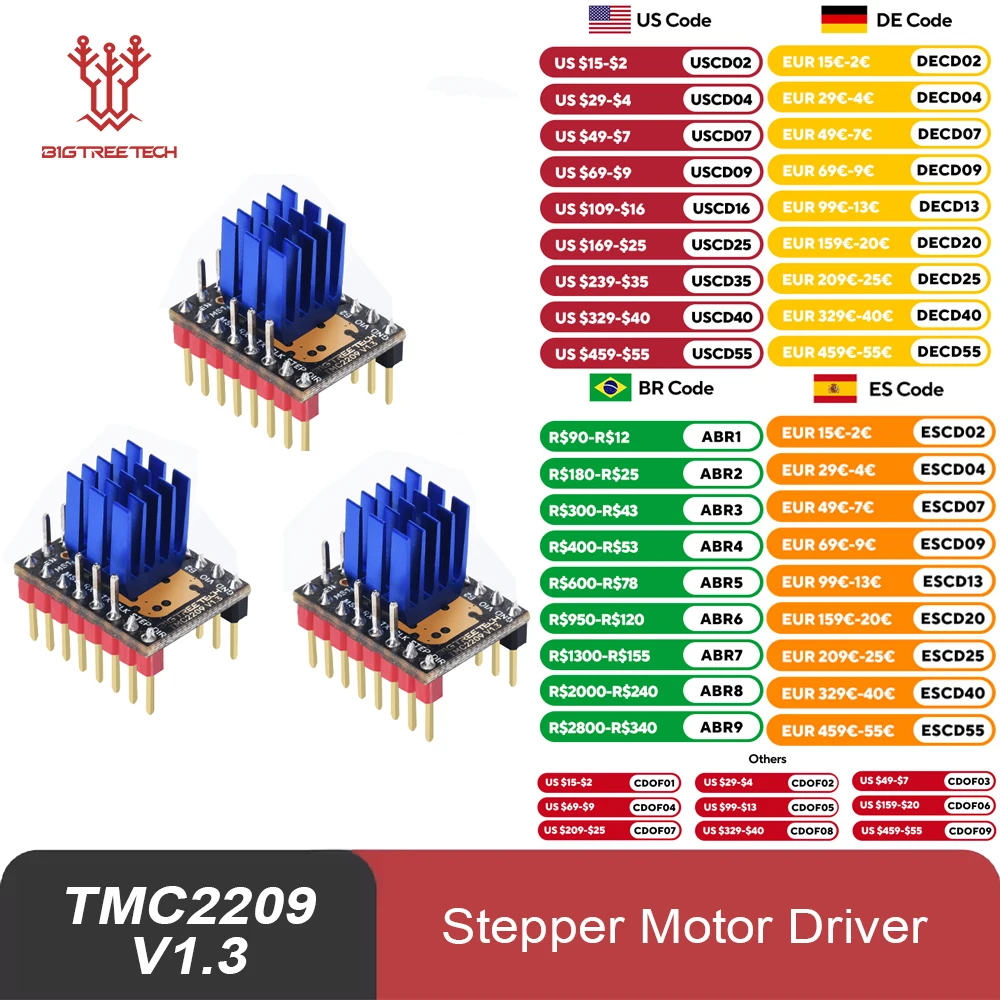
Each BIGTREETECH TMC2209 V1.3 module arrives with a pre-installed blue anodized aluminum heatsink, prominently visible on the chip. This heatsink is not merely decorative; it's a critical component in maintaining optimal operating temperatures for the driver IC. The PCB itself features an immersion gold process, indicating a higher quality manufacturing standard that ensures excellent electrical conductivity and corrosion resistance over time. This build quality is evident.
During extended print jobs, especially those lasting many hours or even days, effective heat dissipation becomes paramount. Overheated drivers can lead to skipped steps, layer shifts, or even permanent failure, ruining a print and potentially damaging the hardware. The robust heatsink and high-quality PCB work in concert to channel heat away from the sensitive electronics, allowing the driver to operate reliably under continuous load. Print consistency improves. This translates directly into a higher success rate for complex and lengthy prints, saving both material and time.
Many entry-level stepper drivers either omit heatsinks entirely or provide inadequate ones, forcing users to seek aftermarket cooling solutions. The integrated and effective thermal management of the TMC2209 V1.3 means users can trust the driver to perform without constant monitoring of its temperature. It's a thoughtful design choice. This focus on durability and stable operation differentiates it from less robust alternatives, offering a superior long-term value proposition.
A key differentiator for the TMC2209 V1.3 is its support for UART (Universal Asynchronous Receiver/Transmitter) communication. This digital interface allows the 3D printer's mainboard to communicate directly with the driver, enabling a suite of advanced features that are simply not possible with traditional STEP/DIR control. This offers immense flexibility. Features like StallGuard, CoolStep, and dynamic current adjustment become accessible through firmware.
StallGuard provides sensorless homing, eliminating the need for physical endstop switches on the X and Y axes. Imagine a cleaner build plate without wires running to limit switches, simplifying assembly and reducing potential points of failure. It can also detect filament runout or nozzle crashes, pausing the print to prevent damage. CoolStep dynamically adjusts the motor current based on load, reducing power consumption and heat generation when the motor is idle or under light load. This saves energy. These features empower users to fine-tune their printer's performance and enhance its safety.
While basic STEP/DIR drivers only receive pulse signals for step and direction, UART communication opens up a bidirectional data stream. This allows for real-time diagnostics, error reporting, and on-the-fly adjustment of parameters like microstep interpolation, motor current, and silent mode settings directly from the printer's firmware or control panel. This level of control is transformative. It's an upgrade from simply telling a motor to move to having a conversation with it, optimizing its behavior for every printing scenario.
The BIGTREETECH TMC2209 V1.3 is designed for broad compatibility with popular 3D printer mainboards, including the BIGTREETECH Octopus V1.1, SKR 2, and even the widely used Creality Ender 3 V2. Its standard pinout ensures it can drop into most existing driver sockets, though some mainboards may require specific jumpers or firmware configurations for full UART functionality. Installation is straightforward.
For educators introducing students to 3D printing, the ease of assembly and the enhanced safety features of these drivers are invaluable. The quiet operation creates a less intimidating and more conducive learning environment. Students can focus on the principles of design and additive manufacturing without being distracted by machine noise. The potential for sensorless homing simplifies the initial setup process, allowing students to get to printing faster. It reduces frustration. This helps in fostering a positive introduction to STEM fields.
Compared to more complex or less documented driver solutions, the TMC2209 V1.3, especially when paired with BIGTREETECH's well-supported mainboards, offers a more predictable and reliable learning platform. The extensive community support and documentation available for these drivers mean that troubleshooting and configuration guides are readily accessible, making it easier for both instructors and students to succeed. It's a robust choice. This simplifies the slicing workflow by ensuring the hardware reliably executes the G-code, removing a layer of complexity for new users.
With a maximum RMS phase current of 2.0A and native microstepping up to 1/256, the TMC2209 V1.3 delivers exceptional performance for even the most demanding 3D printing tasks. This high current capability ensures ample power for larger NEMA 17 stepper motors, common in core XY and large-format printers, preventing motor stalling under heavy loads. High current capacity is key. The fine microstepping resolution ensures that each motor rotation is divided into tiny, imperceptible movements, which translates directly into incredibly smooth diagonal lines and curves on printed objects.
Imagine printing a highly detailed miniature or a functional part with critical dimensions. The precision afforded by 1/256 microstepping means that layer lines are minimized, and surface finishes are remarkably smooth, reducing the need for post-processing. This level of detail is crucial for professional prototypes and high-quality artistic prints. The driver's ability to maintain consistent motor current and smooth motion even at higher speeds contributes to overall print reliability and accuracy. It works tirelessly.
In contrast, drivers with lower microstep interpolation (e.g., 1/16 or 1/32) often exhibit visible "salmon skin" artifacts on print surfaces, especially on flat areas. The TMC2209 V1.3 effectively mitigates these issues, producing prints that are visually superior and structurally more consistent. This makes a real difference. For applications where aesthetic quality and dimensional accuracy are paramount, the performance benefits of this driver are undeniable.
The construction of the BIGTREETECH TMC2209 V1.3, from its immersion gold PCB to its robust heatsink, speaks to a commitment to durability and longevity. These components are designed to withstand the continuous operation inherent in 3D printing, offering a reliable solution that minimizes the need for frequent replacements. This is a durable component. Investing in high-quality drivers like these reduces the overall cost of ownership by preventing print failures and extending the lifespan of the printer's motion system.
Consistent, reliable performance means fewer wasted prints due to driver-related issues, saving on filament costs and valuable printing time. For a school or workshop, this translates into more successful projects and less downtime for maintenance. The upfront cost, while slightly higher than basic drivers, is quickly recouped through improved efficiency and reduced material waste. It's a smart economic choice. The stability current reduction feature, for example, helps prolong motor life by optimizing power delivery.
Compared to selecting the cheapest available drivers, which often come with compromises in cooling, reliability, and advanced features, the TMC2209 V1.3 offers a compelling return on investment. Its advanced capabilities contribute to a more enjoyable and productive 3D printing experience, making it a worthwhile upgrade for any serious user. This driver is built to last.
Imagine your 3D printer operating with a newfound quietness, producing prints with astonishing detail and consistency. Picture a classroom where students are engaged, learning the intricacies of additive manufacturing without the distraction of noisy machines, confidently creating complex designs. This driver transforms the printing experience, turning potential frustrations into seamless creation, allowing you to focus purely on the innovation and joy of bringing digital models to life.
The Core of Motion Control
The TMC2209 V1.3 driver integrates the Trinamic TMC2209 chip, a sophisticated piece of silicon designed specifically for quiet and efficient stepper motor control. This chip supports up to 1/256 native microsteps, a significant leap in granularity for motor positioning. It's incredibly precise. The driver operates using a standard STEP/DIR interface but also boasts full UART communication capabilities.
When integrated into a 3D printer, the impact is immediately noticeable: the typically loud buzzing and grinding of stepper motors are dramatically reduced, often to near-inaudible levels. Imagine a classroom environment where multiple 3D printers are running simultaneously; the absence of constant motor noise allows for focused learning and instruction without distraction. This quietness is not just a comfort; it minimizes vibrations, contributing directly to smoother print surfaces and reduced artifacting. The printer simply purrs.
Compared to older generation drivers like the A4988 or even the popular DRV8825, the TMC2209 V1.3 offers a substantial upgrade. While those older drivers were functional, they often produced audible noise and lacked the advanced features for fine-tuning. The TMC2209, by contrast, brings a level of sophistication previously reserved for industrial applications, making high-quality, silent printing accessible to the consumer and educational market. This is a clear step forward.
Precision Engineering and Thermal Management
Each BIGTREETECH TMC2209 V1.3 module arrives with a pre-installed blue anodized aluminum heatsink, prominently visible on the chip. This heatsink is not merely decorative; it's a critical component in maintaining optimal operating temperatures for the driver IC. The PCB itself features an immersion gold process, indicating a higher quality manufacturing standard that ensures excellent electrical conductivity and corrosion resistance over time. This build quality is evident.
During extended print jobs, especially those lasting many hours or even days, effective heat dissipation becomes paramount. Overheated drivers can lead to skipped steps, layer shifts, or even permanent failure, ruining a print and potentially damaging the hardware. The robust heatsink and high-quality PCB work in concert to channel heat away from the sensitive electronics, allowing the driver to operate reliably under continuous load. Print consistency improves. This translates directly into a higher success rate for complex and lengthy prints, saving both material and time.
Many entry-level stepper drivers either omit heatsinks entirely or provide inadequate ones, forcing users to seek aftermarket cooling solutions. The integrated and effective thermal management of the TMC2209 V1.3 means users can trust the driver to perform without constant monitoring of its temperature. It's a thoughtful design choice. This focus on durability and stable operation differentiates it from less robust alternatives, offering a superior long-term value proposition.
Unlocking Advanced Capabilities with UART
A key differentiator for the TMC2209 V1.3 is its support for UART (Universal Asynchronous Receiver/Transmitter) communication. This digital interface allows the 3D printer's mainboard to communicate directly with the driver, enabling a suite of advanced features that are simply not possible with traditional STEP/DIR control. This offers immense flexibility. Features like StallGuard, CoolStep, and dynamic current adjustment become accessible through firmware.
StallGuard provides sensorless homing, eliminating the need for physical endstop switches on the X and Y axes. Imagine a cleaner build plate without wires running to limit switches, simplifying assembly and reducing potential points of failure. It can also detect filament runout or nozzle crashes, pausing the print to prevent damage. CoolStep dynamically adjusts the motor current based on load, reducing power consumption and heat generation when the motor is idle or under light load. This saves energy. These features empower users to fine-tune their printer's performance and enhance its safety.
While basic STEP/DIR drivers only receive pulse signals for step and direction, UART communication opens up a bidirectional data stream. This allows for real-time diagnostics, error reporting, and on-the-fly adjustment of parameters like microstep interpolation, motor current, and silent mode settings directly from the printer's firmware or control panel. This level of control is transformative. It's an upgrade from simply telling a motor to move to having a conversation with it, optimizing its behavior for every printing scenario.
Seamless Integration and Educational Value
The BIGTREETECH TMC2209 V1.3 is designed for broad compatibility with popular 3D printer mainboards, including the BIGTREETECH Octopus V1.1, SKR 2, and even the widely used Creality Ender 3 V2. Its standard pinout ensures it can drop into most existing driver sockets, though some mainboards may require specific jumpers or firmware configurations for full UART functionality. Installation is straightforward.
For educators introducing students to 3D printing, the ease of assembly and the enhanced safety features of these drivers are invaluable. The quiet operation creates a less intimidating and more conducive learning environment. Students can focus on the principles of design and additive manufacturing without being distracted by machine noise. The potential for sensorless homing simplifies the initial setup process, allowing students to get to printing faster. It reduces frustration. This helps in fostering a positive introduction to STEM fields.
Compared to more complex or less documented driver solutions, the TMC2209 V1.3, especially when paired with BIGTREETECH's well-supported mainboards, offers a more predictable and reliable learning platform. The extensive community support and documentation available for these drivers mean that troubleshooting and configuration guides are readily accessible, making it easier for both instructors and students to succeed. It's a robust choice. This simplifies the slicing workflow by ensuring the hardware reliably executes the G-code, removing a layer of complexity for new users.
Performance Under Pressure
With a maximum RMS phase current of 2.0A and native microstepping up to 1/256, the TMC2209 V1.3 delivers exceptional performance for even the most demanding 3D printing tasks. This high current capability ensures ample power for larger NEMA 17 stepper motors, common in core XY and large-format printers, preventing motor stalling under heavy loads. High current capacity is key. The fine microstepping resolution ensures that each motor rotation is divided into tiny, imperceptible movements, which translates directly into incredibly smooth diagonal lines and curves on printed objects.
Imagine printing a highly detailed miniature or a functional part with critical dimensions. The precision afforded by 1/256 microstepping means that layer lines are minimized, and surface finishes are remarkably smooth, reducing the need for post-processing. This level of detail is crucial for professional prototypes and high-quality artistic prints. The driver's ability to maintain consistent motor current and smooth motion even at higher speeds contributes to overall print reliability and accuracy. It works tirelessly.
In contrast, drivers with lower microstep interpolation (e.g., 1/16 or 1/32) often exhibit visible "salmon skin" artifacts on print surfaces, especially on flat areas. The TMC2209 V1.3 effectively mitigates these issues, producing prints that are visually superior and structurally more consistent. This makes a real difference. For applications where aesthetic quality and dimensional accuracy are paramount, the performance benefits of this driver are undeniable.
The Long-Term Investment
The construction of the BIGTREETECH TMC2209 V1.3, from its immersion gold PCB to its robust heatsink, speaks to a commitment to durability and longevity. These components are designed to withstand the continuous operation inherent in 3D printing, offering a reliable solution that minimizes the need for frequent replacements. This is a durable component. Investing in high-quality drivers like these reduces the overall cost of ownership by preventing print failures and extending the lifespan of the printer's motion system.
Consistent, reliable performance means fewer wasted prints due to driver-related issues, saving on filament costs and valuable printing time. For a school or workshop, this translates into more successful projects and less downtime for maintenance. The upfront cost, while slightly higher than basic drivers, is quickly recouped through improved efficiency and reduced material waste. It's a smart economic choice. The stability current reduction feature, for example, helps prolong motor life by optimizing power delivery.
Compared to selecting the cheapest available drivers, which often come with compromises in cooling, reliability, and advanced features, the TMC2209 V1.3 offers a compelling return on investment. Its advanced capabilities contribute to a more enjoyable and productive 3D printing experience, making it a worthwhile upgrade for any serious user. This driver is built to last.
Imagine your 3D printer operating with a newfound quietness, producing prints with astonishing detail and consistency. Picture a classroom where students are engaged, learning the intricacies of additive manufacturing without the distraction of noisy machines, confidently creating complex designs. This driver transforms the printing experience, turning potential frustrations into seamless creation, allowing you to focus purely on the innovation and joy of bringing digital models to life.