BIGTREETECH TMC2209 V1.3 Stepper Motor Driver
Official Store Deal
Expert Analysis Overview
The BIGTREETECH TMC2209 V1.3 Stepper Motor Driver is a crucial upgrade component for 3D printer enthusiasts and makers who prioritize silent operation and precise motion control in their projects. This advanced driver, developed by Trinamic, is engineered to replace noisier, less efficient predecessors, offering a significant leap in printing experience and capability. Its integration allows for a more refined control over stepper motors, translating directly into smoother movements and higher quality prints.
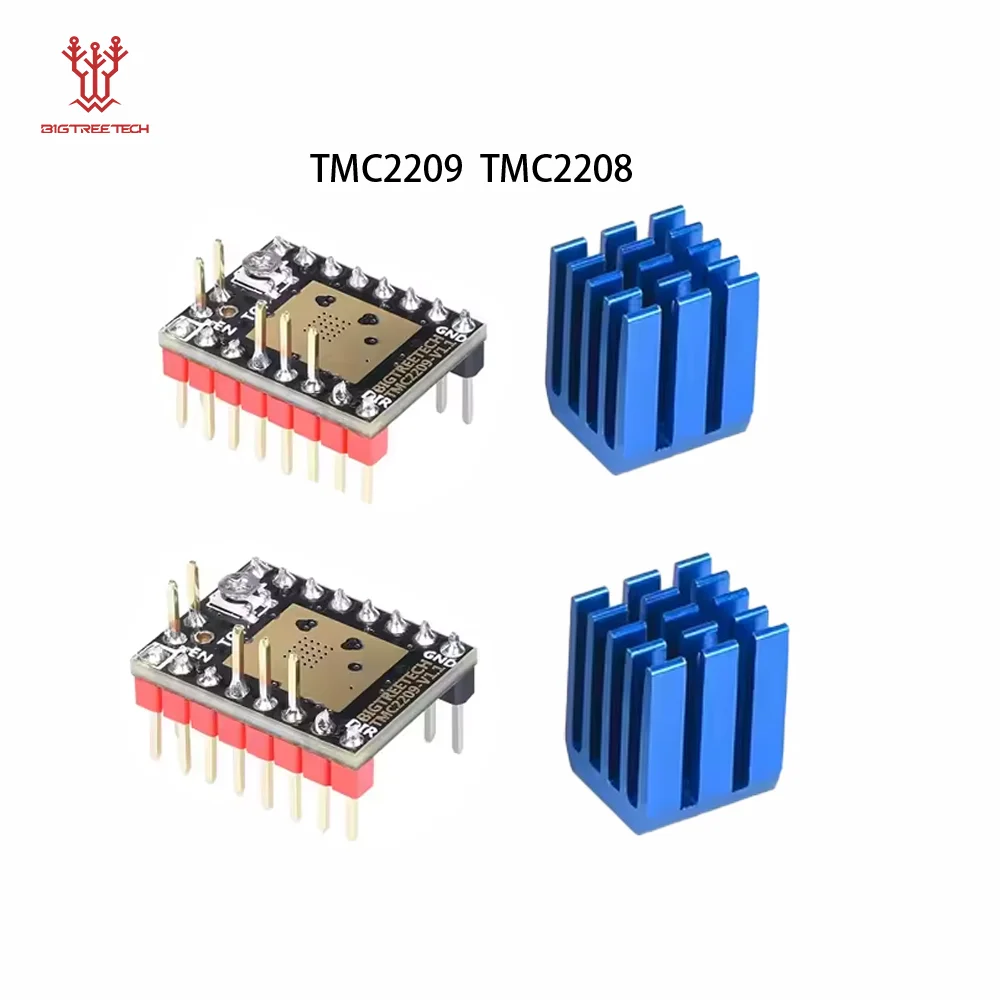
Visible in the images are the compact TMC2209 modules, each featuring a central integrated circuit chip, surrounded by various passive components, and equipped with standard pin headers for easy insertion into a mainboard. The accompanying blue aluminum heatsinks are a clear indicator of the driver's ability to handle higher current loads, a necessary feature for powerful stepper motors.
These components collectively imply a system designed for robust and sustained operation. The driver's primary function is to translate digital control signals from the printer's mainboard into precise analog current pulses for the stepper motor. This translation is critical for determining the motor's speed, direction, and most importantly, its microstepping resolution, which directly impacts print quality and operational noise. Unlike older, more rudimentary drivers, the TMC2209 aims for an experience where the stepper motors are heard minimally, if at all.
Compared to standard entry-level drivers such as the A4988 or DRV8825, the TMC2209 represents a fundamental shift in stepper motor control. Older drivers often rely on simpler chopper algorithms that generate audible noise and can lead to increased motor vibration. This driver, however, leverages sophisticated technologies to mitigate these issues, providing a noticeably quieter and smoother mechanical operation. This is not merely a comfort feature; reduced vibration can also extend the lifespan of mechanical components in a 3D printer.
At the core of the TMC2209's appeal are its advanced operating modes, primarily StealthChop2 and SpreadCycle. StealthChop2 is a voltage mode chopper specifically optimized for silent operation at low speeds, virtually eliminating audible motor noise during slow movements like bed leveling or initial print layers. SpreadCycle, on the other hand, is a current-controlled chopper that provides highly dynamic motion and high torque, particularly beneficial for faster printing speeds where power and responsiveness are paramount.
The implementation of these modes means that a 3D printer can operate with a level of acoustic discretion previously unattainable with standard drivers. Imagine a scenario where print completion is signaled by the printer stopping, rather than by hours of whirring and grinding. This quiet operation significantly enhances the usability of a 3D printer in shared living spaces or workshops. The precision offered by high microstepping capabilities, interpolated up to 256 microsteps, allows for incredibly fine motor movements, which minimizes visible layer lines and improves the overall surface finish of printed parts. Small movements matter.
Drivers lacking these advanced features often produce a characteristic high-pitched whine or grinding sound, especially during rapid acceleration and deceleration. This noise is not only distracting but also indicative of less efficient motor control, which can manifest as ringing or ghosting artifacts on printed surfaces. The TMC2209 addresses these common pain points by providing a smoother, more controlled current waveform to the motor coils, resulting in less mechanical stress and improved print fidelity. It's a foundational component for any high-quality printing setup.
The TMC2209 V1.3 driver distinguishes itself with its support for UART (Universal Asynchronous Receiver/Transmitter) communication. While not explicitly visible as a dedicated port, the pinout on the module supports this serial interface, allowing for software-based configuration. This means that instead of relying on physical jumpers or potentiometers to set parameters like microstepping and motor current, these settings can be dynamically adjusted through the printer's firmware.
The benefits of UART extend far beyond simple parameter adjustment. It allows for advanced features such as dynamic current control, where the motor current can be reduced when the motor is idle, decreasing heat generation and power consumption. Additionally, UART provides diagnostic feedback, allowing the mainboard to monitor the driver's status, including temperature and error conditions. This level of control and feedback is invaluable for optimizing printer performance, troubleshooting issues, and implementing sophisticated motion profiles. Firmware adjustments are key.
This open configurability through UART sets the TMC2209 apart from many fixed-mode drivers. With older drivers, changing microstepping or current often required physically manipulating jumpers or turning tiny potentiometers, a process that was both tedious and prone to error. The ability to fine-tune these parameters via firmware not only simplifies the tuning process but also enables more experimental setups and custom optimizations, a true boon for the maker community. It allows for a more integrated and intelligent printer system.
The inclusion of blue aluminum heatsinks with each driver module is a critical aspect of its design, acknowledging the importance of thermal management in high-performance electronics. Stepper motor drivers generate heat as they regulate current, and this heat needs to be efficiently dissipated to ensure stable operation and longevity. The heatsinks are designed to increase the surface area for heat exchange, allowing the driver chip to run cooler.
Effective heat dissipation has a direct impact on the driver's performance and lifespan. Excessive heat can lead to thermal throttling, where the driver automatically reduces its current output to prevent damage, potentially causing skipped steps and failed prints. In extreme cases, sustained overheating can permanently damage the integrated circuit. The heatsinks, when properly applied with thermal adhesive, significantly reduce the risk of such issues, allowing the driver to maintain its specified current output consistently, even during long printing jobs. Stable temperatures mean stable prints.
For high-current applications, such as driving large NEMA 17 or NEMA 23 stepper motors, passive heatsinks alone may not be sufficient. In such scenarios, active cooling, typically in the form of a dedicated fan directed at the driver board, becomes essential. Unlike applications with lower current demands where a heatsink might be optional, for 3D printing, especially with fast print speeds and demanding movements, proper cooling is a non-negotiable requirement for the TMC2209 to perform reliably and to its full potential. The included heatsinks are a good starting point, but system-level cooling must be considered.
The visible quality of the PCB (Printed Circuit Board) and the soldering points on the TMC2209 modules suggest a robust construction suitable for the demands of a DIY workshop environment. The compact form factor, consistent with the StepStick standard, ensures compatibility with a wide range of mainboards without requiring excessive space. The components appear well-integrated, indicating a manufacturing process focused on reliability.
This build quality implies that the drivers can withstand the typical handling and installation processes encountered by makers. In a hobby where components are frequently swapped, tested, and reconfigured, the physical resilience of the driver is an important consideration. A well-constructed PCB minimizes the risk of cold solder joints or component detachment, issues that can lead to intermittent failures and frustrating troubleshooting sessions. Reliability is paramount.
The overall build quality observed aligns with the expectations within the 3D printing enthusiast market. While these are not industrial-grade components designed for extreme environments, they meet the necessary standards for home and small-scale workshop use. This balance of cost-effectiveness and functional durability makes them a popular choice for upgrades and new builds, providing a reliable foundation for precise motion control. It's a standard that the community trusts.
The BIGTREETECH TMC2209 V1.3 boasts extensive compatibility with popular 3D printer mainboards, including the BTT Octopus, SKR V1.4, SKR Mini E3, and even specific printer models like the Ender 3 V2 and Voron 2.4. This broad compatibility is a significant advantage for the maker community, as it ensures that documentation, firmware examples, and troubleshooting guides are readily available across various platforms.
Such widespread adoption within the community greatly aids in the modification and improvement of machines over time. When encountering an issue or seeking to optimize performance, users can tap into a vast pool of shared knowledge and experience. This community support is invaluable, providing solutions to common problems and fostering innovation through shared configurations and custom firmware modifications. Collaboration accelerates progress.
Unlike niche or proprietary components that might leave users isolated, the TMC2209's popularity means that experimenting with custom parts and configurations is well-supported. Whether upgrading an existing printer or building a new one from scratch, the abundance of resources helps reduce the learning curve and potential frustrations associated with new hardware. This accessibility to community troubleshooting and custom part experimentation makes the TMC2209 a cornerstone for open-source 3D printing projects. It's truly a community-backed component.
A common frustration for many 3D printer owners is the inherent noise generated by stepper motors, especially during long print jobs. This constant mechanical hum can make printing in living spaces or shared offices impractical. The TMC2209 directly addresses this pain point by offering a solution that transforms a noisy machine into a remarkably quiet one, enhancing the overall user experience.
The direct solution provided by this driver is not just about comfort; it's about elevating the entire printing process. By reducing vibrations, the TMC2209 contributes to better print quality by minimizing artifacts that can arise from mechanical resonance. This translates into cleaner, more aesthetically pleasing models and functional parts. The investment in these drivers often pays dividends in terms of improved output and a more enjoyable interaction with the 3D printer. It's a noticeable improvement.
Investing in quality stepper drivers like the TMC2209 offers long-term value beyond the initial purchase price. The improved efficiency can lead to less wear and tear on mechanical components, potentially extending the life of the printer itself. Furthermore, the enhanced print quality reduces the need for reprints due to imperfections, saving both time and material. This component allows for a significant upgrade in capability, enabling users to achieve higher standards in their 3D printing endeavors with less fuss and more satisfaction. Imagine the tranquility of a nearly silent printer, churning out flawless parts while you work or relax, unbothered by mechanical chatter. This is the quiet revolution the TMC2209 brings to your workspace, transforming a utility into a seamless extension of your creative process.
The Heart of Motion Control: Stepper Driver Evolution
Visible in the images are the compact TMC2209 modules, each featuring a central integrated circuit chip, surrounded by various passive components, and equipped with standard pin headers for easy insertion into a mainboard. The accompanying blue aluminum heatsinks are a clear indicator of the driver's ability to handle higher current loads, a necessary feature for powerful stepper motors.
These components collectively imply a system designed for robust and sustained operation. The driver's primary function is to translate digital control signals from the printer's mainboard into precise analog current pulses for the stepper motor. This translation is critical for determining the motor's speed, direction, and most importantly, its microstepping resolution, which directly impacts print quality and operational noise. Unlike older, more rudimentary drivers, the TMC2209 aims for an experience where the stepper motors are heard minimally, if at all.
Compared to standard entry-level drivers such as the A4988 or DRV8825, the TMC2209 represents a fundamental shift in stepper motor control. Older drivers often rely on simpler chopper algorithms that generate audible noise and can lead to increased motor vibration. This driver, however, leverages sophisticated technologies to mitigate these issues, providing a noticeably quieter and smoother mechanical operation. This is not merely a comfort feature; reduced vibration can also extend the lifespan of mechanical components in a 3D printer.
Engineering for Silence and Precision
At the core of the TMC2209's appeal are its advanced operating modes, primarily StealthChop2 and SpreadCycle. StealthChop2 is a voltage mode chopper specifically optimized for silent operation at low speeds, virtually eliminating audible motor noise during slow movements like bed leveling or initial print layers. SpreadCycle, on the other hand, is a current-controlled chopper that provides highly dynamic motion and high torque, particularly beneficial for faster printing speeds where power and responsiveness are paramount.
The implementation of these modes means that a 3D printer can operate with a level of acoustic discretion previously unattainable with standard drivers. Imagine a scenario where print completion is signaled by the printer stopping, rather than by hours of whirring and grinding. This quiet operation significantly enhances the usability of a 3D printer in shared living spaces or workshops. The precision offered by high microstepping capabilities, interpolated up to 256 microsteps, allows for incredibly fine motor movements, which minimizes visible layer lines and improves the overall surface finish of printed parts. Small movements matter.
Drivers lacking these advanced features often produce a characteristic high-pitched whine or grinding sound, especially during rapid acceleration and deceleration. This noise is not only distracting but also indicative of less efficient motor control, which can manifest as ringing or ghosting artifacts on printed surfaces. The TMC2209 addresses these common pain points by providing a smoother, more controlled current waveform to the motor coils, resulting in less mechanical stress and improved print fidelity. It's a foundational component for any high-quality printing setup.
The Tinker's Toolkit: Configurability and Integration
The TMC2209 V1.3 driver distinguishes itself with its support for UART (Universal Asynchronous Receiver/Transmitter) communication. While not explicitly visible as a dedicated port, the pinout on the module supports this serial interface, allowing for software-based configuration. This means that instead of relying on physical jumpers or potentiometers to set parameters like microstepping and motor current, these settings can be dynamically adjusted through the printer's firmware.
The benefits of UART extend far beyond simple parameter adjustment. It allows for advanced features such as dynamic current control, where the motor current can be reduced when the motor is idle, decreasing heat generation and power consumption. Additionally, UART provides diagnostic feedback, allowing the mainboard to monitor the driver's status, including temperature and error conditions. This level of control and feedback is invaluable for optimizing printer performance, troubleshooting issues, and implementing sophisticated motion profiles. Firmware adjustments are key.
This open configurability through UART sets the TMC2209 apart from many fixed-mode drivers. With older drivers, changing microstepping or current often required physically manipulating jumpers or turning tiny potentiometers, a process that was both tedious and prone to error. The ability to fine-tune these parameters via firmware not only simplifies the tuning process but also enables more experimental setups and custom optimizations, a true boon for the maker community. It allows for a more integrated and intelligent printer system.
Thermal Management: Keeping Cool Under Pressure
The inclusion of blue aluminum heatsinks with each driver module is a critical aspect of its design, acknowledging the importance of thermal management in high-performance electronics. Stepper motor drivers generate heat as they regulate current, and this heat needs to be efficiently dissipated to ensure stable operation and longevity. The heatsinks are designed to increase the surface area for heat exchange, allowing the driver chip to run cooler.
Effective heat dissipation has a direct impact on the driver's performance and lifespan. Excessive heat can lead to thermal throttling, where the driver automatically reduces its current output to prevent damage, potentially causing skipped steps and failed prints. In extreme cases, sustained overheating can permanently damage the integrated circuit. The heatsinks, when properly applied with thermal adhesive, significantly reduce the risk of such issues, allowing the driver to maintain its specified current output consistently, even during long printing jobs. Stable temperatures mean stable prints.
For high-current applications, such as driving large NEMA 17 or NEMA 23 stepper motors, passive heatsinks alone may not be sufficient. In such scenarios, active cooling, typically in the form of a dedicated fan directed at the driver board, becomes essential. Unlike applications with lower current demands where a heatsink might be optional, for 3D printing, especially with fast print speeds and demanding movements, proper cooling is a non-negotiable requirement for the TMC2209 to perform reliably and to its full potential. The included heatsinks are a good starting point, but system-level cooling must be considered.
Robustness for the Workshop
The visible quality of the PCB (Printed Circuit Board) and the soldering points on the TMC2209 modules suggest a robust construction suitable for the demands of a DIY workshop environment. The compact form factor, consistent with the StepStick standard, ensures compatibility with a wide range of mainboards without requiring excessive space. The components appear well-integrated, indicating a manufacturing process focused on reliability.
This build quality implies that the drivers can withstand the typical handling and installation processes encountered by makers. In a hobby where components are frequently swapped, tested, and reconfigured, the physical resilience of the driver is an important consideration. A well-constructed PCB minimizes the risk of cold solder joints or component detachment, issues that can lead to intermittent failures and frustrating troubleshooting sessions. Reliability is paramount.
The overall build quality observed aligns with the expectations within the 3D printing enthusiast market. While these are not industrial-grade components designed for extreme environments, they meet the necessary standards for home and small-scale workshop use. This balance of cost-effectiveness and functional durability makes them a popular choice for upgrades and new builds, providing a reliable foundation for precise motion control. It's a standard that the community trusts.
Community and Customization Potential
The BIGTREETECH TMC2209 V1.3 boasts extensive compatibility with popular 3D printer mainboards, including the BTT Octopus, SKR V1.4, SKR Mini E3, and even specific printer models like the Ender 3 V2 and Voron 2.4. This broad compatibility is a significant advantage for the maker community, as it ensures that documentation, firmware examples, and troubleshooting guides are readily available across various platforms.
Such widespread adoption within the community greatly aids in the modification and improvement of machines over time. When encountering an issue or seeking to optimize performance, users can tap into a vast pool of shared knowledge and experience. This community support is invaluable, providing solutions to common problems and fostering innovation through shared configurations and custom firmware modifications. Collaboration accelerates progress.
Unlike niche or proprietary components that might leave users isolated, the TMC2209's popularity means that experimenting with custom parts and configurations is well-supported. Whether upgrading an existing printer or building a new one from scratch, the abundance of resources helps reduce the learning curve and potential frustrations associated with new hardware. This accessibility to community troubleshooting and custom part experimentation makes the TMC2209 a cornerstone for open-source 3D printing projects. It's truly a community-backed component.
The Upgrade Path: From Stock to Stellar
A common frustration for many 3D printer owners is the inherent noise generated by stepper motors, especially during long print jobs. This constant mechanical hum can make printing in living spaces or shared offices impractical. The TMC2209 directly addresses this pain point by offering a solution that transforms a noisy machine into a remarkably quiet one, enhancing the overall user experience.
The direct solution provided by this driver is not just about comfort; it's about elevating the entire printing process. By reducing vibrations, the TMC2209 contributes to better print quality by minimizing artifacts that can arise from mechanical resonance. This translates into cleaner, more aesthetically pleasing models and functional parts. The investment in these drivers often pays dividends in terms of improved output and a more enjoyable interaction with the 3D printer. It's a noticeable improvement.
Investing in quality stepper drivers like the TMC2209 offers long-term value beyond the initial purchase price. The improved efficiency can lead to less wear and tear on mechanical components, potentially extending the life of the printer itself. Furthermore, the enhanced print quality reduces the need for reprints due to imperfections, saving both time and material. This component allows for a significant upgrade in capability, enabling users to achieve higher standards in their 3D printing endeavors with less fuss and more satisfaction. Imagine the tranquility of a nearly silent printer, churning out flawless parts while you work or relax, unbothered by mechanical chatter. This is the quiet revolution the TMC2209 brings to your workspace, transforming a utility into a seamless extension of your creative process.