BIGTREETECH Belter Digital Belt Tension Tool
Official Store Deal
Expert Analysis Overview
The BIGTREETECH Belter is a precision digital belt tension tool engineered for the meticulous 3D printer enthusiast. This device stands as a significant upgrade over subjective manual methods or less consistent frequency-based phone applications, offering a tangible, repeatable measurement of belt tension. It's a critical instrument for anyone aiming to achieve flawless print quality and maintain the optimal performance of their 3D printer, particularly for CoreXY machines like the Voron V2.4 where belt tension directly impacts dimensional accuracy and surface finish.
The Belter's primary visual feature is its digital display, providing an immediate, unambiguous numerical reading. This numerical output eliminates the guesswork associated with traditional 'pluck' tests, which rely on auditory interpretation or subjective feel. A consistent measurement is paramount.
This immediate digital feedback translates directly into a more efficient and accurate calibration process. Users can adjust belt tension with confidence, knowing the exact force applied across the belt. The tool ensures that each belt on the printer, whether it's the X or Y axis, can be set to an identical tension value, a factor often overlooked but crucial for preventing print artifacts.
Compared to rudimentary analog spring gauges or even sophisticated smartphone apps that measure belt frequency, this direct force measurement offers a more robust and less environmentally susceptible reading. Ambient noise doesn't interfere. It's a more direct approach to force measurement.
Proper belt tension in a 3D printer, especially CoreXY kinematics, is not merely a suggestion; it is a fundamental requirement for print quality. Imbalances or inconsistencies in belt tension manifest as visible defects in printed objects, such as ghosting (repeating patterns of features), ringing (vibrations appearing as ripples), or even layer shifts (misaligned layers).
When belts are too loose, they can skip teeth on pulleys, leading to inaccurate positioning and dimensional errors. Conversely, overly tight belts introduce excessive strain on motors, bearings, and printer frames, potentially leading to premature wear, increased noise, and reduced motor lifespan. Finding the sweet spot is vital.
This tool allows for precise adjustments that mitigate these issues. By providing a quantifiable metric, it empowers users to troubleshoot print quality issues with an objective reference point. The ability to return to a known good tension setting after maintenance or modifications is invaluable for consistent results.
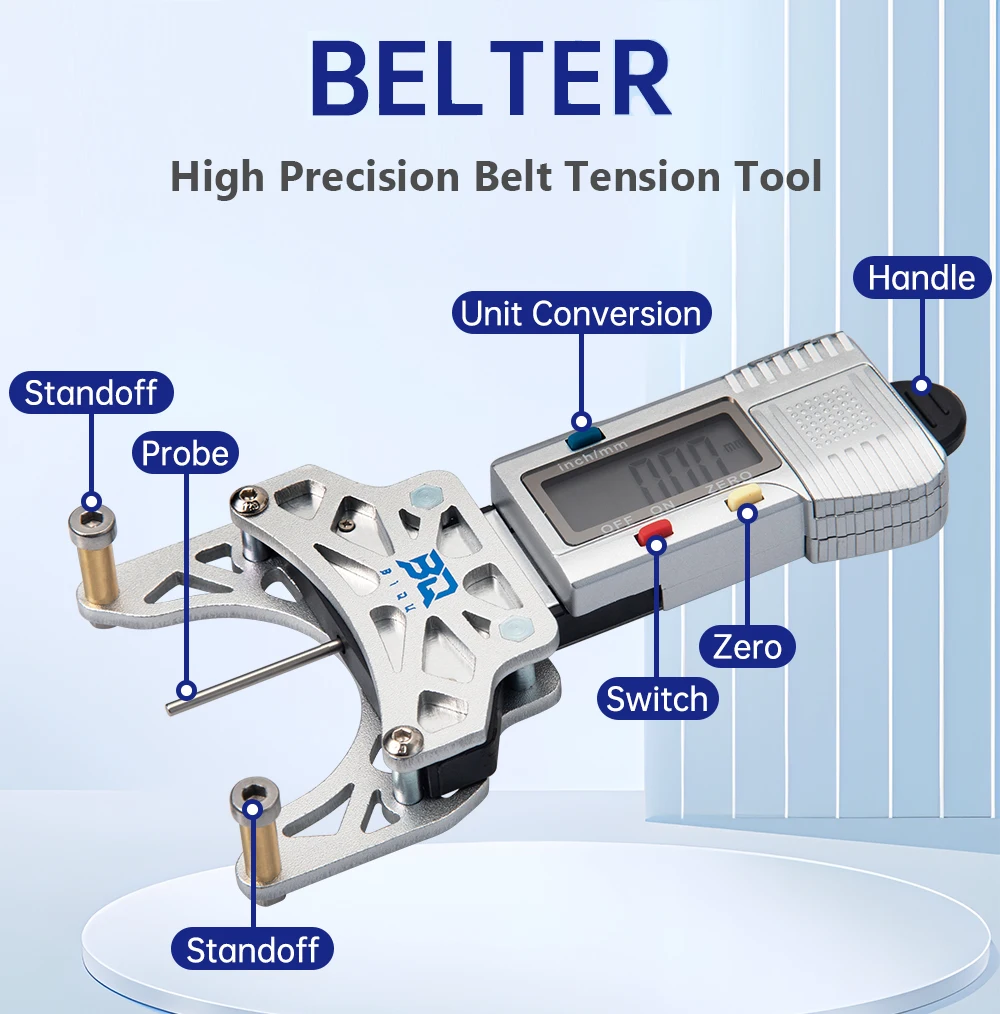
The tool's design incorporates an ergonomic handle, visible in the provided images, which suggests a comfortable and secure grip during operation. This is not a trivial detail; maintaining a steady hand is essential for obtaining consistent measurements. The handle's shape appears to facilitate single-handed use, freeing the other hand for belt adjustments.
Comfortable handling directly influences the repeatability of measurements. A user can apply consistent pressure to the probe without undue strain or awkward positioning, leading to more reliable data. This thoughtful design minimizes user fatigue during lengthy tuning sessions.
Unlike tools with awkward grips or small, hard-to-read displays, the Belter prioritizes user experience. Its clear LCD display is easily visible, even in less-than-ideal workshop lighting. Readability is never an issue.
Visible controls include a unit conversion button, a zero button, and a switch (power) button. These simple, clearly labeled controls enhance usability significantly. The unit conversion feature allows adaptability to different measurement preferences or community standards, for example, switching between grams-force and Newtons.
The zero function is particularly useful for relative measurements or for establishing a baseline for a specific belt type or printer configuration. This allows for quick calibration and consistent comparisons across multiple belts or adjustments over time. Zeroing out is a quick process.
Such intuitive controls reduce the learning curve, making the tool accessible even for those new to precise 3D printer calibration. It streamlines the tuning process, allowing more time for printing and less time struggling with measurement tools. This design philosophy aligns well with the DIY and tinkering culture of 3D printing.
The BIGTREETECH Belter features a visible aluminum alloy frame, suggesting a robust and durable construction. This metal body provides a rigid platform for the measurement mechanism, ensuring accuracy and resisting deformation over time. A sturdy frame is crucial.
Such material choices imply a tool built to withstand the rigors of a busy workshop environment. It is less prone to flex or breakage compared to tools made entirely of plastic, which can degrade with repeated use or accidental drops. The visible metal components speak to a long service life.
This robust construction positions the Belter as a long-term investment for serious makers. Unlike cheaper, all-plastic alternatives that might offer inconsistent readings or break under pressure, the Belter's materials promise enduring precision. It's built for the long haul.
Key to its functionality is the precision probe, a slender rod that makes direct contact with the belt. The design ensures a consistent contact point and minimizes interference from surrounding components. The probe's thin profile allows it to access belts in confined spaces, common in compact 3D printer designs.
The probe works in conjunction with the standoffs, which appear to provide stable contact points against the printer frame or structure. These standoffs help ensure the tool is held perpendicular to the belt, preventing skewed readings. Proper alignment is critical.
This combination of probe and standoffs contributes to the tool's repeatability. Without such features, users might struggle to apply the tool consistently, leading to varied measurements even on a perfectly tensioned belt. The design promotes accurate and consistent application.
For the maker and tinkerer, the Belter offers more than just a measurement; it provides data for iterative improvement and experimentation. The ability to precisely quantify belt tension allows for systematic testing of different belt types, pulley materials, or motor configurations. Data-driven decisions become possible.
Within communities like the Voron ecosystem, where users frequently share build logs, tuning guides, and troubleshooting tips, a tool like the Belter becomes indispensable. Sharing precise tension values helps others replicate successful setups or diagnose issues more effectively. It fosters collaborative problem-solving.
When experimenting with custom parts or modifications, the Belter provides a baseline. If a new motor or idler is installed, the user can ensure the belts are tensioned to the same specifications as before, isolating the impact of the new component. This facilitates controlled experimentation.
The longevity and consistent performance of a 3D printer are heavily dependent on proper maintenance, and belt tension is a significant part of that regimen. Belts can stretch over time, especially new ones, or lose tension due to vibrations during printing. Regular checks are necessary.
Implementing the Belter into a routine maintenance schedule can proactively prevent print quality degradation. Instead of waiting for visible print defects to appear, users can periodically check and adjust belt tension, ensuring the printer operates at its peak. Prevention is better than cure.
This proactive approach saves time and filament in the long run by reducing failed prints and the need for extensive troubleshooting. The investment in a precision tool like the Belter pays dividends through consistent output and reduced frustration. It's a smart operational choice.
The BIGTREETECH Belter's value proposition extends far beyond the initial build of a printer. For those who frequently build, modify, or maintain multiple 3D printers, the tool becomes a cornerstone of their calibration kit. Its consistent performance ensures reliable results across different machines. It's a reliable workshop staple.
The robust construction and digital precision mean the tool itself will remain accurate and functional for years, outlasting many of the components it helps calibrate. This long-term reliability reinforces its position as a wise investment for any serious 3D printing hobbyist or professional. Durability ensures lasting utility.
Imagine printing complex parts with unwavering accuracy, knowing every belt is perfectly tensioned and your machine is operating at its peak potential. Visualize the satisfaction of sharing precise tuning data with a global community, contributing to the collective knowledge of 3D printing. This tool isn't just about measuring; it's about enabling a higher standard of craftsmanship and fostering a deeper engagement with the mechanics of 3D printing, allowing you to focus on innovation and creation rather than constant troubleshooting. The Belter empowers consistent, high-fidelity production for all your additive manufacturing endeavors.
Achieving Precision: The Belter's Core Function
The Belter's primary visual feature is its digital display, providing an immediate, unambiguous numerical reading. This numerical output eliminates the guesswork associated with traditional 'pluck' tests, which rely on auditory interpretation or subjective feel. A consistent measurement is paramount.
This immediate digital feedback translates directly into a more efficient and accurate calibration process. Users can adjust belt tension with confidence, knowing the exact force applied across the belt. The tool ensures that each belt on the printer, whether it's the X or Y axis, can be set to an identical tension value, a factor often overlooked but crucial for preventing print artifacts.
Compared to rudimentary analog spring gauges or even sophisticated smartphone apps that measure belt frequency, this direct force measurement offers a more robust and less environmentally susceptible reading. Ambient noise doesn't interfere. It's a more direct approach to force measurement.
The Importance of Consistent Tension
Proper belt tension in a 3D printer, especially CoreXY kinematics, is not merely a suggestion; it is a fundamental requirement for print quality. Imbalances or inconsistencies in belt tension manifest as visible defects in printed objects, such as ghosting (repeating patterns of features), ringing (vibrations appearing as ripples), or even layer shifts (misaligned layers).
When belts are too loose, they can skip teeth on pulleys, leading to inaccurate positioning and dimensional errors. Conversely, overly tight belts introduce excessive strain on motors, bearings, and printer frames, potentially leading to premature wear, increased noise, and reduced motor lifespan. Finding the sweet spot is vital.
This tool allows for precise adjustments that mitigate these issues. By providing a quantifiable metric, it empowers users to troubleshoot print quality issues with an objective reference point. The ability to return to a known good tension setting after maintenance or modifications is invaluable for consistent results.
Ergonomics and Display Clarity
The tool's design incorporates an ergonomic handle, visible in the provided images, which suggests a comfortable and secure grip during operation. This is not a trivial detail; maintaining a steady hand is essential for obtaining consistent measurements. The handle's shape appears to facilitate single-handed use, freeing the other hand for belt adjustments.
Comfortable handling directly influences the repeatability of measurements. A user can apply consistent pressure to the probe without undue strain or awkward positioning, leading to more reliable data. This thoughtful design minimizes user fatigue during lengthy tuning sessions.
Unlike tools with awkward grips or small, hard-to-read displays, the Belter prioritizes user experience. Its clear LCD display is easily visible, even in less-than-ideal workshop lighting. Readability is never an issue.
Intuitive Controls for the Maker
Visible controls include a unit conversion button, a zero button, and a switch (power) button. These simple, clearly labeled controls enhance usability significantly. The unit conversion feature allows adaptability to different measurement preferences or community standards, for example, switching between grams-force and Newtons.
The zero function is particularly useful for relative measurements or for establishing a baseline for a specific belt type or printer configuration. This allows for quick calibration and consistent comparisons across multiple belts or adjustments over time. Zeroing out is a quick process.
Such intuitive controls reduce the learning curve, making the tool accessible even for those new to precise 3D printer calibration. It streamlines the tuning process, allowing more time for printing and less time struggling with measurement tools. This design philosophy aligns well with the DIY and tinkering culture of 3D printing.
Construction and Longevity
The BIGTREETECH Belter features a visible aluminum alloy frame, suggesting a robust and durable construction. This metal body provides a rigid platform for the measurement mechanism, ensuring accuracy and resisting deformation over time. A sturdy frame is crucial.
Such material choices imply a tool built to withstand the rigors of a busy workshop environment. It is less prone to flex or breakage compared to tools made entirely of plastic, which can degrade with repeated use or accidental drops. The visible metal components speak to a long service life.
This robust construction positions the Belter as a long-term investment for serious makers. Unlike cheaper, all-plastic alternatives that might offer inconsistent readings or break under pressure, the Belter's materials promise enduring precision. It's built for the long haul.
The Precision Probe and Standoffs
Key to its functionality is the precision probe, a slender rod that makes direct contact with the belt. The design ensures a consistent contact point and minimizes interference from surrounding components. The probe's thin profile allows it to access belts in confined spaces, common in compact 3D printer designs.
The probe works in conjunction with the standoffs, which appear to provide stable contact points against the printer frame or structure. These standoffs help ensure the tool is held perpendicular to the belt, preventing skewed readings. Proper alignment is critical.
This combination of probe and standoffs contributes to the tool's repeatability. Without such features, users might struggle to apply the tool consistently, leading to varied measurements even on a perfectly tensioned belt. The design promotes accurate and consistent application.
The Tinkerer's Advantage: Modularity and Community
For the maker and tinkerer, the Belter offers more than just a measurement; it provides data for iterative improvement and experimentation. The ability to precisely quantify belt tension allows for systematic testing of different belt types, pulley materials, or motor configurations. Data-driven decisions become possible.
Within communities like the Voron ecosystem, where users frequently share build logs, tuning guides, and troubleshooting tips, a tool like the Belter becomes indispensable. Sharing precise tension values helps others replicate successful setups or diagnose issues more effectively. It fosters collaborative problem-solving.
When experimenting with custom parts or modifications, the Belter provides a baseline. If a new motor or idler is installed, the user can ensure the belts are tensioned to the same specifications as before, isolating the impact of the new component. This facilitates controlled experimentation.
Maintaining Optimal Tension: A Critical Aspect of 3D Printing
The longevity and consistent performance of a 3D printer are heavily dependent on proper maintenance, and belt tension is a significant part of that regimen. Belts can stretch over time, especially new ones, or lose tension due to vibrations during printing. Regular checks are necessary.
Implementing the Belter into a routine maintenance schedule can proactively prevent print quality degradation. Instead of waiting for visible print defects to appear, users can periodically check and adjust belt tension, ensuring the printer operates at its peak. Prevention is better than cure.
This proactive approach saves time and filament in the long run by reducing failed prints and the need for extensive troubleshooting. The investment in a precision tool like the Belter pays dividends through consistent output and reduced frustration. It's a smart operational choice.
Beyond the Build: Long-Term Value
The BIGTREETECH Belter's value proposition extends far beyond the initial build of a printer. For those who frequently build, modify, or maintain multiple 3D printers, the tool becomes a cornerstone of their calibration kit. Its consistent performance ensures reliable results across different machines. It's a reliable workshop staple.
The robust construction and digital precision mean the tool itself will remain accurate and functional for years, outlasting many of the components it helps calibrate. This long-term reliability reinforces its position as a wise investment for any serious 3D printing hobbyist or professional. Durability ensures lasting utility.
Imagine printing complex parts with unwavering accuracy, knowing every belt is perfectly tensioned and your machine is operating at its peak potential. Visualize the satisfaction of sharing precise tuning data with a global community, contributing to the collective knowledge of 3D printing. This tool isn't just about measuring; it's about enabling a higher standard of craftsmanship and fostering a deeper engagement with the mechanics of 3D printing, allowing you to focus on innovation and creation rather than constant troubleshooting. The Belter empowers consistent, high-fidelity production for all your additive manufacturing endeavors.