BEGRINT All-Metal Ceramic Hotend for Anycubic Kobra S1/S1 Combo
Official Store Deal
Expert Analysis Overview
The BEGRINT All-Metal Ceramic Hotend is a significant thermal upgrade designed for Anycubic Kobra S1 and S1 Combo 3D printers, targeting users who demand enhanced material compatibility, faster print speeds, and superior thermal performance. This component directly addresses the limitations of standard hotends, particularly concerning high-temperature and abrasive filament processing.
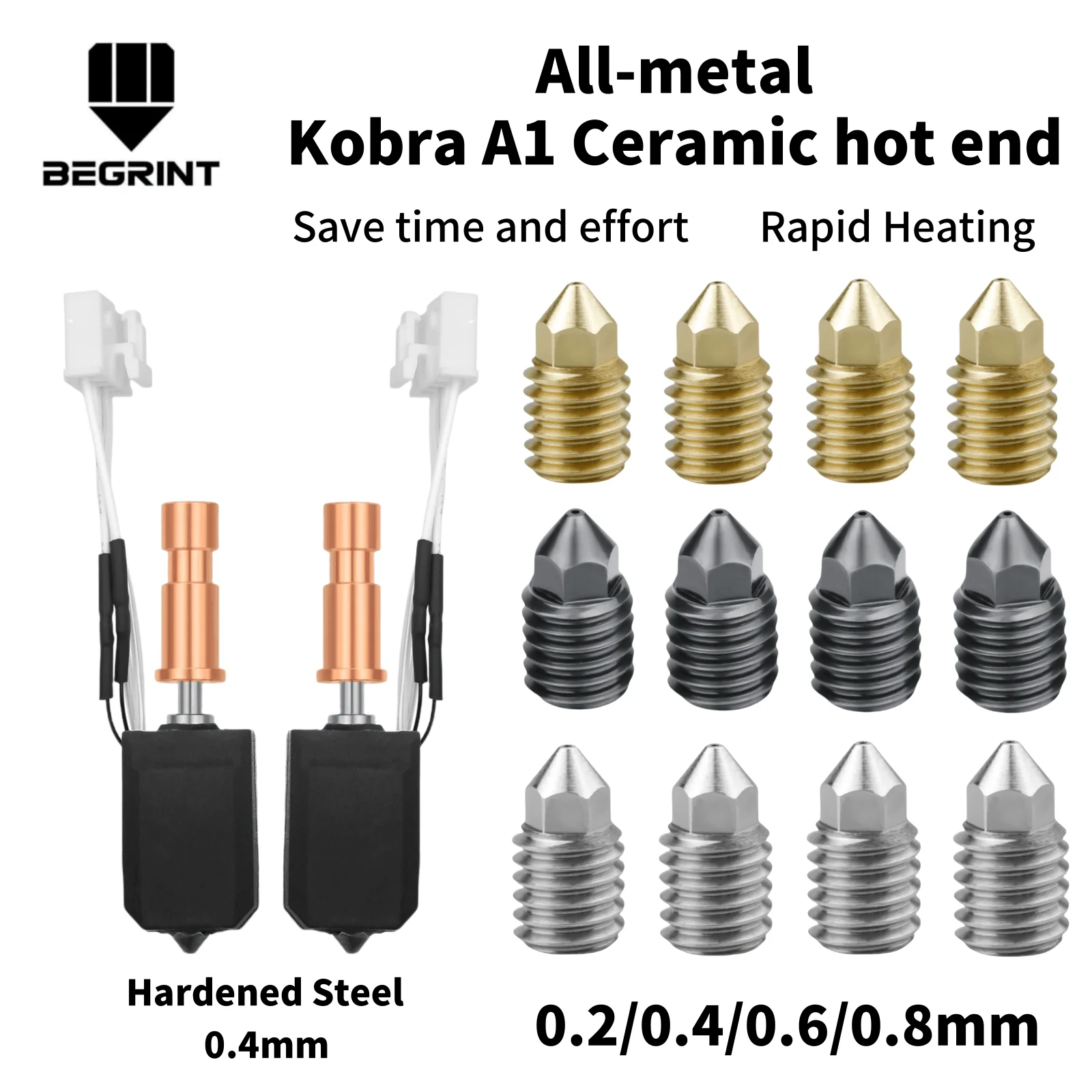
The hotend features a ceramic heating element, a departure from traditional cartridge heaters. This design choice is visible in the product imagery, showing a compact, integrated heating block with a distinct ceramic appearance. The ceramic element is engineered for direct and uniform heat transfer to the melt zone.
This direct heating mechanism translates into significantly reduced preheating times. Data presented indicates a preheating duration to 250°C of just 38 seconds, a substantial improvement over the 1 minute 20 seconds observed with the original hotend. Such rapid thermal acquisition minimizes idle time, accelerating the overall printing workflow.
Compared to conventional hotends that rely on external heating cartridges and less efficient thermal pathways, this ceramic integration offers a more responsive and energy-efficient heating solution. It ensures that the printer reaches operational temperatures quickly, a critical factor for production environments or users with time-sensitive projects.
An all-metal throat tube, constructed from titanium alloy and copper, forms the core of this hotend's material compatibility. This combination is explicitly shown in the product visuals, highlighting the distinct metallic components. The all-metal design eliminates the PTFE liner in the hot zone.
Removing the PTFE liner is crucial for printing high-temperature filaments like ABS, Nylon, PC, and PEEK. PTFE degrades at temperatures above 250°C, releasing toxic fumes and causing clogs. With a maximum operational temperature of 350°C, this hotend safely processes materials that would otherwise be inaccessible or problematic for standard setups. This capability allows for the creation of functional prototypes and end-use parts requiring specific mechanical properties.
Standard hotends, often featuring a PTFE tube extending into the melt zone, are inherently limited to lower temperature filaments such as PLA and PETG. This all-metal upgrade fundamentally broadens the scope of printable materials, positioning the Kobra S1 series as a more versatile tool for advanced applications. It is a direct solution for material-specific project requirements.
The hotend is rated for a high flow rate of 35mm³/s. This metric, prominently displayed, signifies the volume of molten filament that can be extruded per second. Achieving this rate requires optimized internal geometry and efficient heat transfer.
Such a high flow rate enables faster print speeds without compromising extrusion quality. For large prints or batch production, reducing print time by even a small percentage per layer accumulates into significant overall time savings. This directly impacts project timelines and operational efficiency.
Many stock hotends are designed for lower flow rates, typically sufficient for hobbyist speeds but inadequate for rapid prototyping or larger models. The BEGRINT hotend's high-flow capacity positions it as an upgrade for users looking to push the boundaries of their printer's speed without sacrificing structural integrity or surface finish. It delivers material quickly and consistently.
The kit includes a selection of nozzles made from hardened steel, brass, and copper plate, in sizes ranging from 0.2mm to 0.8mm. The visual representation clearly distinguishes these materials and sizes, emphasizing their specific applications. Hardened steel nozzles are particularly highlighted.
Hardened steel nozzles are essential for printing abrasive filaments such as carbon fiber-filled PLA, wood-filled, or metal-filled materials. These composite filaments rapidly wear down softer brass nozzles, leading to inconsistent extrusion and print failures. The inclusion of various nozzle materials and sizes provides comprehensive adaptability for different print requirements, from fine detail to rapid prototyping.
Unlike basic kits that often only provide brass nozzles, this comprehensive selection ensures the user is equipped for a wide array of filament types and desired print resolutions. This strategic inclusion mitigates the need for separate purchases, offering immediate utility for specialized printing tasks. It is a complete solution for diverse material needs.
The hotend is designed for straightforward installation, reportedly achievable in 20 seconds. The integrated wiring and modular design, visible in the comparison images, contribute to this ease of assembly. The wiring appears pre-terminated for direct connection.
Simplified installation minimizes downtime and reduces the technical barrier for users upgrading their Kobra S1. The plug-and-play nature, as suggested by the design, allows for quick swaps, which is beneficial for maintenance or when switching between specialized hotends. This design prioritizes user convenience.
Many aftermarket hotends can be complex to install, often requiring extensive wiring modifications or custom mounting solutions. The BEGRINT hotend's design appears to be a direct replacement, streamlining the upgrade process significantly compared to more generic or less integrated alternatives. It is a user-friendly upgrade path.
An accurate thermistor is integrated into the hotend assembly. This component is critical for precise temperature readings, which directly influence print quality and material adhesion. The visual cues suggest a robust and well-protected thermistor placement.
Precise temperature control prevents issues like layer delamination, stringing, and inconsistent extrusion, which are often caused by temperature fluctuations. An accurate thermistor ensures the filament melts at its optimal temperature, leading to stronger, more dimensionally accurate prints. This is fundamental for reliable additive manufacturing.
Inferior thermistors or poor thermal contact can lead to significant temperature discrepancies, making it difficult to achieve consistent results, especially with temperature-sensitive materials. The emphasis on an accurate thermistor in this design highlights a commitment to stable and repeatable thermal performance, surpassing the variability sometimes found in less optimized systems. It maintains consistent thermal conditions.
Engineering for Thermal Velocity: Rapid Heating Dynamics
The hotend features a ceramic heating element, a departure from traditional cartridge heaters. This design choice is visible in the product imagery, showing a compact, integrated heating block with a distinct ceramic appearance. The ceramic element is engineered for direct and uniform heat transfer to the melt zone.
This direct heating mechanism translates into significantly reduced preheating times. Data presented indicates a preheating duration to 250°C of just 38 seconds, a substantial improvement over the 1 minute 20 seconds observed with the original hotend. Such rapid thermal acquisition minimizes idle time, accelerating the overall printing workflow.
Compared to conventional hotends that rely on external heating cartridges and less efficient thermal pathways, this ceramic integration offers a more responsive and energy-efficient heating solution. It ensures that the printer reaches operational temperatures quickly, a critical factor for production environments or users with time-sensitive projects.
Expanding Filament Horizons: Material Mastery
An all-metal throat tube, constructed from titanium alloy and copper, forms the core of this hotend's material compatibility. This combination is explicitly shown in the product visuals, highlighting the distinct metallic components. The all-metal design eliminates the PTFE liner in the hot zone.
Removing the PTFE liner is crucial for printing high-temperature filaments like ABS, Nylon, PC, and PEEK. PTFE degrades at temperatures above 250°C, releasing toxic fumes and causing clogs. With a maximum operational temperature of 350°C, this hotend safely processes materials that would otherwise be inaccessible or problematic for standard setups. This capability allows for the creation of functional prototypes and end-use parts requiring specific mechanical properties.
Standard hotends, often featuring a PTFE tube extending into the melt zone, are inherently limited to lower temperature filaments such as PLA and PETG. This all-metal upgrade fundamentally broadens the scope of printable materials, positioning the Kobra S1 series as a more versatile tool for advanced applications. It is a direct solution for material-specific project requirements.
Precision Extrusion: High-Flow Capabilities
The hotend is rated for a high flow rate of 35mm³/s. This metric, prominently displayed, signifies the volume of molten filament that can be extruded per second. Achieving this rate requires optimized internal geometry and efficient heat transfer.
Such a high flow rate enables faster print speeds without compromising extrusion quality. For large prints or batch production, reducing print time by even a small percentage per layer accumulates into significant overall time savings. This directly impacts project timelines and operational efficiency.
Many stock hotends are designed for lower flow rates, typically sufficient for hobbyist speeds but inadequate for rapid prototyping or larger models. The BEGRINT hotend's high-flow capacity positions it as an upgrade for users looking to push the boundaries of their printer's speed without sacrificing structural integrity or surface finish. It delivers material quickly and consistently.
Durability and Versatility: Nozzle System Analysis
The kit includes a selection of nozzles made from hardened steel, brass, and copper plate, in sizes ranging from 0.2mm to 0.8mm. The visual representation clearly distinguishes these materials and sizes, emphasizing their specific applications. Hardened steel nozzles are particularly highlighted.
Hardened steel nozzles are essential for printing abrasive filaments such as carbon fiber-filled PLA, wood-filled, or metal-filled materials. These composite filaments rapidly wear down softer brass nozzles, leading to inconsistent extrusion and print failures. The inclusion of various nozzle materials and sizes provides comprehensive adaptability for different print requirements, from fine detail to rapid prototyping.
Unlike basic kits that often only provide brass nozzles, this comprehensive selection ensures the user is equipped for a wide array of filament types and desired print resolutions. This strategic inclusion mitigates the need for separate purchases, offering immediate utility for specialized printing tasks. It is a complete solution for diverse material needs.
Streamlined Integration: Installation and Maintenance
The hotend is designed for straightforward installation, reportedly achievable in 20 seconds. The integrated wiring and modular design, visible in the comparison images, contribute to this ease of assembly. The wiring appears pre-terminated for direct connection.
Simplified installation minimizes downtime and reduces the technical barrier for users upgrading their Kobra S1. The plug-and-play nature, as suggested by the design, allows for quick swaps, which is beneficial for maintenance or when switching between specialized hotends. This design prioritizes user convenience.
Many aftermarket hotends can be complex to install, often requiring extensive wiring modifications or custom mounting solutions. The BEGRINT hotend's design appears to be a direct replacement, streamlining the upgrade process significantly compared to more generic or less integrated alternatives. It is a user-friendly upgrade path.
Thermal Stability: Accurate Thermistor Integration
An accurate thermistor is integrated into the hotend assembly. This component is critical for precise temperature readings, which directly influence print quality and material adhesion. The visual cues suggest a robust and well-protected thermistor placement.
Precise temperature control prevents issues like layer delamination, stringing, and inconsistent extrusion, which are often caused by temperature fluctuations. An accurate thermistor ensures the filament melts at its optimal temperature, leading to stronger, more dimensionally accurate prints. This is fundamental for reliable additive manufacturing.
Inferior thermistors or poor thermal contact can lead to significant temperature discrepancies, making it difficult to achieve consistent results, especially with temperature-sensitive materials. The emphasis on an accurate thermistor in this design highlights a commitment to stable and repeatable thermal performance, surpassing the variability sometimes found in less optimized systems. It maintains consistent thermal conditions.