Bambu Lab Hardened Steel Nozzles for X1/P1S Series 3D Printers
Official Store Deal
Expert Analysis Overview
Precision Extrusion: The Hardened Steel Advantage
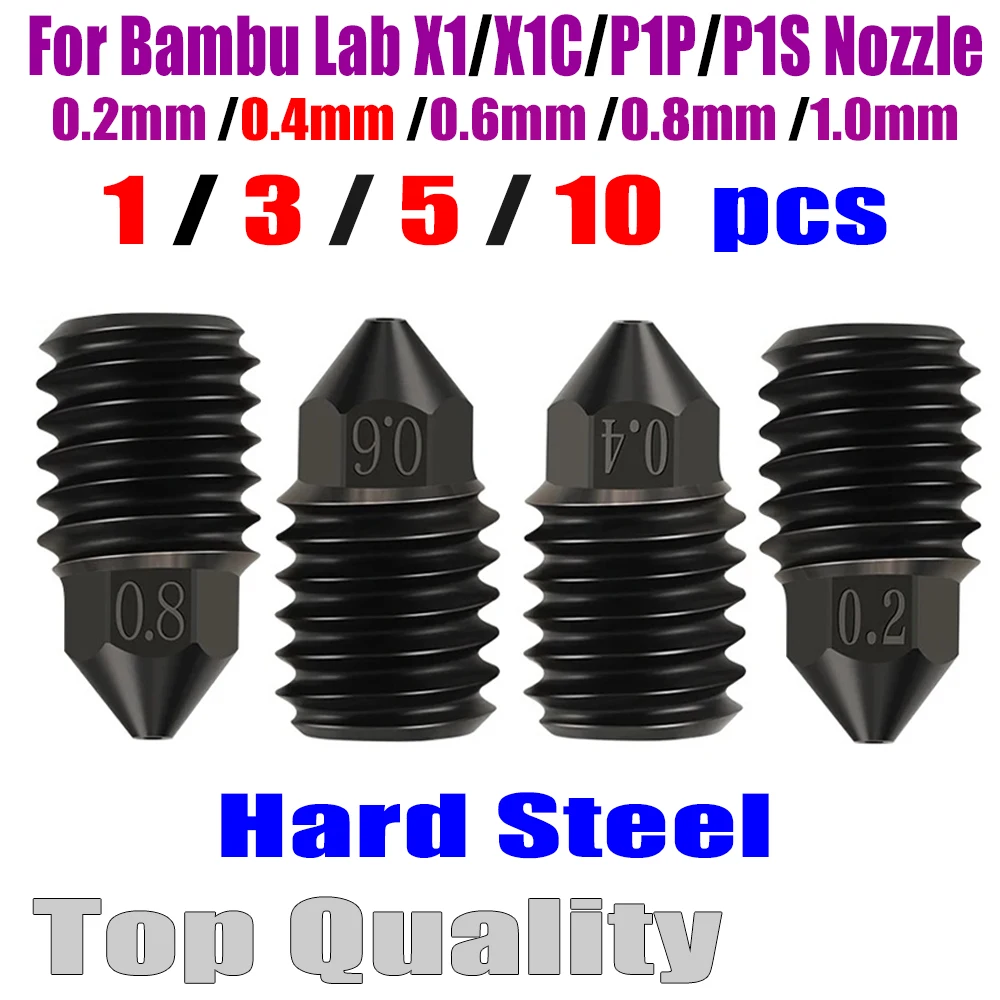
The Bambu Lab Hardened Steel Nozzles are critical extrusion components engineered for the X1, X1C, P1P, and P1S series 3D printers. These nozzles are a significant upgrade over standard brass alternatives, specifically designed to withstand the rigors of abrasive filament printing. Their construction targets users who demand consistent, high-quality output across a diverse range of materials, ensuring dimensional accuracy and minimizing print failures.This hardened steel construction is not merely a material choice; it represents a fundamental shift in print capability. Standard brass nozzles, while excellent for common filaments like PLA and PETG, rapidly degrade when exposed to filled or abrasive materials. This degradation leads to inconsistent extrusion, dimensional inaccuracies, and ultimately, failed prints. Hardened steel, by contrast, maintains its precise orifice geometry over extended periods, even when processing challenging composites.
For any serious additive manufacturing enthusiast or professional, the ability to reliably print with advanced materials is paramount. These nozzles extend the operational lifespan of the hotend assembly, reducing the frequency of replacements and the associated downtime. They are a strategic investment for those pushing the boundaries of material science in 3D printing.
Material Science: The Core of Durability
The primary material for these nozzles is hardened steel. This specific alloy undergoes a heat treatment process that significantly increases its surface hardness and wear resistance.This enhanced hardness directly translates to superior performance when printing with abrasive filaments. Materials such as carbon fiber-filled nylon, glass fiber-reinforced PETG, glow-in-the-dark PLA, or metal-filled composites contain hard particles that act like sandpaper on softer nozzle materials. Hardened steel resists this abrasive wear, preserving the nozzle's critical orifice diameter.
Compared to traditional brass nozzles, which can show measurable wear after just a few hundred grams of abrasive filament, hardened steel nozzles maintain their integrity for kilograms of such materials. This longevity is a key factor in consistent print quality and reduced operational costs over time.
Orifice Versatility: Tailoring Print Resolution and Speed
These nozzles are available in a comprehensive range of orifice diameters: 0.2mm, 0.4mm, 0.6mm, 0.8mm, and 1.0mm. This selection allows for precise control over print resolution and speed.A 0.2mm nozzle is ideal for extremely fine detail and intricate geometries. It enables the creation of parts with very thin walls and high surface finish, often at the expense of print speed. This size is perfect for miniature models or highly detailed prototypes where visual fidelity is critical.
Conversely, a 1.0mm nozzle facilitates rapid printing and stronger parts with fewer perimeters. It excels in applications where speed and structural integrity are prioritized over minute details, such as large functional prototypes or structural components. The 0.4mm, 0.6mm, and 0.8mm sizes offer a balanced approach, catering to a wide array of general-purpose printing needs, from standard models to faster functional parts.
Internal Geometry: Smooth Filament Flow
An often-overlooked but critical feature is the smooth inner surface of the nozzle. This internal finish is crucial for consistent filament extrusion.A smooth bore minimizes friction as the molten filament passes through the nozzle. Reduced friction prevents pressure fluctuations within the melt zone, leading to a more uniform flow rate and consistent line width. This directly impacts the quality of the printed layers, preventing artifacts like blobbing or stringing.
Rough internal surfaces, common in lower-quality nozzles, can impede filament flow, causing back pressure and inconsistent extrusion. The optimized internal geometry of these hardened steel nozzles ensures a predictable and stable extrusion process, which is fundamental for reliable and high-quality 3D prints.
Seamless Integration: Bambu Lab Ecosystem Compatibility
These nozzles are specifically designed for direct compatibility with Bambu Lab X1, X1C, P1P, and P1S 3D printers. This ensures a perfect fit and seamless integration into the existing hotend assembly.Direct compatibility eliminates the need for adapters or modifications, simplifying the upgrade process. Users can confidently swap out their existing nozzles without concerns about fitment issues, filament leakage, or compromised thermal performance. This plug-and-play nature is a significant advantage for users of the Bambu Lab ecosystem.
Unlike generic nozzles that might require extensive calibration or even physical modifications to fit, these Bambu Lab-specific nozzles are engineered to work optimally with the printer's hotend design. This ensures that the printer's advanced features, such as automatic flow calibration, continue to function as intended, preserving the user experience.
Installation and Maintenance Considerations
The threaded design of these nozzles ensures a secure connection to the hotend. Proper installation is vital to prevent filament leakage and maintain thermal efficiency.Heating the hotend to printing temperature before attempting to remove or install a nozzle is a standard best practice. This softens any residual filament, allowing for easier and safer removal without stripping threads or damaging the hotend. A small amount of thread sealant, often present on new nozzles, further aids in creating a leak-proof seal.
Regular inspection of the nozzle tip for wear or damage is recommended, especially when printing abrasive materials. While hardened steel offers superior durability, it is not indestructible. Replacing a worn nozzle proactively prevents print quality degradation and potential hotend issues. This simple maintenance step ensures long-term reliability.
Operational Excellence in Additive Manufacturing
The hardened steel construction of these nozzles provides exceptional resistance to wear. This is crucial for maintaining precise print quality over extended periods, particularly when utilizing abrasive filaments.Their robust nature allows for consistent performance across thousands of print hours. This directly translates to fewer failed prints and reduced material waste. The structural integrity of the nozzle tip remains intact, ensuring that the extruded filament diameter is consistent from the first layer to the last.
Compared to softer materials like brass, which can quickly develop an enlarged or irregular orifice, hardened steel maintains its original dimensions. This consistent orifice size is fundamental for achieving repeatable and dimensionally accurate parts, a requirement for engineering and prototyping applications.
Print Quality and Consistency
Achieving superior print quality hinges on consistent filament extrusion. These hardened steel nozzles contribute significantly to this consistency.The stable orifice diameter and smooth internal bore ensure a uniform flow of molten plastic. This uniformity prevents variations in line width and layer height, which are common causes of visible print artifacts. The result is smoother surfaces, better layer adhesion, and more accurate part dimensions.
Users will notice a marked improvement in the visual appeal and functional performance of their printed objects. Fine details are rendered with greater precision, and overall part strength is enhanced due to better inter-layer bonding. This level of consistency is difficult to achieve with worn or inferior nozzle materials.
Expanding Material Capabilities
One of the most compelling advantages of these hardened steel nozzles is the expanded range of materials they enable. They are compatible with all 1.75mm consumables.Filaments like carbon fiber-filled PLA, PC, PEEK, and various nylons, which are highly abrasive, can be printed reliably. These advanced materials offer superior mechanical properties, such as increased strength, stiffness, or heat resistance, opening up new possibilities for functional prototypes and end-use parts. The nozzle resists wear.
Without hardened steel nozzles, attempting to print these materials would quickly damage standard brass nozzles, leading to costly replacements and frustrating print failures. This upgrade effectively unlocks the full potential of a Bambu Lab printer, allowing users to experiment with and utilize a much broader spectrum of engineering-grade filaments.
Value Proposition: A Strategic Investment
While hardened steel nozzles typically carry a higher initial cost than brass alternatives, their long-term value proposition is substantial. They are an investment in reliability and capability.The extended lifespan of hardened steel nozzles significantly reduces the frequency of replacements. This not only saves money on replacement parts but also minimizes downtime associated with nozzle changes. The cost-per-print for abrasive materials becomes considerably lower.
Furthermore, the ability to reliably print with advanced, often more expensive, filaments without fear of nozzle degradation protects the investment in those materials. Failed prints due to nozzle wear are costly in both time and material. These nozzles mitigate that risk, ensuring a higher success rate for complex and critical prints.
Imagine consistently producing high-strength, dimensionally accurate parts from advanced composites, knowing that your extrusion system is robust enough to handle the challenge. Visualize the satisfaction of flawless first layers and intricate details, print after print, without the frustration of clogs or inconsistent extrusion. Consider the expanded possibilities for functional prototypes and end-use components, all enabled by a reliable, wear-resistant extrusion path. These hardened steel nozzles empower users to push the boundaries of their Bambu Lab 3D printers, transforming ambitious designs into tangible realities with unwavering precision and durability. This is the future of reliable, high-performance 3D printing.