Bambu Lab A1/A1 Mini Fast Speed Hotend Kit
Official Store Deal
Expert Analysis Overview
The Bambu Lab A1/A1 Mini Hotend Kit is a critical upgrade component designed for 3D printing enthusiasts seeking enhanced material compatibility and print precision. This assembly, available in various nozzle sizes and materials, directly addresses common limitations found in standard hotends, offering a substantial improvement for both novice and experienced makers. Its design emphasizes quick-swap functionality, a hallmark of the Bambu Lab ecosystem, streamlining maintenance and material changes. This part is essential for maintaining optimal print quality and expanding the range of filaments usable with the A1 and A1 Mini printers.
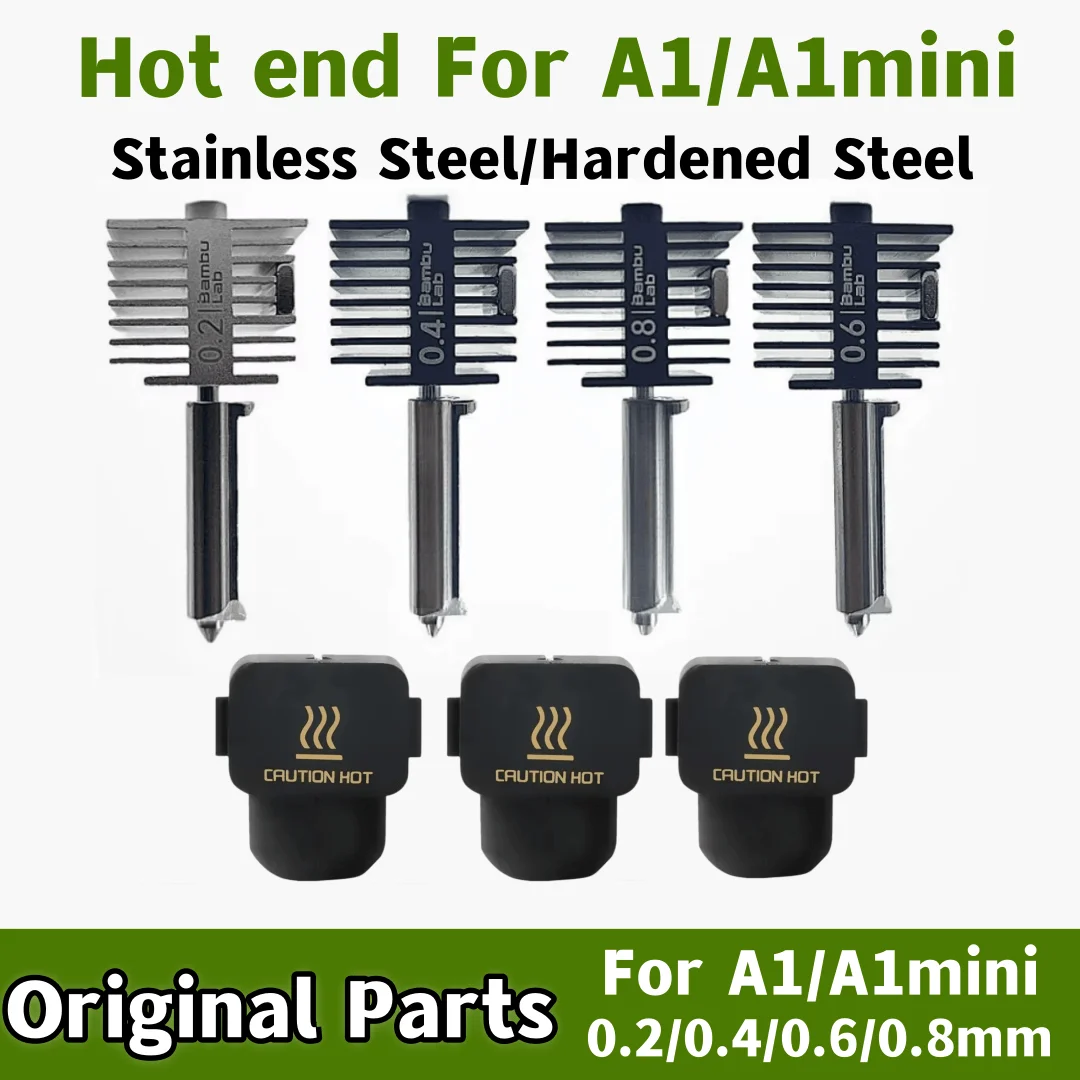
The hotend assembly arrives as a complete unit, integrating the heater block, heat sink, and nozzle into a single, compact module. This integrated design simplifies replacement and ensures consistent thermal performance across the entire printhead. The visible heat fins on the heat sink are precisely machined, suggesting efficient heat dissipation away from the cold end, which is crucial for preventing heat creep and subsequent filament jams. Each nozzle size is clearly marked on the heat sink, making identification straightforward during installation. This thoughtful labeling prevents mix-ups.
This kit offers a range of nozzle diameters: 0.2mm, 0.4mm, 0.6mm, and 0.8mm. The 0.2mm nozzle is crafted from stainless steel, a choice often preferred for its fine detail capabilities and corrosion resistance when printing non-abrasive materials. The remaining sizes—0.4mm, 0.6mm, and 0.8mm—feature hardened steel construction. Hardened steel is significantly more resistant to wear, making it indispensable for printing abrasive filaments like carbon fiber, glass fiber, or metal-filled compounds. This material selection extends the printer's utility. Without a hardened steel nozzle, these advanced materials would rapidly degrade a brass or stainless steel nozzle, leading to inconsistent extrusion and print failures.
Consider a scenario where intricate miniature figures require exceptional detail. The 0.2mm stainless steel nozzle provides the necessary precision, laying down incredibly fine lines for smooth surfaces and sharp features. Conversely, when tackling large, functional parts that demand strength and quick completion, the 0.8mm hardened steel nozzle allows for significantly faster print times and larger layer heights. It's a simple swap. This versatility empowers users to select the ideal tool for any printing task, minimizing compromise on either speed or quality. Compared to printers that require complex hotend disassembly to change nozzle sizes or materials, this integrated approach is a significant time-saver.
Installation of these hotends on a Bambu Lab A1 or A1 Mini printer is designed for ease. The quick-swap mechanism means users can replace the entire assembly in mere seconds, often without needing tools beyond what's included with the printer. This plug-and-play functionality drastically reduces downtime, a common frustration with less user-friendly 3D printers. The electrical connections are integrated into the module, eliminating the need to re-wire thermistors or heater cartridges. This makes hotend changes less intimidating for newcomers.
Imagine needing to switch from a standard PLA print to a carbon fiber reinforced nylon project. With a traditional hotend, this might involve heating the nozzle, carefully unscrewing it, cleaning residual filament, and then installing a new, hardened nozzle. This process can be fiddly and risks damaging components. With the Bambu Lab system, it's a matter of unclipping one hotend and clipping in another. This efficiency is a game-changer for makers who frequently experiment with different materials or require specific nozzle sizes for various projects. The convenience factor cannot be overstated. It truly simplifies the tinkering process.
For the maker community, access to original, high-quality replacement parts is paramount. These hotends, being original equipment, ensure perfect fitment and compatibility with the printer's firmware and calibration routines. This prevents the headaches often associated with third-party components that might require extensive tuning or custom profiles. The ability to quickly swap between different nozzle sizes encourages experimentation with various layer heights and print strategies, pushing the boundaries of what the A1/A1 Mini can achieve. This fosters a more creative and less frustrating printing experience.
Community support for Bambu Lab printers is robust, with numerous guides and forums dedicated to optimizing print settings for different hotend configurations. This means that users are not left to figure out complex parameters on their own; shared knowledge helps accelerate the learning curve. The availability of these distinct nozzle options directly supports the community's drive to modify and improve their machines over time. It allows for advanced material testing. The ease of swapping enables rapid iteration of custom parts, a core aspect of the tinkerer's workflow. This flexibility is key to innovation.
The different nozzle sizes directly impact print resolution and speed. A 0.2mm nozzle excels at producing incredibly fine details, ideal for aesthetic models or parts requiring tight tolerances. However, it prints slower. Conversely, the 0.8mm nozzle dramatically cuts down print times for larger objects by allowing thicker extrusion lines and layer heights, albeit with a coarser finish. The 0.4mm nozzle is the general-purpose workhorse, balancing speed and detail for most common prints. Its versatility makes it a user favorite.
When printing a large enclosure for electronics, the 0.8mm hardened steel nozzle saves hours, providing a strong, functional part quickly, even if the surface finish is not mirror-smooth. Then, for a small, intricate gear, switching to the 0.2mm stainless steel nozzle ensures every tooth is perfectly defined, minimizing post-processing. This adaptability is critical for a diverse range of projects. The inherent precision of original parts ensures consistent extrusion and minimal stringing or blobbing, contributing to overall print quality. Every detail matters.
Investing in original hotends, particularly those with hardened steel nozzles, translates to significant long-term savings. While the initial cost might be slightly higher than generic brass alternatives, the vastly superior wear resistance of hardened steel means fewer replacements over time, especially when printing abrasive filaments. A worn nozzle leads to inconsistent extrusion, dimensional inaccuracies, and ultimately, failed prints. Replacing a hotend frequently due to wear is both costly and time-consuming.
Consider the operational lifespan. A single hardened steel nozzle can outlast multiple brass nozzles when printing materials like glow-in-the-dark or wood-filled filaments. This reduces consumable costs and maintenance frequency. The robust construction of the entire assembly, from the heat sink to the electrical connections, ensures reliable operation under continuous use. This reliability is something many makers value above all else. The low price point for such a critical, original component further enhances its value proposition, making it an accessible upgrade for any A1/A1 Mini owner looking to expand their printing capabilities.
Imagine your workshop humming with productivity, seamlessly transitioning between delicate prototypes and robust functional parts. The hotend kit empowers precise control over every extrusion, ensuring consistent, high-quality results across a spectrum of materials. This allows for unfettered creativity and efficient project completion, turning ambitious ideas into tangible realities with ease and reliability.
Precision Engineering for Print Perfection
The hotend assembly arrives as a complete unit, integrating the heater block, heat sink, and nozzle into a single, compact module. This integrated design simplifies replacement and ensures consistent thermal performance across the entire printhead. The visible heat fins on the heat sink are precisely machined, suggesting efficient heat dissipation away from the cold end, which is crucial for preventing heat creep and subsequent filament jams. Each nozzle size is clearly marked on the heat sink, making identification straightforward during installation. This thoughtful labeling prevents mix-ups.
Nozzle Caliber and Material Versatility
This kit offers a range of nozzle diameters: 0.2mm, 0.4mm, 0.6mm, and 0.8mm. The 0.2mm nozzle is crafted from stainless steel, a choice often preferred for its fine detail capabilities and corrosion resistance when printing non-abrasive materials. The remaining sizes—0.4mm, 0.6mm, and 0.8mm—feature hardened steel construction. Hardened steel is significantly more resistant to wear, making it indispensable for printing abrasive filaments like carbon fiber, glass fiber, or metal-filled compounds. This material selection extends the printer's utility. Without a hardened steel nozzle, these advanced materials would rapidly degrade a brass or stainless steel nozzle, leading to inconsistent extrusion and print failures.
Consider a scenario where intricate miniature figures require exceptional detail. The 0.2mm stainless steel nozzle provides the necessary precision, laying down incredibly fine lines for smooth surfaces and sharp features. Conversely, when tackling large, functional parts that demand strength and quick completion, the 0.8mm hardened steel nozzle allows for significantly faster print times and larger layer heights. It's a simple swap. This versatility empowers users to select the ideal tool for any printing task, minimizing compromise on either speed or quality. Compared to printers that require complex hotend disassembly to change nozzle sizes or materials, this integrated approach is a significant time-saver.
Seamless Integration and User Experience
Installation of these hotends on a Bambu Lab A1 or A1 Mini printer is designed for ease. The quick-swap mechanism means users can replace the entire assembly in mere seconds, often without needing tools beyond what's included with the printer. This plug-and-play functionality drastically reduces downtime, a common frustration with less user-friendly 3D printers. The electrical connections are integrated into the module, eliminating the need to re-wire thermistors or heater cartridges. This makes hotend changes less intimidating for newcomers.
Imagine needing to switch from a standard PLA print to a carbon fiber reinforced nylon project. With a traditional hotend, this might involve heating the nozzle, carefully unscrewing it, cleaning residual filament, and then installing a new, hardened nozzle. This process can be fiddly and risks damaging components. With the Bambu Lab system, it's a matter of unclipping one hotend and clipping in another. This efficiency is a game-changer for makers who frequently experiment with different materials or require specific nozzle sizes for various projects. The convenience factor cannot be overstated. It truly simplifies the tinkering process.
The Tinkerer's Advantage
For the maker community, access to original, high-quality replacement parts is paramount. These hotends, being original equipment, ensure perfect fitment and compatibility with the printer's firmware and calibration routines. This prevents the headaches often associated with third-party components that might require extensive tuning or custom profiles. The ability to quickly swap between different nozzle sizes encourages experimentation with various layer heights and print strategies, pushing the boundaries of what the A1/A1 Mini can achieve. This fosters a more creative and less frustrating printing experience.
Community support for Bambu Lab printers is robust, with numerous guides and forums dedicated to optimizing print settings for different hotend configurations. This means that users are not left to figure out complex parameters on their own; shared knowledge helps accelerate the learning curve. The availability of these distinct nozzle options directly supports the community's drive to modify and improve their machines over time. It allows for advanced material testing. The ease of swapping enables rapid iteration of custom parts, a core aspect of the tinkerer's workflow. This flexibility is key to innovation.
Optimizing Workflow and Print Quality
The different nozzle sizes directly impact print resolution and speed. A 0.2mm nozzle excels at producing incredibly fine details, ideal for aesthetic models or parts requiring tight tolerances. However, it prints slower. Conversely, the 0.8mm nozzle dramatically cuts down print times for larger objects by allowing thicker extrusion lines and layer heights, albeit with a coarser finish. The 0.4mm nozzle is the general-purpose workhorse, balancing speed and detail for most common prints. Its versatility makes it a user favorite.
When printing a large enclosure for electronics, the 0.8mm hardened steel nozzle saves hours, providing a strong, functional part quickly, even if the surface finish is not mirror-smooth. Then, for a small, intricate gear, switching to the 0.2mm stainless steel nozzle ensures every tooth is perfectly defined, minimizing post-processing. This adaptability is critical for a diverse range of projects. The inherent precision of original parts ensures consistent extrusion and minimal stringing or blobbing, contributing to overall print quality. Every detail matters.
Long-Term Value and Durability
Investing in original hotends, particularly those with hardened steel nozzles, translates to significant long-term savings. While the initial cost might be slightly higher than generic brass alternatives, the vastly superior wear resistance of hardened steel means fewer replacements over time, especially when printing abrasive filaments. A worn nozzle leads to inconsistent extrusion, dimensional inaccuracies, and ultimately, failed prints. Replacing a hotend frequently due to wear is both costly and time-consuming.
Consider the operational lifespan. A single hardened steel nozzle can outlast multiple brass nozzles when printing materials like glow-in-the-dark or wood-filled filaments. This reduces consumable costs and maintenance frequency. The robust construction of the entire assembly, from the heat sink to the electrical connections, ensures reliable operation under continuous use. This reliability is something many makers value above all else. The low price point for such a critical, original component further enhances its value proposition, making it an accessible upgrade for any A1/A1 Mini owner looking to expand their printing capabilities.
Imagine your workshop humming with productivity, seamlessly transitioning between delicate prototypes and robust functional parts. The hotend kit empowers precise control over every extrusion, ensuring consistent, high-quality results across a spectrum of materials. This allows for unfettered creativity and efficient project completion, turning ambitious ideas into tangible realities with ease and reliability.