AX900 Dual-Band WiFi 6 & Bluetooth 5.4 USB Adapter
Official Store Deal
Expert Analysis Overview
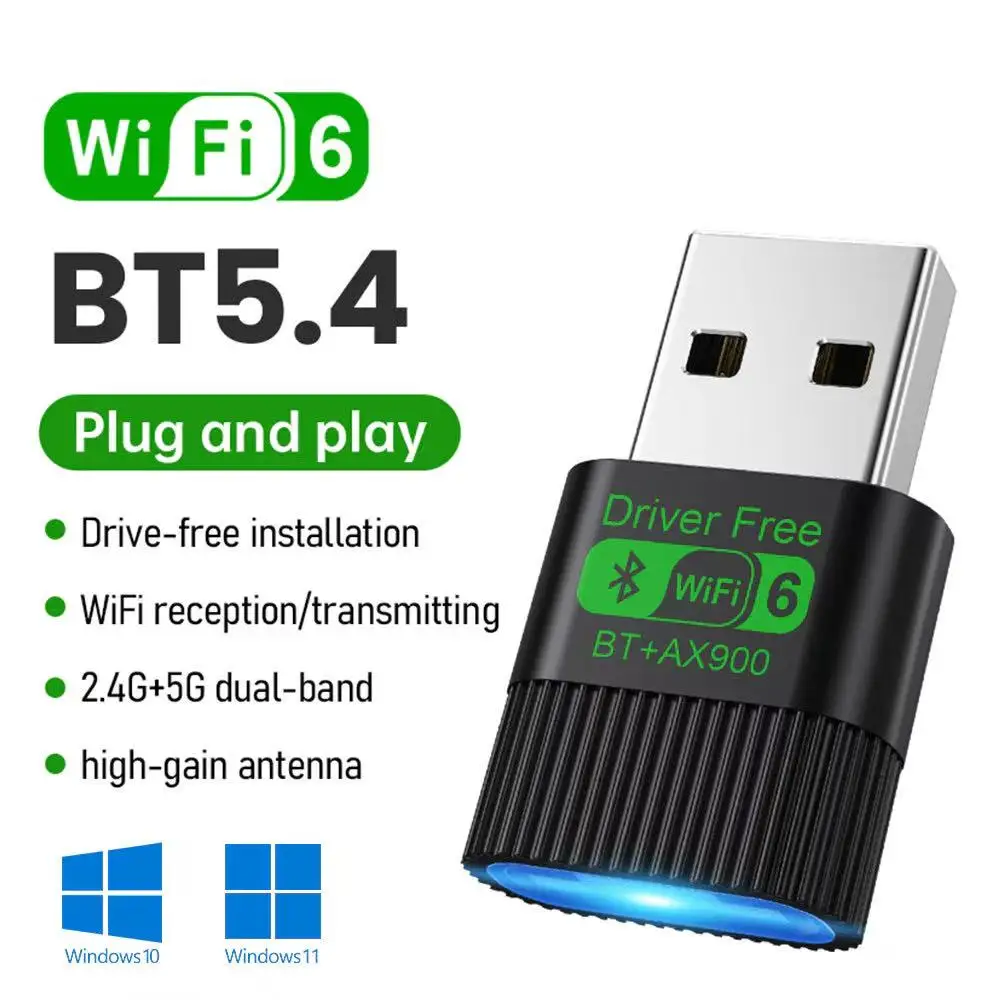
The SM176B-MN is a compact, dual-function wireless adapter engineered for modern Windows environments requiring both high-speed Wi-Fi 6 and advanced Bluetooth 5.4 connectivity. This peripheral targets users seeking to upgrade legacy systems or enhance the wireless capabilities of existing devices without complex driver installations. Its design prioritizes ease of deployment and simultaneous operation of both wireless protocols, a critical consideration for integrated computing experiences.
This adapter explicitly supports Wi-Fi 6 (802.11ax) and Bluetooth 5.4 standards. The Wi-Fi component operates across both 2.4 GHz and 5 GHz frequency bands. Data rates are specified at 286 Mbps on the 2.4 GHz band and 600 Mbps on the 5 GHz band, culminating in an aggregate theoretical throughput of approximately 900 Mbps, hence the AX900 designation. These figures represent the maximum link speeds achievable under optimal conditions, which are influenced by environmental factors and network congestion.
Such specifications imply a significant upgrade for systems currently utilizing older Wi-Fi standards like 802.11n or 802.11ac. Users will experience enhanced data transfer rates, reduced latency, and improved network efficiency, particularly in dense wireless environments. The dual-band capability ensures flexibility, allowing the device to connect to either frequency for optimal performance based on range and interference levels. The 5 GHz band offers higher speeds over shorter distances, while the 2.4 GHz band provides better penetration and range.
Compared to standard 802.11ac adapters, which typically max out around 433-867 Mbps on the 5 GHz band, this Wi-Fi 6 solution offers a more robust connection. The inclusion of Bluetooth 5.4 further distinguishes it from single-function Wi-Fi dongles or older Bluetooth 4.x adapters. This integrated approach streamlines peripheral management and reduces the number of required USB ports.
The stated transmission rates of 286 Mbps for 2.4 GHz and 600 Mbps for 5 GHz are indicative of the physical layer (PHY) rates. Actual application-layer throughput will be lower due to protocol overhead. The 5 GHz band, with its 600 Mbps capability, is suitable for bandwidth-intensive tasks. This includes 4K video streaming or large file transfers within a local network.
Effective channel utilization is a hallmark of Wi-Fi 6. Orthogonal Frequency-Division Multiple Access (OFDMA) and Multi-User Multiple-Input Multiple-Output (MU-MIMO) technologies, inherent to Wi-Fi 6, contribute to this efficiency. While a single client adapter cannot fully leverage MU-MIMO's multi-user benefits, it still gains from OFDMA's ability to segment channels for multiple simultaneous transmissions. This results in more efficient use of available spectrum.
In scenarios with multiple Wi-Fi 6 compatible devices on the same network, the overall network performance improves. The adapter's ability to participate in these advanced scheduling mechanisms reduces contention and latency. This is a crucial advantage in modern smart home or office environments where numerous devices compete for wireless resources.
The integration of Bluetooth 5.4 provides a significant leap over previous Bluetooth versions. Bluetooth 5.4 introduces enhanced security features and improved energy efficiency, particularly for Low Energy (LE) devices. This version also supports Periodic Advertising with Responses (PAwR) and Encrypted Advertising Data (EAD), which are beneficial for IoT applications and secure device pairing.
This advanced Bluetooth standard ensures stable and low-latency connections for a wide array of peripherals. Wireless headphones, keyboards, mice, and game controllers benefit from the increased bandwidth and reduced interference. The ability to maintain multiple simultaneous Bluetooth connections reliably is also improved.
Older Bluetooth 4.x adapters often suffer from connection drops or higher latency, especially when multiple devices are active. The Bluetooth 5.4 implementation in this adapter mitigates these issues, providing a more seamless user experience. For users who rely on wireless peripherals for productivity or entertainment, this represents a substantial functional enhancement.
One of the primary selling points is its "Driver Free" installation for Windows 10 and Windows 11. This implies the device utilizes standard USB classes and drivers pre-integrated into these operating systems. The plug-and-play functionality simplifies deployment, eliminating the need for manual driver downloads or complex setup procedures.
Driver-free operation minimizes potential software conflicts and streamlines the user experience. For IT administrators or users managing multiple devices, this feature reduces setup time and support overhead. The reliance on native OS drivers also suggests a higher degree of stability and compatibility with future Windows updates.
In contrast, many third-party wireless adapters, especially those with proprietary chipsets, often require specific driver installations. These drivers can sometimes be outdated, incompatible with newer OS versions, or introduce system instability. The native driver approach of the SM176B-MN circumvents these common frustrations, offering a more robust and user-friendly solution.
The adapter features a compact USB form factor, with dimensions of 31 x 17.7 x 8.3 mm. This small footprint minimizes protrusion when plugged into a laptop or desktop, reducing the risk of accidental damage. The design incorporates a "high-gain antenna", which is typically an internal PCB antenna optimized for signal reception and transmission within the device's compact enclosure.
The compact size makes it highly portable, suitable for laptop users who frequently travel. Its minimal profile ensures it does not obstruct adjacent USB ports. The internal antenna design, while convenient, may offer less flexibility than external antenna solutions in terms of signal optimization.
Unlike larger USB adapters with external, adjustable antennas, this device relies on its internal design for signal integrity. While external antennas can sometimes provide marginal improvements in specific signal-challenged environments, the integrated high-gain design is generally sufficient for most typical usage scenarios. The blue LED indicator provides visual confirmation of operational status.
The device supports a comprehensive suite of wireless encryption methods, including WPA-WEP, WPA, WPA-PSK, WPA2-PSK, and WPA3. The inclusion of WPA3 is particularly noteworthy, as it represents the latest standard in Wi-Fi security. WPA3 offers stronger encryption and more robust protection against brute-force attacks compared to its predecessors.
Implementing WPA3 is crucial for maintaining network security in both personal and professional environments. It provides enhanced privacy and integrity for wireless communications, protecting sensitive data from unauthorized access. The backward compatibility with older WPA/WPA2 standards ensures interoperability with a wide range of existing wireless access points.
Many older adapters may only support up to WPA2, leaving networks vulnerable to more sophisticated attacks. The WPA3 capability of this adapter future-proofs the connection, aligning with current best practices for wireless network security. This is a significant consideration for users concerned about data protection and network integrity.
The adapter is marketed as a "2-in-1" device capable of simultaneous Wi-Fi reception/transmission and Bluetooth operation. This dual functionality is critical for modern computing, allowing users to connect to a wireless network while simultaneously using Bluetooth peripherals. The internal architecture is designed to manage both protocols without significant performance degradation.
This simultaneous operation eliminates the need for separate Wi-Fi and Bluetooth adapters, conserving USB ports and simplifying cable management. Users can stream high-definition content over Wi-Fi while using a Bluetooth headset for audio or a game controller for input. The integrated chipset efficiently handles resource allocation between the two wireless interfaces.
Many older or cheaper combined adapters often exhibit performance issues when both Wi-Fi and Bluetooth are active, leading to interference or reduced throughput. The design of this AX900 adapter aims to mitigate such conflicts, providing a stable and reliable dual-function experience. This integrated capability enhances the overall utility and value proposition for the end-user.
This AX900 dual-band Wi-Fi 6 and Bluetooth 5.4 USB adapter offers a compelling solution for upgrading wireless capabilities on Windows 10/11 systems. Its driver-free installation, advanced security protocols, and simultaneous operation of both Wi-Fi and Bluetooth make it a practical choice for users seeking enhanced network performance and peripheral connectivity. The compact form factor ensures portability and discreet integration. This device provides a tangible improvement in wireless efficiency and security, making it a valuable addition to any compatible computing setup. Imagine seamless, high-speed internet access combined with lag-free Bluetooth peripheral control, transforming your digital interactions into a fluid and responsive experience.
Wireless Protocol Integration and Performance Metrics
This adapter explicitly supports Wi-Fi 6 (802.11ax) and Bluetooth 5.4 standards. The Wi-Fi component operates across both 2.4 GHz and 5 GHz frequency bands. Data rates are specified at 286 Mbps on the 2.4 GHz band and 600 Mbps on the 5 GHz band, culminating in an aggregate theoretical throughput of approximately 900 Mbps, hence the AX900 designation. These figures represent the maximum link speeds achievable under optimal conditions, which are influenced by environmental factors and network congestion.
Such specifications imply a significant upgrade for systems currently utilizing older Wi-Fi standards like 802.11n or 802.11ac. Users will experience enhanced data transfer rates, reduced latency, and improved network efficiency, particularly in dense wireless environments. The dual-band capability ensures flexibility, allowing the device to connect to either frequency for optimal performance based on range and interference levels. The 5 GHz band offers higher speeds over shorter distances, while the 2.4 GHz band provides better penetration and range.
Compared to standard 802.11ac adapters, which typically max out around 433-867 Mbps on the 5 GHz band, this Wi-Fi 6 solution offers a more robust connection. The inclusion of Bluetooth 5.4 further distinguishes it from single-function Wi-Fi dongles or older Bluetooth 4.x adapters. This integrated approach streamlines peripheral management and reduces the number of required USB ports.
Throughput Dynamics and Channel Utilization
The stated transmission rates of 286 Mbps for 2.4 GHz and 600 Mbps for 5 GHz are indicative of the physical layer (PHY) rates. Actual application-layer throughput will be lower due to protocol overhead. The 5 GHz band, with its 600 Mbps capability, is suitable for bandwidth-intensive tasks. This includes 4K video streaming or large file transfers within a local network.
Effective channel utilization is a hallmark of Wi-Fi 6. Orthogonal Frequency-Division Multiple Access (OFDMA) and Multi-User Multiple-Input Multiple-Output (MU-MIMO) technologies, inherent to Wi-Fi 6, contribute to this efficiency. While a single client adapter cannot fully leverage MU-MIMO's multi-user benefits, it still gains from OFDMA's ability to segment channels for multiple simultaneous transmissions. This results in more efficient use of available spectrum.
In scenarios with multiple Wi-Fi 6 compatible devices on the same network, the overall network performance improves. The adapter's ability to participate in these advanced scheduling mechanisms reduces contention and latency. This is a crucial advantage in modern smart home or office environments where numerous devices compete for wireless resources.
Bluetooth 5.4 Capabilities and Peripheral Interoperability
The integration of Bluetooth 5.4 provides a significant leap over previous Bluetooth versions. Bluetooth 5.4 introduces enhanced security features and improved energy efficiency, particularly for Low Energy (LE) devices. This version also supports Periodic Advertising with Responses (PAwR) and Encrypted Advertising Data (EAD), which are beneficial for IoT applications and secure device pairing.
This advanced Bluetooth standard ensures stable and low-latency connections for a wide array of peripherals. Wireless headphones, keyboards, mice, and game controllers benefit from the increased bandwidth and reduced interference. The ability to maintain multiple simultaneous Bluetooth connections reliably is also improved.
Older Bluetooth 4.x adapters often suffer from connection drops or higher latency, especially when multiple devices are active. The Bluetooth 5.4 implementation in this adapter mitigates these issues, providing a more seamless user experience. For users who rely on wireless peripherals for productivity or entertainment, this represents a substantial functional enhancement.
System Compatibility and Driver Management
One of the primary selling points is its "Driver Free" installation for Windows 10 and Windows 11. This implies the device utilizes standard USB classes and drivers pre-integrated into these operating systems. The plug-and-play functionality simplifies deployment, eliminating the need for manual driver downloads or complex setup procedures.
Driver-free operation minimizes potential software conflicts and streamlines the user experience. For IT administrators or users managing multiple devices, this feature reduces setup time and support overhead. The reliance on native OS drivers also suggests a higher degree of stability and compatibility with future Windows updates.
In contrast, many third-party wireless adapters, especially those with proprietary chipsets, often require specific driver installations. These drivers can sometimes be outdated, incompatible with newer OS versions, or introduce system instability. The native driver approach of the SM176B-MN circumvents these common frustrations, offering a more robust and user-friendly solution.
Physical Design and Antenna Configuration
The adapter features a compact USB form factor, with dimensions of 31 x 17.7 x 8.3 mm. This small footprint minimizes protrusion when plugged into a laptop or desktop, reducing the risk of accidental damage. The design incorporates a "high-gain antenna", which is typically an internal PCB antenna optimized for signal reception and transmission within the device's compact enclosure.
The compact size makes it highly portable, suitable for laptop users who frequently travel. Its minimal profile ensures it does not obstruct adjacent USB ports. The internal antenna design, while convenient, may offer less flexibility than external antenna solutions in terms of signal optimization.
Unlike larger USB adapters with external, adjustable antennas, this device relies on its internal design for signal integrity. While external antennas can sometimes provide marginal improvements in specific signal-challenged environments, the integrated high-gain design is generally sufficient for most typical usage scenarios. The blue LED indicator provides visual confirmation of operational status.
Security Protocols and Network Hardening
The device supports a comprehensive suite of wireless encryption methods, including WPA-WEP, WPA, WPA-PSK, WPA2-PSK, and WPA3. The inclusion of WPA3 is particularly noteworthy, as it represents the latest standard in Wi-Fi security. WPA3 offers stronger encryption and more robust protection against brute-force attacks compared to its predecessors.
Implementing WPA3 is crucial for maintaining network security in both personal and professional environments. It provides enhanced privacy and integrity for wireless communications, protecting sensitive data from unauthorized access. The backward compatibility with older WPA/WPA2 standards ensures interoperability with a wide range of existing wireless access points.
Many older adapters may only support up to WPA2, leaving networks vulnerable to more sophisticated attacks. The WPA3 capability of this adapter future-proofs the connection, aligning with current best practices for wireless network security. This is a significant consideration for users concerned about data protection and network integrity.
Operational Versatility and Simultaneous Functionality
The adapter is marketed as a "2-in-1" device capable of simultaneous Wi-Fi reception/transmission and Bluetooth operation. This dual functionality is critical for modern computing, allowing users to connect to a wireless network while simultaneously using Bluetooth peripherals. The internal architecture is designed to manage both protocols without significant performance degradation.
This simultaneous operation eliminates the need for separate Wi-Fi and Bluetooth adapters, conserving USB ports and simplifying cable management. Users can stream high-definition content over Wi-Fi while using a Bluetooth headset for audio or a game controller for input. The integrated chipset efficiently handles resource allocation between the two wireless interfaces.
Many older or cheaper combined adapters often exhibit performance issues when both Wi-Fi and Bluetooth are active, leading to interference or reduced throughput. The design of this AX900 adapter aims to mitigate such conflicts, providing a stable and reliable dual-function experience. This integrated capability enhances the overall utility and value proposition for the end-user.
Conclusion: Elevating Wireless Connectivity
This AX900 dual-band Wi-Fi 6 and Bluetooth 5.4 USB adapter offers a compelling solution for upgrading wireless capabilities on Windows 10/11 systems. Its driver-free installation, advanced security protocols, and simultaneous operation of both Wi-Fi and Bluetooth make it a practical choice for users seeking enhanced network performance and peripheral connectivity. The compact form factor ensures portability and discreet integration. This device provides a tangible improvement in wireless efficiency and security, making it a valuable addition to any compatible computing setup. Imagine seamless, high-speed internet access combined with lag-free Bluetooth peripheral control, transforming your digital interactions into a fluid and responsive experience.