AULA WIN68 HE Magnetic Switch Gaming Keyboard
Official Store Deal
Expert Analysis Overview
Precision Engineering for Competitive Play
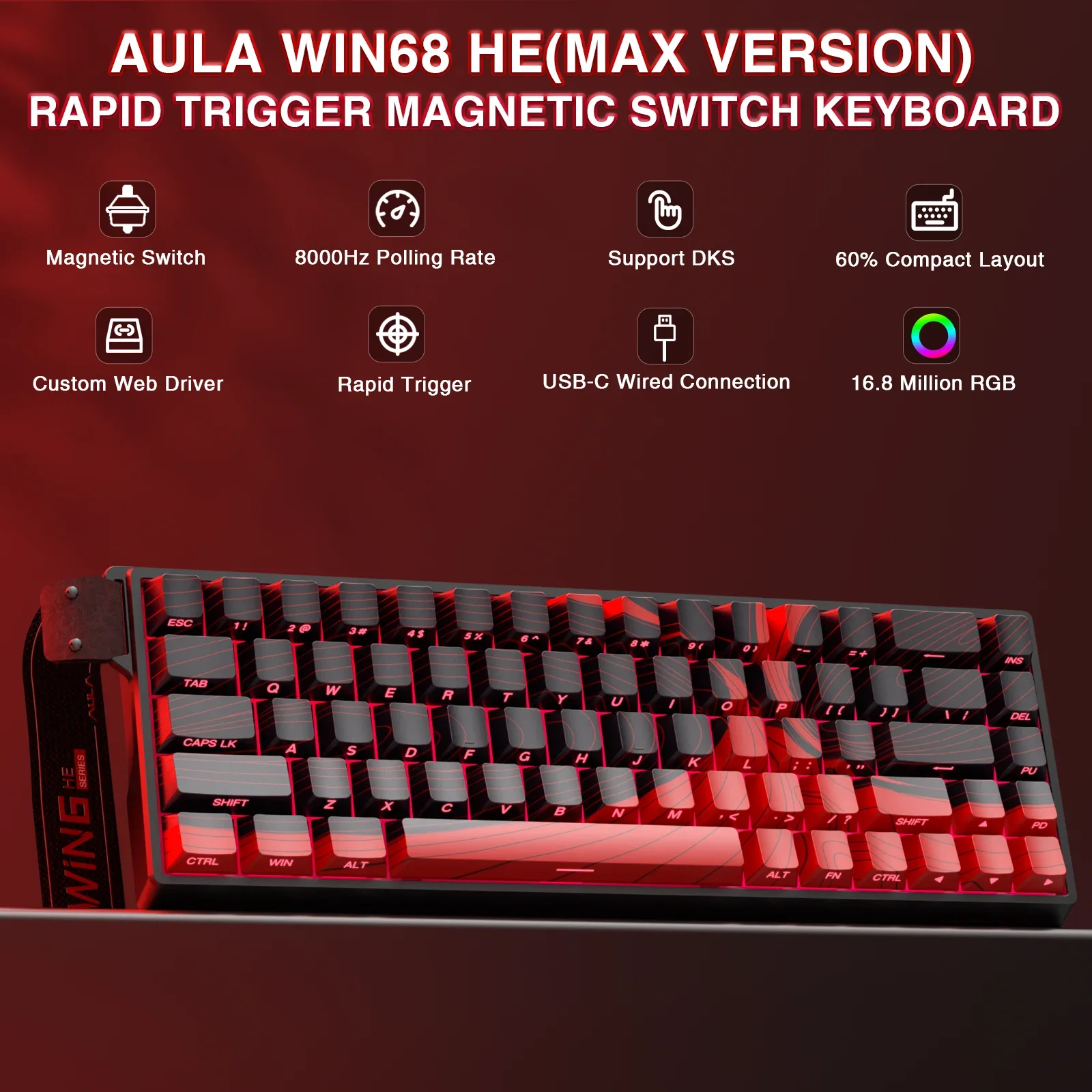
The AULA WIN68 HE is a high-performance magnetic switch keyboard explicitly designed for competitive gaming. It integrates a compact 60-68% layout with advanced rapid trigger technology. This keyboard is built for gamers who demand exacting input precision and lightning-fast response times. Its architecture prioritizes both performance and a satisfying tactile experience.
Unpacking the Core Technology
At its heart, the WIN68 HE utilizes magnetic switches, a departure from traditional mechanical switches. These switches rely on Hall effect sensors, detecting the distance a key travels rather than a physical contact point. This design enables features like rapid trigger, allowing for immediate reset and re-actuation as soon as a key begins to lift. The actuation point is adjustable, offering precision down to 0.02mm.
Traditional mechanical switches typically actuate at a fixed point, often 1.5mm or 2.0mm into the press. Magnetic switches, by contrast, offer a dynamic actuation range. This means that a slight lift of the finger can reset the key, making repeated key presses significantly faster in games requiring rapid input, such as first-person shooters or rhythm games. The competitive edge this provides is substantial.
For gamers transitioning from standard mechanical keyboards, the responsiveness of magnetic switches is immediately noticeable. The ability to customize actuation points means players can fine-tune their input to an almost absurd degree, creating a personalized feel that can improve reaction times. This level of control is not available on most conventional gaming keyboards.
The Auditory and Tactile Profile
This keyboard features a layered sound dampening system. An exploded view reveals multiple layers: a metal positioning plate, PO sandwich cotton, PCB circuit board, PO bottom cotton, and a thick rubber bottom shell. These components work in concert to create a more subdued sound profile.
Keyboards without such dampening often produce a hollow, resonant sound, especially on bottom-out. The inclusion of PO sandwich and bottom cotton layers aims to absorb much of this unwanted acoustic energy. This results in a cleaner, less clacky sound. The sound is less distracting. It offers a more premium auditory experience than many stock boards.
Compared to entry-level mechanical keyboards, which frequently omit internal dampening, the WIN68 HE's construction suggests a focus on acoustic refinement. The goal is a more pleasing 'thock' or muted 'clack' rather than the sharp, high-pitched sounds associated with undamped boards. This makes long gaming sessions less fatiguing on the ears.
Keycap and Stabilizer Examination
The keycaps are described as side-engraved sublimation keycaps. This indicates the legends are dyed into the PBT plastic rather than laser-etched or printed on top. PBT plastic is known for its durability and resistance to shine over time. Side engraving means the legends are on the front face of the keycap, rather than the top. This design choice contributes to a clean top aesthetic and prevents legends from fading due to finger contact.
Many keyboards, especially in this price range, use ABS keycaps. ABS keycaps, while vibrant, tend to develop a greasy shine with prolonged use. PBT keycaps, particularly with dye-sublimation, maintain their texture and appearance for much longer. This ensures the keyboard looks and feels new, even after hundreds of hours of use. The legends remain crisp. This is a significant durability advantage.
Stabilizers are explicitly mentioned as magnetic satellite switches. This is a critical detail for smooth key operation, especially on larger keys like the spacebar, shift, and enter. Magnetic stabilizers aim to reduce wobble and rattle. They provide a consistent key press across the entire width of the keycap. This enhances typing feel. Poor stabilizers can ruin a keyboard's feel.
Connectivity and Polling Rate
The AULA WIN68 HE connects via USB-C wired connection. This ensures a stable and low-latency connection, crucial for competitive gaming. A wired connection eliminates any potential for wireless interference or input lag.
Wireless keyboards, while convenient, introduce an additional layer of potential latency and battery management concerns. For esports, a wired connection remains the gold standard. The USB-C port is also a modern standard, offering reversible connectivity and robust physical design. It is a reliable choice.
Furthermore, the keyboard boasts an 8000Hz polling rate. This means the keyboard reports its status to the computer 8000 times per second. A higher polling rate translates directly to lower input latency. This can provide a fractional but measurable advantage in fast-paced games. The input is registered almost instantly.
Most standard gaming keyboards offer 1000Hz polling rates. An 8000Hz rate reduces the communication delay from 1ms to 0.125ms. While the human eye may not perceive such a minute difference, the cumulative effect over many inputs can contribute to a feeling of greater responsiveness and precision. It minimizes the delay between action and on-screen result.
Customization and Lighting
Customization is a strong suit, with a custom web driver available. This software allows users to fine-tune various aspects of the keyboard's performance. This includes adjusting actuation points, creating macros, and customizing RGB lighting effects. The software provides deep control.
The keyboard features 16.8 million colors of RGB backlight. This extensive color palette allows for personalized lighting schemes. Users can choose from multiple preset lighting effects or customize individual key lighting. The lighting is vivid. It adds aesthetic appeal. This deep customization allows users to match their keyboard's look to their gaming setup or personal preference. It enhances the overall user experience. The lighting options are comprehensive.
Beyond aesthetics, the custom driver and DKS (Dual Key Stroke) support offer functional advantages. DKS allows for different actions depending on the depth of a key press. This provides an additional layer of control for complex game mechanics. It expands user capability.
Build Quality and Durability
The image highlights a thick rubber shell and mentions a thick rubber bottom shell in the exploded view. This substantial construction implies enhanced durability and a premium feel. A heavier, denser keyboard tends to feel more stable on the desk. It resists flexing during intense use.
Many budget keyboards use thin plastic housings that can flex or creak under pressure. The emphasis on a thick rubber shell suggests a robust construction. This contributes to the keyboard's longevity. It also helps dampen sound. The weight provides stability. This build quality is often overlooked but critical for a long-lasting peripheral.
The overall construction, with its multiple dampening layers and robust shell, points to a product built to withstand the rigors of competitive gaming. It's designed for resilience. The attention to internal components like the metal positioning plate further reinforces this commitment to durability. It's a solid piece of hardware.
Switch Options and Feel
The AULA WIN68 HE offers several magnetic switch options, each with distinct pressure characteristics. The Wing Chun Magnetic Axis has an initial pressure of 36gf and a bottom pressure of 49gf, with 0.02mm accuracy. The Semantic Magnetic Axis features 33gf initial and 53gf bottom pressure, with 0.04mm accuracy. The Gray Wood Magnetic Axis offers 32gf initial and 50gf bottom pressure, also with 0.04mm accuracy. Each switch type provides a different tactile force. This allows users to select a switch that best matches their typing and gaming preferences.
The choice of switch directly impacts the feel of the keyboard. Lighter switches (like the Gray Wood) require less force to actuate, potentially reducing finger fatigue during extended use. Heavier switches (like the Semantic) can provide a more substantial feel, reducing accidental presses. The accuracy variance, though slight, caters to the most discerning users. It's about personal preference. This variety is a key advantage, letting users fine-tune their input device.
Imagine the immediate, precise feedback under your fingertips as commands register with unparalleled speed. Picture a battlefield where every micro-adjustment and rapid-fire sequence flows effortlessly from your fingers to the screen. This keyboard promises to be a reliable extension of your will, enhancing your performance and immersing you deeper into the game.