Anycubic Kobra S1 3D Printer
Official Store Deal
Expert Analysis Overview
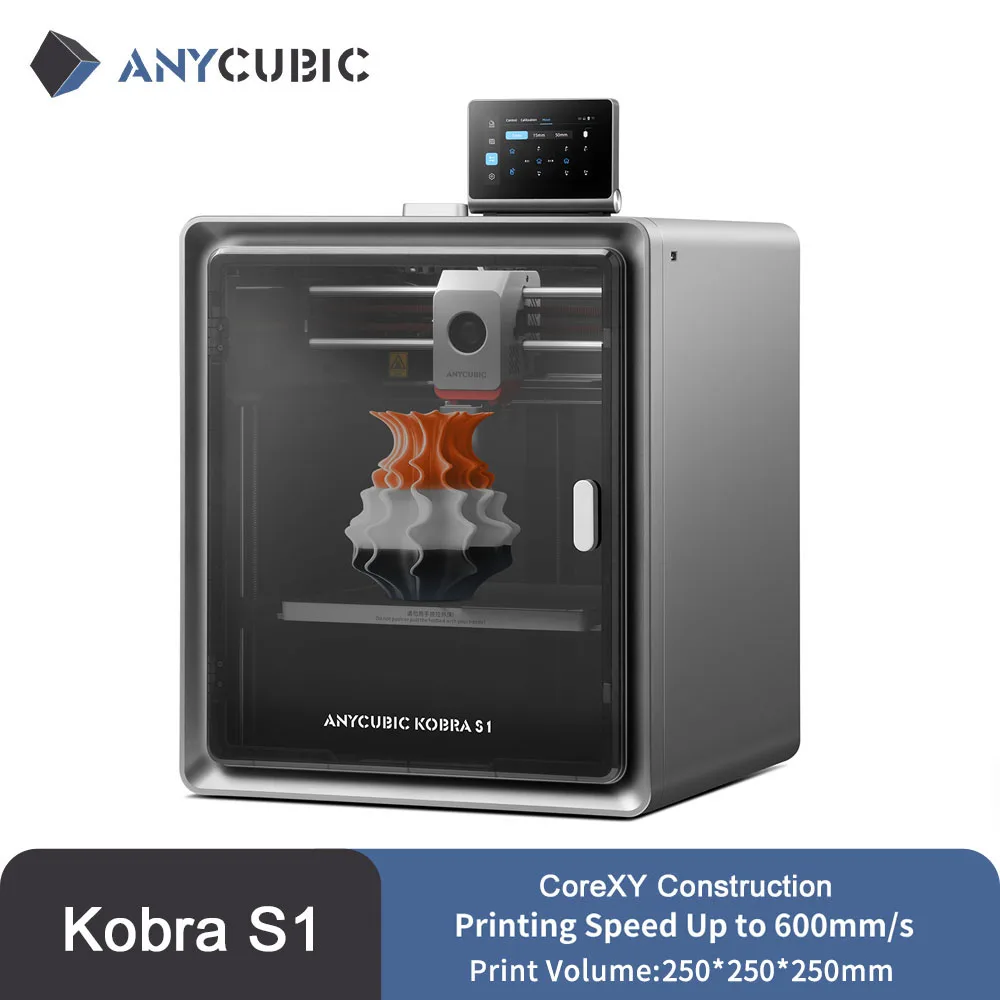
The Anycubic Kobra S1 is a high-speed, enclosed 3D printer aimed at serious hobbyists and makers who demand both rapid prototyping and material versatility. This machine distinguishes itself by integrating a CoreXY motion system within a fully enclosed build chamber, a combination that typically signifies a more advanced and capable printing platform than standard open-frame Cartesian models. Its design points to a printer ready for demanding tasks right out of the box, offering a compelling upgrade for those looking to expand their additive manufacturing capabilities.
The Kobra S1 operates on a CoreXY motion system, a kinematic arrangement where the print head moves in both X and Y axes via a single belt system, while the print bed only moves along the Z-axis. This configuration minimizes moving mass on the print head, leading to significantly reduced inertia. Less inertia translates directly into higher acceleration and print speeds without sacrificing print quality.
Compared to typical Cartesian printers, which often struggle with ringing or ghosting at elevated speeds due to the bed moving back and forth, the CoreXY design maintains print head stability. This stability is crucial. It ensures that intricate details and sharp corners are rendered accurately, even when the machine is pushing its limits. For makers, this means faster iteration cycles on prototypes and more reliable production of final parts.
Consider the inherent stability difference. Many entry-level printers are Cartesian, where the print bed swings around. This printer offers a much more rigid foundation.
Performance metrics for the Kobra S1 indicate a maximum print speed of 600mm/s and a recommended operating speed of 300mm/s, coupled with a maximum acceleration of 20000mm/s². These figures place it firmly in the high-speed category for consumer-grade FDM printers. Such speeds allow for dramatically reduced lead times on projects.
Completing a standard Benchy benchmark print, a common test for 3D printer performance, in approximately 15 minutes showcases its raw speed potential. This rapid output is a game-changer for anyone engaged in frequent prototyping or small-batch manufacturing. Time is valuable.
Unlike many standard desktop printers that top out around 100-150mm/s, the Kobra S1 cuts print durations by a factor of two to four. This efficiency gain translates directly into increased productivity, enabling more projects to be completed in less time. The impact on workflow can be substantial.
The fully enclosed build chamber of the Kobra S1 is a critical feature for anyone serious about printing with engineering-grade filaments. Materials like ABS, ASA, and even some nylons are notorious for warping and delaminating without a stable, warm environment. The enclosure actively mitigates these issues.
By maintaining a consistent internal temperature, the enclosure reduces thermal stress on printed parts, promoting better layer adhesion and dimensional accuracy. This capability expands the range of functional parts that can be reliably produced. Durability improves significantly.
Open-frame printers, while often cheaper, are largely restricted to PLA and PETG for reliable results, especially for larger prints. The Kobra S1's enclosure positions it as a more versatile tool, allowing tinkerers to experiment with materials that offer superior mechanical properties, UV resistance, or chemical resistance for specific applications. This is a clear advantage for functional prints.
At the core of the Kobra S1's material versatility is its 320°C full-metal hotend. This high-temperature capability means the printer can melt and extrude a much broader spectrum of filaments than printers limited to 250°C or less. The full-metal design also ensures greater durability and less wear over time, even with abrasive filaments.
The hotend also supports quick swapping and a range of nozzle sizes, from a fine 0.2mm for detailed work to a robust 0.8mm for faster, coarser prints. This modularity allows makers to quickly adapt the printer to different project requirements. Detail work is possible. Large, quick prints are also manageable.
This level of hotend flexibility is often found on much more expensive professional machines. It empowers users to optimize their print quality and speed for specific applications, whether it's creating incredibly fine miniatures or structurally strong, rapidly printed jigs and fixtures. This adaptability is key for ongoing experimentation.
The Kobra S1 handles a wide array of mainstream filaments, including PLA, PLA+, PETG, ABS, and ASA. This broad compatibility means users are not limited in their material choices for different projects, from basic prototypes to durable, end-use parts. Each material offers distinct properties.
For example, printing with ABS or ASA allows for parts with high impact strength and temperature resistance, ideal for automotive components or outdoor enclosures. PLA and PETG remain excellent choices for general-purpose printing and aesthetic models. The printer's ability to manage these variations without significant modification is a boon for active makers.
While the Kobra S1 supports multi-color printing, it requires the addition of the Anycubic ACE PRO unit. This modular approach allows users to upgrade to multi-material capabilities as their needs evolve, without having to purchase a completely new machine. This is a sensible upgrade path.
Anycubic printers generally benefit from a decent community following, offering resources for troubleshooting, custom firmware, and hardware modifications. The CoreXY structure of the Kobra S1 provides a solid foundation for future enhancements. Makers often seek to optimize their machines beyond factory specifications.
Given the enclosed design, modifications might focus on internal improvements like lighting, camera monitoring, or advanced filtration systems. The swappable hotend already encourages experimentation with different nozzle types or even third-party hotend components, fostering a spirit of customization. Tinkering is encouraged.
For those who enjoy pushing the boundaries of their equipment, the Kobra S1 offers a platform ripe for exploration. Access to shared knowledge within the 3D printing community can provide solutions to common issues and inspiration for unique upgrades. This collaborative aspect extends the printer's value.
The initial investment in the Anycubic Kobra S1 positions it as a serious tool for serious makers. Its combination of high speed, enclosed build volume, and versatile hotend means less time waiting for prints and fewer failed prints due to environmental factors or material limitations. This translates into significant time savings.
Unlike cheaper, slower printers that might frustrate users with their limitations, the Kobra S1 offers a more professional experience, enabling ambitious projects from the start. The capability to reliably print with advanced materials opens doors to creating functional components that withstand real-world conditions. This is a practical advantage.
Consider the cost per successful print. A machine that consistently delivers high-quality results across diverse materials, and does so quickly, effectively lowers the long-term cost of ownership by maximizing material utility and minimizing wasted effort. This printer offers a strong return on investment for the dedicated user. It is a workhorse.
Imagine quickly iterating on product designs, printing durable replacement parts for household items, or even launching a small-scale production of custom components. The Kobra S1 provides the reliability and performance necessary to bring these visions to life, empowering makers to explore new creative and functional possibilities with confidence and efficiency. The possibilities are truly expansive.
Engineering for Speed and Precision
The Kobra S1 operates on a CoreXY motion system, a kinematic arrangement where the print head moves in both X and Y axes via a single belt system, while the print bed only moves along the Z-axis. This configuration minimizes moving mass on the print head, leading to significantly reduced inertia. Less inertia translates directly into higher acceleration and print speeds without sacrificing print quality.
Compared to typical Cartesian printers, which often struggle with ringing or ghosting at elevated speeds due to the bed moving back and forth, the CoreXY design maintains print head stability. This stability is crucial. It ensures that intricate details and sharp corners are rendered accurately, even when the machine is pushing its limits. For makers, this means faster iteration cycles on prototypes and more reliable production of final parts.
Consider the inherent stability difference. Many entry-level printers are Cartesian, where the print bed swings around. This printer offers a much more rigid foundation.
Blazing Through Print Jobs
Performance metrics for the Kobra S1 indicate a maximum print speed of 600mm/s and a recommended operating speed of 300mm/s, coupled with a maximum acceleration of 20000mm/s². These figures place it firmly in the high-speed category for consumer-grade FDM printers. Such speeds allow for dramatically reduced lead times on projects.
Completing a standard Benchy benchmark print, a common test for 3D printer performance, in approximately 15 minutes showcases its raw speed potential. This rapid output is a game-changer for anyone engaged in frequent prototyping or small-batch manufacturing. Time is valuable.
Unlike many standard desktop printers that top out around 100-150mm/s, the Kobra S1 cuts print durations by a factor of two to four. This efficiency gain translates directly into increased productivity, enabling more projects to be completed in less time. The impact on workflow can be substantial.
Enclosed Environment for Advanced Materials
The fully enclosed build chamber of the Kobra S1 is a critical feature for anyone serious about printing with engineering-grade filaments. Materials like ABS, ASA, and even some nylons are notorious for warping and delaminating without a stable, warm environment. The enclosure actively mitigates these issues.
By maintaining a consistent internal temperature, the enclosure reduces thermal stress on printed parts, promoting better layer adhesion and dimensional accuracy. This capability expands the range of functional parts that can be reliably produced. Durability improves significantly.
Open-frame printers, while often cheaper, are largely restricted to PLA and PETG for reliable results, especially for larger prints. The Kobra S1's enclosure positions it as a more versatile tool, allowing tinkerers to experiment with materials that offer superior mechanical properties, UV resistance, or chemical resistance for specific applications. This is a clear advantage for functional prints.
The Versatility of a High-Temperature Hotend
At the core of the Kobra S1's material versatility is its 320°C full-metal hotend. This high-temperature capability means the printer can melt and extrude a much broader spectrum of filaments than printers limited to 250°C or less. The full-metal design also ensures greater durability and less wear over time, even with abrasive filaments.
The hotend also supports quick swapping and a range of nozzle sizes, from a fine 0.2mm for detailed work to a robust 0.8mm for faster, coarser prints. This modularity allows makers to quickly adapt the printer to different project requirements. Detail work is possible. Large, quick prints are also manageable.
This level of hotend flexibility is often found on much more expensive professional machines. It empowers users to optimize their print quality and speed for specific applications, whether it's creating incredibly fine miniatures or structurally strong, rapidly printed jigs and fixtures. This adaptability is key for ongoing experimentation.
Filament Spectrum and Multicolor Potential
The Kobra S1 handles a wide array of mainstream filaments, including PLA, PLA+, PETG, ABS, and ASA. This broad compatibility means users are not limited in their material choices for different projects, from basic prototypes to durable, end-use parts. Each material offers distinct properties.
For example, printing with ABS or ASA allows for parts with high impact strength and temperature resistance, ideal for automotive components or outdoor enclosures. PLA and PETG remain excellent choices for general-purpose printing and aesthetic models. The printer's ability to manage these variations without significant modification is a boon for active makers.
While the Kobra S1 supports multi-color printing, it requires the addition of the Anycubic ACE PRO unit. This modular approach allows users to upgrade to multi-material capabilities as their needs evolve, without having to purchase a completely new machine. This is a sensible upgrade path.
Community and Modification Potential
Anycubic printers generally benefit from a decent community following, offering resources for troubleshooting, custom firmware, and hardware modifications. The CoreXY structure of the Kobra S1 provides a solid foundation for future enhancements. Makers often seek to optimize their machines beyond factory specifications.
Given the enclosed design, modifications might focus on internal improvements like lighting, camera monitoring, or advanced filtration systems. The swappable hotend already encourages experimentation with different nozzle types or even third-party hotend components, fostering a spirit of customization. Tinkering is encouraged.
For those who enjoy pushing the boundaries of their equipment, the Kobra S1 offers a platform ripe for exploration. Access to shared knowledge within the 3D printing community can provide solutions to common issues and inspiration for unique upgrades. This collaborative aspect extends the printer's value.
Long-Term Value for the Maker
The initial investment in the Anycubic Kobra S1 positions it as a serious tool for serious makers. Its combination of high speed, enclosed build volume, and versatile hotend means less time waiting for prints and fewer failed prints due to environmental factors or material limitations. This translates into significant time savings.
Unlike cheaper, slower printers that might frustrate users with their limitations, the Kobra S1 offers a more professional experience, enabling ambitious projects from the start. The capability to reliably print with advanced materials opens doors to creating functional components that withstand real-world conditions. This is a practical advantage.
Consider the cost per successful print. A machine that consistently delivers high-quality results across diverse materials, and does so quickly, effectively lowers the long-term cost of ownership by maximizing material utility and minimizing wasted effort. This printer offers a strong return on investment for the dedicated user. It is a workhorse.
Imagine quickly iterating on product designs, printing durable replacement parts for household items, or even launching a small-scale production of custom components. The Kobra S1 provides the reliability and performance necessary to bring these visions to life, empowering makers to explore new creative and functional possibilities with confidence and efficiency. The possibilities are truly expansive.