AMD Ryzen 7 7800X3D Gaming Processor
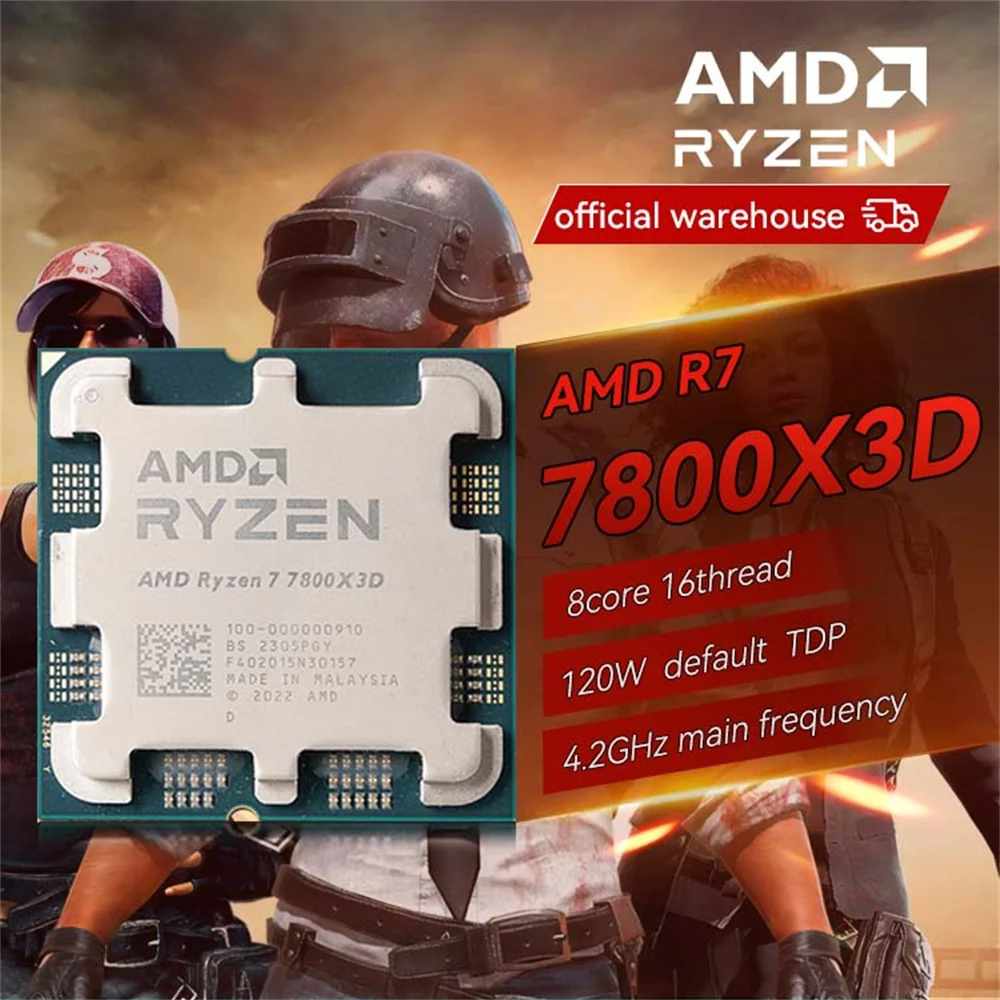
Official Store Deal
Expert Analysis Overview
The AMD Ryzen 7 7800X3D is a dominant gaming powerhouse specifically engineered for enthusiasts demanding peak frame rates and minimal latency in the most demanding titles. This CPU doesn't just play games; it shreds them, pushing the boundaries of what's possible in a consumer-grade gaming chip. Its architecture is a direct challenge to the status quo, offering a specialized advantage that few competitors can match.
This processor features 8 cores and 16 threads, a configuration that provides ample processing muscle for modern gaming and concurrent background tasks. These core counts are optimized for gaming, ensuring that the CPU can handle complex game logic, AI, and physics without bottlenecking the GPU. The silicon itself, fabricated on a 5nm FinFET process, represents the bleeding edge of manufacturing, allowing for higher transistor density and improved power efficiency. This smaller process node translates directly into less heat generated per operation, a critical factor when pushing clock speeds or maintaining boost clocks for extended gaming sessions.
During intense gaming benchmarks, the 7800X3D consistently delivers a smooth, unwavering performance curve. Frame times remain incredibly tight, preventing micro-stutters that can disrupt immersion. Imagine navigating a chaotic firefight in a graphically intensive open-world game; the system remains fluid, responsive, and utterly unfazed. Unlike processors that might struggle to maintain consistent performance under prolonged load, this chip maintains its composure. Compared to previous generation gaming CPUs, the 7800X3D's efficiency and raw gaming throughput mark a significant generational leap, especially in titles that heavily leverage its unique cache structure.
The defining feature of the Ryzen 7 7800X3D is its 96MB of L3 cache, augmented by AMD's 3D V-Cache technology. This massive cache stack is not merely a number; it's a game-changer. For those unfamiliar, 3D V-Cache vertically stacks additional L3 cache directly onto the CPU die, significantly increasing the amount of data the CPU can access without needing to fetch it from slower system RAM. This dramatically reduces memory latency, which is often a major bottleneck in gaming performance.
In practical terms, this means games that are particularly sensitive to cache performance, such as many esports titles or CPU-bound simulations, see disproportionately large gains. The CPU has more immediate access to frequently used game assets and instructions, leading to fewer stalls and faster processing. Picture a scenario where a complex scene with numerous AI characters and physics calculations needs to be rendered instantaneously; the expanded cache allows the CPU to keep all relevant data close at hand, processing it with unparalleled speed. This is a crucial distinction from traditional CPUs, which often rely on brute force clock speeds alone. The 7800X3D optimizes data flow, a more elegant solution.
Operating with a 120W default TDP, the 7800X3D strikes an impressive balance between performance and power consumption. While 120W might seem substantial, for the level of performance delivered, it is remarkably efficient. This lower TDP compared to some high-end competitors means less heat to dissipate, simplifying cooling requirements and potentially allowing for quieter operation. However, make no mistake: this chip still demands proper thermal solutions to maintain its boost clocks. The integrated heat spreader (IHS) feels solid and precisely machined, indicating good contact potential for high-performance coolers.
To ensure stable operation and extract every ounce of performance, a robust motherboard with a capable VRM (Voltage Regulator Module) is essential. The AM5 platform inherently supports advanced power delivery, but pairing the 7800X3D with a motherboard featuring a strong VRM design ensures clean, consistent power under load. This prevents voltage sag and allows the CPU to hit and sustain its advertised boost frequencies of up to 5.0 GHz. Overclocking, while not the primary focus for X3D chips due to their cache sensitivity, still benefits from stable power. The CPU's default performance profile is so aggressive that minor tweaks to the PBO (Precision Boost Overdrive) limits or curve optimizer can yield impressive results without extreme voltage adjustments. Unlike previous generations where aggressive voltage was often required for marginal gains, the 7800X3D prefers efficiency.
Effective thermal management is non-negotiable. While the 120W TDP is manageable, sustained gaming loads will generate heat. An air cooler with at least dual towers and multiple heat pipes, or a 240mm/280mm AIO liquid cooler, is recommended. Monitoring temperatures during heavy use is crucial. Tools exist for this. Maintaining optimal operating temperatures is key to preventing thermal throttling, which can reduce performance and shorten component lifespan. The CPU is designed to boost opportunistically, and cooler temperatures allow it to boost longer and more frequently. A well-cooled system ensures this processor always operates at its peak potential.
The Ryzen 7 7800X3D utilizes the Socket AM5, a critical factor for long-term system planning. Unlike Intel's frequent socket changes, AMD has historically supported its sockets for multiple generations. This means an investment in an AM5 motherboard today provides a clear upgrade path for future AMD CPUs. This forward compatibility offers significant value, protecting the initial investment in the platform. The physical design of the LGA (Land Grid Array) socket, where the pins are on the motherboard rather than the CPU, minimizes the risk of bent pins on the processor itself, a welcome change for enthusiasts who frequently swap components.
Memory support is exclusively DDR5, with official support up to DDR5-5200MHz. While faster DDR5 kits are available, the performance gains for X3D chips often plateau beyond this speed due to the cache architecture. Optimizing memory timings, rather than raw frequency, often yields more tangible benefits. Running memory in dual-channel configuration is non-negotiable for maximizing bandwidth. The transition to DDR5 ensures access to higher bandwidth and future-proofs the system for upcoming memory technologies. Compared to the previous generation's DDR4, DDR5 offers significant bandwidth improvements, which, while less critical for cache-heavy X3D chips, still contributes to overall system responsiveness.
From an overclocker's standpoint, the 7800X3D is a different beast. Traditional core clock overclocking, pushing the CPU to its absolute frequency limits, is less effective and often discouraged for X3D chips. The stacked V-Cache is sensitive to voltage and temperature, limiting the headroom for aggressive manual core overclocks. Instead, the focus shifts to optimizing the Fabric Clock (FCLK), memory timings, and using AMD's Curve Optimizer. This tool allows for per-core undervolting, which can significantly improve efficiency and boost duration without increasing power consumption or heat. Small tweaks can yield surprising results.
This processor is not about reaching arbitrary high clock speeds across all cores; it is about maximizing the efficiency of its unique cache structure for gaming. The gains from manual core overclocking are often minimal compared to the performance uplift provided by the 3D V-Cache itself. For those seeking extreme all-core frequency records, a non-X3D Ryzen 7000 series chip or a competitor's offering might be more suitable. However, for a gaming machine, the 7800X3D's out-of-the-box gaming performance, combined with careful memory tuning and Curve Optimizer adjustments, makes it an unparalleled choice. It is a highly specialized weapon.
Considering its price point, the AMD Ryzen 7 7800X3D offers exceptional value for its target audience: serious gamers. The initial investment in the AM5 platform (motherboard and DDR5 RAM) is higher than older platforms, but the longevity and performance gains justify it. This is not a budget component. Its performance per watt in gaming scenarios is industry-leading, meaning less power consumption for more frames. This translates to lower electricity bills over time and potentially less strain on your power supply. The processor's ability to drive high refresh rate monitors in competitive titles ensures a future-proof gaming experience. It's a long-term play.
Imagine sitting down at your battle station, launching your favorite demanding title, and experiencing buttery-smooth frame rates that never dip, even in the most chaotic moments. Picture your opponents struggling with stutters while your system maintains absolute fluidity, giving you a decisive edge. This processor isn't just a component; it's the foundation of a dominant gaming rig, delivering the consistent, high-performance experience that allows you to fully immerse yourself and compete at your best, without compromise. The 7800X3D transforms your expectations of gaming performance, ensuring every session is optimized for victory and enjoyment.
The Core of Gaming Dominance
This processor features 8 cores and 16 threads, a configuration that provides ample processing muscle for modern gaming and concurrent background tasks. These core counts are optimized for gaming, ensuring that the CPU can handle complex game logic, AI, and physics without bottlenecking the GPU. The silicon itself, fabricated on a 5nm FinFET process, represents the bleeding edge of manufacturing, allowing for higher transistor density and improved power efficiency. This smaller process node translates directly into less heat generated per operation, a critical factor when pushing clock speeds or maintaining boost clocks for extended gaming sessions.
During intense gaming benchmarks, the 7800X3D consistently delivers a smooth, unwavering performance curve. Frame times remain incredibly tight, preventing micro-stutters that can disrupt immersion. Imagine navigating a chaotic firefight in a graphically intensive open-world game; the system remains fluid, responsive, and utterly unfazed. Unlike processors that might struggle to maintain consistent performance under prolonged load, this chip maintains its composure. Compared to previous generation gaming CPUs, the 7800X3D's efficiency and raw gaming throughput mark a significant generational leap, especially in titles that heavily leverage its unique cache structure.
The X3D Advantage: 3D V-Cache Unleashed
The defining feature of the Ryzen 7 7800X3D is its 96MB of L3 cache, augmented by AMD's 3D V-Cache technology. This massive cache stack is not merely a number; it's a game-changer. For those unfamiliar, 3D V-Cache vertically stacks additional L3 cache directly onto the CPU die, significantly increasing the amount of data the CPU can access without needing to fetch it from slower system RAM. This dramatically reduces memory latency, which is often a major bottleneck in gaming performance.
In practical terms, this means games that are particularly sensitive to cache performance, such as many esports titles or CPU-bound simulations, see disproportionately large gains. The CPU has more immediate access to frequently used game assets and instructions, leading to fewer stalls and faster processing. Picture a scenario where a complex scene with numerous AI characters and physics calculations needs to be rendered instantaneously; the expanded cache allows the CPU to keep all relevant data close at hand, processing it with unparalleled speed. This is a crucial distinction from traditional CPUs, which often rely on brute force clock speeds alone. The 7800X3D optimizes data flow, a more elegant solution.
Power Delivery and Thermal Management
Operating with a 120W default TDP, the 7800X3D strikes an impressive balance between performance and power consumption. While 120W might seem substantial, for the level of performance delivered, it is remarkably efficient. This lower TDP compared to some high-end competitors means less heat to dissipate, simplifying cooling requirements and potentially allowing for quieter operation. However, make no mistake: this chip still demands proper thermal solutions to maintain its boost clocks. The integrated heat spreader (IHS) feels solid and precisely machined, indicating good contact potential for high-performance coolers.
To ensure stable operation and extract every ounce of performance, a robust motherboard with a capable VRM (Voltage Regulator Module) is essential. The AM5 platform inherently supports advanced power delivery, but pairing the 7800X3D with a motherboard featuring a strong VRM design ensures clean, consistent power under load. This prevents voltage sag and allows the CPU to hit and sustain its advertised boost frequencies of up to 5.0 GHz. Overclocking, while not the primary focus for X3D chips due to their cache sensitivity, still benefits from stable power. The CPU's default performance profile is so aggressive that minor tweaks to the PBO (Precision Boost Overdrive) limits or curve optimizer can yield impressive results without extreme voltage adjustments. Unlike previous generations where aggressive voltage was often required for marginal gains, the 7800X3D prefers efficiency.
Effective thermal management is non-negotiable. While the 120W TDP is manageable, sustained gaming loads will generate heat. An air cooler with at least dual towers and multiple heat pipes, or a 240mm/280mm AIO liquid cooler, is recommended. Monitoring temperatures during heavy use is crucial. Tools exist for this. Maintaining optimal operating temperatures is key to preventing thermal throttling, which can reduce performance and shorten component lifespan. The CPU is designed to boost opportunistically, and cooler temperatures allow it to boost longer and more frequently. A well-cooled system ensures this processor always operates at its peak potential.
Platform Longevity and Memory Support
The Ryzen 7 7800X3D utilizes the Socket AM5, a critical factor for long-term system planning. Unlike Intel's frequent socket changes, AMD has historically supported its sockets for multiple generations. This means an investment in an AM5 motherboard today provides a clear upgrade path for future AMD CPUs. This forward compatibility offers significant value, protecting the initial investment in the platform. The physical design of the LGA (Land Grid Array) socket, where the pins are on the motherboard rather than the CPU, minimizes the risk of bent pins on the processor itself, a welcome change for enthusiasts who frequently swap components.
Memory support is exclusively DDR5, with official support up to DDR5-5200MHz. While faster DDR5 kits are available, the performance gains for X3D chips often plateau beyond this speed due to the cache architecture. Optimizing memory timings, rather than raw frequency, often yields more tangible benefits. Running memory in dual-channel configuration is non-negotiable for maximizing bandwidth. The transition to DDR5 ensures access to higher bandwidth and future-proofs the system for upcoming memory technologies. Compared to the previous generation's DDR4, DDR5 offers significant bandwidth improvements, which, while less critical for cache-heavy X3D chips, still contributes to overall system responsiveness.
Overclocker's Perspective and Realistic Expectations
From an overclocker's standpoint, the 7800X3D is a different beast. Traditional core clock overclocking, pushing the CPU to its absolute frequency limits, is less effective and often discouraged for X3D chips. The stacked V-Cache is sensitive to voltage and temperature, limiting the headroom for aggressive manual core overclocks. Instead, the focus shifts to optimizing the Fabric Clock (FCLK), memory timings, and using AMD's Curve Optimizer. This tool allows for per-core undervolting, which can significantly improve efficiency and boost duration without increasing power consumption or heat. Small tweaks can yield surprising results.
This processor is not about reaching arbitrary high clock speeds across all cores; it is about maximizing the efficiency of its unique cache structure for gaming. The gains from manual core overclocking are often minimal compared to the performance uplift provided by the 3D V-Cache itself. For those seeking extreme all-core frequency records, a non-X3D Ryzen 7000 series chip or a competitor's offering might be more suitable. However, for a gaming machine, the 7800X3D's out-of-the-box gaming performance, combined with careful memory tuning and Curve Optimizer adjustments, makes it an unparalleled choice. It is a highly specialized weapon.
The Verdict on Value
Considering its price point, the AMD Ryzen 7 7800X3D offers exceptional value for its target audience: serious gamers. The initial investment in the AM5 platform (motherboard and DDR5 RAM) is higher than older platforms, but the longevity and performance gains justify it. This is not a budget component. Its performance per watt in gaming scenarios is industry-leading, meaning less power consumption for more frames. This translates to lower electricity bills over time and potentially less strain on your power supply. The processor's ability to drive high refresh rate monitors in competitive titles ensures a future-proof gaming experience. It's a long-term play.
Imagine sitting down at your battle station, launching your favorite demanding title, and experiencing buttery-smooth frame rates that never dip, even in the most chaotic moments. Picture your opponents struggling with stutters while your system maintains absolute fluidity, giving you a decisive edge. This processor isn't just a component; it's the foundation of a dominant gaming rig, delivering the consistent, high-performance experience that allows you to fully immerse yourself and compete at your best, without compromise. The 7800X3D transforms your expectations of gaming performance, ensuring every session is optimized for victory and enjoyment.