AMD Ryzen 5 7500F AM5 Processor
Official Store Deal
Expert Analysis Overview
The Core of Modern Gaming: AMD Ryzen 5 7500F
The AMD Ryzen 5 7500F is a highly capable 6-core, 12-thread CPU designed for PC builders seeking robust gaming and multitasking performance on the cutting-edge AM5 platform without breaking the bank. This processor offers a compelling entry point into the latest generation of AMD architecture, delivering significant horsepower for demanding applications and modern titles. Its focus on raw computational power makes it an excellent foundation for a dedicated gaming rig.
This processor operates at a base clock of 3.7GHz, capable of boosting to higher frequencies under load. Such speeds ensure applications load quickly. The 5nm manufacturing process is a marvel of modern engineering, allowing for greater transistor density and improved power efficiency. This translates directly into cooler operation and more headroom for performance, a crucial factor for sustained high-performance computing.
Unlike older generations that often struggled with thermal management, the 7500F's efficient design minimizes heat output. This allows for more stable performance over extended periods. Builders can expect a more responsive system, particularly in CPU-intensive tasks. This efficiency also means less strain on cooling solutions, potentially reducing overall system noise.
Architectural Prowess and Performance Metrics
The Ryzen 5 7500F leverages the Zen 4 architecture, bringing substantial improvements over previous generations. This architecture enhances instruction per cycle (IPC) counts, which directly impacts how much work the CPU can accomplish in a given clock cycle. A higher IPC means faster execution of tasks.
With 6 cores and 12 threads, the 7500F handles multithreaded workloads with ease. This is particularly beneficial for simultaneous gaming and streaming, or for content creation tasks like video editing and 3D rendering. The processor manages multiple processes efficiently.
Its 32MB of L3 cache is a significant asset for gaming performance. Large cache sizes reduce latency by keeping frequently accessed data closer to the CPU cores. This results in smoother frame rates and quicker load times in many popular games, providing a noticeable advantage in competitive scenarios. The cache hierarchy is optimized for rapid data access.
Platform Compatibility and Ecosystem Advantages
The AMD Ryzen 5 7500F utilizes the Socket AM5, AMD's latest mainstream desktop platform. This socket introduces support for DDR5 RAM and PCIe 5.0, future-proofing your build. DDR5 memory offers significantly higher bandwidth and lower latency compared to DDR4, directly impacting system responsiveness and gaming performance. PCIe 5.0 provides double the bandwidth of PCIe 4.0, beneficial for next-generation GPUs and NVMe SSDs, ensuring data transfers are lightning-fast.
Choosing an AM5 platform also means access to a growing ecosystem of motherboards. These boards often feature advanced power delivery systems and robust connectivity options. Builders gain flexibility for future upgrades. This platform offers longevity, allowing users to potentially upgrade their CPU within the same socket for several generations.
Careful consideration of motherboard selection is paramount. An appropriate AM5 motherboard ensures full compatibility and unlocks the processor's potential. Verify the motherboard's BIOS version supports the 7500F. Many boards ship with compatible BIOS versions, but a quick check prevents installation headaches. Power delivery on the motherboard must also be sufficient for stable operation, though the 7500F's 65W TDP is relatively modest.
The Value Proposition of a Used Processor
This particular offering is a used processor, which presents a significant value advantage. Purchasing a used CPU allows access to high-performance hardware at a reduced cost. This is an excellent strategy for budget-conscious builders who still demand strong performance. The cost savings can be reallocated to other critical components, such as a more powerful graphics card or increased RAM capacity.
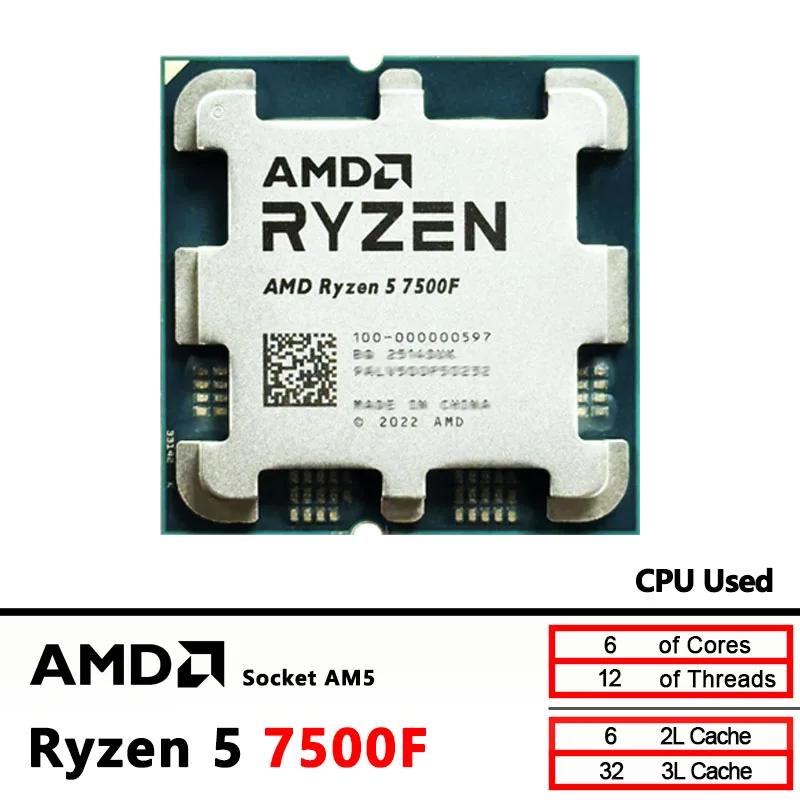
Used processors undergo rigorous inspection before resale. The images show a CPU in good condition. While minor cosmetic imperfections, such as light scratches, are normal for a used component, they do not impact performance. The functional integrity remains intact. The internal components are unaffected by surface blemishes.
Transparency regarding the product's used status is crucial. Buyers should understand that production cycles and manufacturing locations can vary, leading to slight PCB differences. These variations are purely cosmetic and do not affect the CPU's actual use or functional performance. A one-year warranty provides peace of mind for the purchase.
Thermal and Power Considerations
The Ryzen 5 7500F has a Thermal Design Power (TDP) of 65W. This relatively low power draw makes it an efficient processor. A standard CPU cooler, even a stock-equivalent air cooler, can often manage its thermals effectively. For optimal performance and lower noise levels, an aftermarket air cooler or a liquid AIO cooler is recommended, especially for sustained heavy loads or overclocking attempts.
Power supply requirements are also modest due to the 65W TDP. A quality 550W or 650W power supply will be more than sufficient for a system built around the 7500F, even when paired with a mid-range to high-end dedicated graphics card. This efficiency helps keep system power consumption down. Lower power consumption means reduced electricity bills over time.
Ensuring proper airflow within the PC case is always important. Good case ventilation helps dissipate heat from all components, not just the CPU. This contributes to overall system stability and longevity. A well-ventilated case improves thermal performance.
Graphics and Display Output
Crucially, the AMD Ryzen 5 7500F does not include integrated graphics. The 'F' suffix in its model name denotes this absence. This means a dedicated graphics card is absolutely essential for any system built with this CPU. Without a GPU, the system will not output a display. This is a key consideration for system planning.
For gamers, this is often a non-issue, as a dedicated graphics card is always part of a gaming build. However, for users building a system for general productivity or server tasks who might not initially plan for a discrete GPU, this is a vital point. Budget allocation must account for a separate graphics card. This CPU is designed to be paired with a powerful GPU.
This design choice allows AMD to potentially offer the 7500F at a more competitive price point. The cost savings are passed on to the consumer. Users who already own a graphics card or plan to purchase one benefit most from this configuration. It streamlines the processor's function to pure computational tasks.
Building with the 7500F: Practical Considerations
When integrating the 7500F into a build, physical dimensions are standard for an AM5 CPU. It will fit into any compatible AM5 motherboard socket. Cooler clearance, however, depends on the chosen motherboard and case. Most standard tower coolers and AIOs are designed to fit within typical ATX or Micro-ATX cases. Always check cooler height specifications against case maximums.
Installation of an AM5 CPU is straightforward, following the standard LGA (Land Grid Array) procedure. Pins are on the motherboard socket, not the CPU. This design reduces the risk of bent pins on the processor itself. Careful alignment and gentle placement are key. Secure the retention arm firmly.
For those upgrading from older platforms, the 7500F offers a substantial performance leap. The transition to AM5 necessitates a new motherboard and DDR5 RAM. While an investment, this upgrade provides a modern foundation for years to come. The performance gains justify the platform transition.
Imagine firing up your favorite AAA title, experiencing buttery-smooth frame rates and rapid load times, all powered by a processor that handles every demand with effortless grace. Picture yourself seamlessly switching between intense gaming sessions and productivity tasks, knowing your system is built on a robust, future-ready foundation. This processor empowers a responsive, high-performance computing experience, allowing you to focus on what matters most: enjoying your digital world without compromise.