AMD Ryzen 5 2600 CPU Processor AM4
Official Store Deal
Expert Analysis Overview
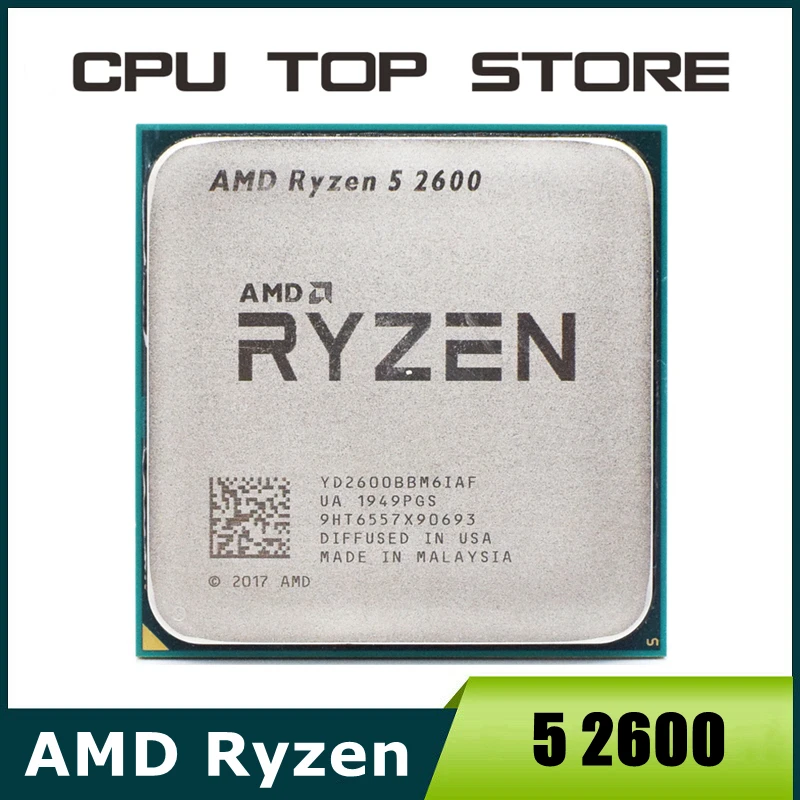
The AMD Ryzen 5 2600 is a highly capable mid-range processor, delivering exceptional multi-threaded performance for budget-conscious PC builders and upgraders. It represents a significant value proposition for those seeking a robust foundation for gaming, content creation, and everyday productivity without a premium price tag. This CPU, with its distinct metallic heat spreader and gold-plated pins, feels substantial in hand, indicating a quality build. The clear "AMD RYZEN 5 2600" branding on the integrated heat spreader (IHS) immediately confirms its identity, a solid piece of engineering.
At its heart, the Ryzen 5 2600 features six physical cores and twelve processing threads. This configuration allows the CPU to handle multiple tasks simultaneously with remarkable efficiency, a cornerstone of modern computing. The base clock speed operates at a respectable 3.4 GHz, capable of boosting up to 3.9 GHz under optimal thermal and power conditions. This clock speed provides a solid foundation for diverse workloads. The CPU’s design prioritizes parallel processing.
For the user, this translates directly into a smoother and more responsive computing experience. Imagine running a demanding game like Cyberpunk 2077 or Assassin's Creed Valhalla, streaming music in the background, and having multiple resource-intensive browser tabs open, all without experiencing noticeable slowdowns or frustrating stutters. The twelve threads are particularly beneficial for applications specifically designed to leverage parallel processing, such as professional video editing software like Adobe Premiere Pro, 3D rendering programs like Blender, or even complex scientific simulations that require extensive computational power. This CPU excels in such scenarios, making it a powerful tool.
Compared to its predecessor, the first-generation Ryzen 5 1600, the 2600, built on the refined Zen+ architecture, offered subtle but meaningful improvements across the board. While the core and thread count remained consistent, the refinements in the 12nm manufacturing process, coupled with enhancements to memory latency and cache performance, provided a noticeable uplift in real-world responsiveness and frame rates in many popular gaming titles. It was a clear step forward for the platform, offering tangible gains.
The Ryzen 5 2600 utilizes AMD's Zen+ architecture, fabricated on a refined 12-nanometer (nm) manufacturing process. This process node is smaller and more efficient than the 14nm of the original Zen architecture, allowing for higher clock speeds at similar power levels or, conversely, lower power consumption at similar clock speeds. This efficiency is crucial for performance and thermal management. The smaller transistors mean more can fit.
This architectural iteration brought about several key improvements, most notably in instruction per cycle (IPC) performance. IPC refers to the number of instructions a CPU can execute in a single clock cycle; higher IPC means more work gets done faster. Zen+ also contributed to better memory compatibility and lower memory latency, which are vital for Ryzen processors to perform at their peak due as the internal Infinity Fabric interconnect scales with memory speed. These subtle tweaks enhance overall system snappiness and responsiveness, making daily tasks feel quicker.
When contrasted with Intel's competing offerings from the same generation, such as the Core i5-8400 or i5-8600K, the Ryzen 5 2600 often presented a compelling alternative, particularly in multi-threaded workloads. While Intel might have held a slight edge in single-core performance for some specific, older games, the Ryzen's superior thread count provided a distinct advantage in productivity tasks, streaming, and applications that could fully utilize all available threads. It offered more versatility for the average user, providing a balanced approach to computing.
The Ryzen 5 2600 is designed for the AM4 socket, a platform that has proven to be remarkably long-lived and versatile since its introduction. This socket compatibility means it can be paired with a wide array of motherboards, from entry-level A320 boards (though B350, B450, or even X470 chipsets are generally recommended for full feature access and overclocking capabilities) to high-end X570 boards with appropriate BIOS updates. This support is a major advantage for builders.
For users, this translates into significant flexibility when building a new system or upgrading an existing one. An existing AM4 motherboard, perhaps from an older Ryzen 1000 series build, can often be updated with a simple BIOS flash to support the 2600, providing an affordable and substantial performance boost without needing a complete platform overhaul. This backward compatibility extends the life of existing hardware investments, saving money.
The longevity of the AM4 platform, which supported multiple generations of Ryzen processors (from Zen to Zen 3), stands in stark contrast to some competing platforms that saw more frequent socket changes, forcing users into expensive motherboard upgrades. This commitment from AMD to a stable socket allowed users to invest in a motherboard with confidence, knowing they had a clear and viable upgrade path for several years. This platform strategy benefited many, fostering a loyal user base.
With a Thermal Design Power (TDP) of 65 watts, the Ryzen 5 2600 is a relatively power-efficient processor for its core count and performance. This moderate TDP simplifies cooling requirements, making it suitable for a wide range of cooling solutions, from basic air coolers to more advanced liquid cooling setups. The CPU's integrated heat spreader (IHS), a solid piece of metal, efficiently transfers heat from the silicon die to the attached cooler. This efficiency is a practical benefit.
This power efficiency means that even a modest aftermarket cooler, or in some cases, the bundled Wraith Stealth cooler (if it were included with this specific offering, though it is not), can effectively manage the heat generated by the 2600, even under sustained heavy loads. This allows for quieter system operation and helps prevent thermal throttling, ensuring consistent performance during extended gaming sessions, video encoding, or other demanding workloads. Good cooling is essential for stability.
Compared to higher-end processors with TDPs exceeding 100W or even 200W, the 2600's 65W rating means significantly less heat is dumped into the PC case. This can be a significant factor for users building compact Small Form Factor (SFF) systems where airflow is restricted, or for those prioritizing a quiet computing environment. It offers a cooler and quieter experience, which is often overlooked.
The Ryzen 5 2600 supports DDR4 memory, and it is particularly sensitive to and benefits significantly from faster RAM speeds. The integrated memory controller is designed to work optimally with dual-channel configurations and higher frequencies, such as DDR4-3000MHz or DDR4-3200MHz. This is crucial for performance.
The impact of memory speed on Ryzen performance cannot be overstated, especially for the 2000 series. This is largely due to AMD's Infinity Fabric interconnect, which links the CPU's core complexes (CCXes) and scales directly with the memory clock speed. Faster RAM means a faster Infinity Fabric, which in turn leads to lower latency between cores and improved data transfer rates across the CPU. Users will notice the difference in responsiveness.
Unlike some older Intel platforms that were less sensitive to memory speed, Ryzen processors, particularly the 2000 series, truly shine when paired with optimized DDR4 kits. Investing in a good set of 3000MHz or 3200MHz RAM with decent timings (e.g., CL16) is often one of the most cost-effective upgrades to unlock the full potential of a Ryzen 2600 system, providing a tangible boost in gaming frame rates and application performance. It's a smart investment for any builder.
Equipped with a generous 16MB of L3 cache, the Ryzen 5 2600 ensures that frequently accessed data is readily available to the CPU cores without having to fetch it from the much slower system RAM. This large cache minimizes the need for high-latency memory access, thereby reducing overall latency and improving the processor's responsiveness. Fast access is key.
For gamers, a larger L3 cache can translate into smoother frame delivery, reduced stuttering, and faster loading times, especially in titles that are sensitive to data access speeds and frequently reuse game assets. For productivity users, it means quicker loading times for large files, more fluid operation within demanding applications like CAD software, and improved compilation times for developers. The cache makes a significant difference in daily use.
This 16MB L3 cache was a standard offering for many mid-range Ryzen processors of its generation, providing a substantial buffer compared to CPUs with smaller cache sizes. The efficient cache design, combined with the Zen+ architecture's improvements, contributes significantly to the processor's ability to handle complex tasks with agility and maintain high throughput. It handles complex data well, keeping the cores fed.
A critical aspect of the Ryzen 5 2600 is its lack of integrated graphics. This means that a dedicated graphics card is absolutely necessary for any system built around this CPU to output a display to a monitor. The CPU itself is purely a processing unit, focused solely on computational tasks. This is a design choice.
For PC builders, this is an important consideration for the overall budget and component selection. While it adds the cost of a separate GPU, it also allows for greater flexibility in choosing a graphics solution tailored precisely to specific needs, from an entry-level card for basic display output and light gaming to a high-performance card for demanding gaming or professional rendering. A dedicated GPU offers choice and specialization.
This design choice contrasts with AMD's "G" series Ryzen processors (e.g., Ryzen 5 2400G), which include powerful integrated Vega graphics. The 2600 targets users who already plan to purchase a discrete graphics card, allowing AMD to allocate more silicon area to CPU cores and cache, thereby optimizing raw processing power rather than splitting resources with a GPU. It focuses on raw CPU power, which is its strength.
The Ryzen 5 2600 continues to offer an outstanding performance-per-dollar ratio, especially when considering its current pricing in the used or refurbished market. Its accessible price point makes it an incredibly attractive option for budget-conscious builders or those looking to revive an older AM4 system with a significant performance uplift. This value is compelling.
For someone assembling a new PC on a tight budget, the 2600 allows more funds to be allocated towards other critical components like a better graphics card, a faster NVMe SSD, or more capacious RAM, which can collectively have a more noticeable impact on overall system performance and user experience. It enables balanced builds that don't compromise on key areas.
Compared to newer, more expensive processors, the 2600 still holds its own in many common workloads, particularly when multi-threading is utilized. While it won't break any benchmark records against current-generation flagships, the sheer capability it provides for its cost makes it a compelling choice for many users seeking a capable and affordable CPU. It delivers solid bang for the buck, making it a smart economic choice.
Installing the Ryzen 5 2600 involves careful handling due to its Pin Grid Array (PGA) design, where the pins are located on the CPU itself rather than within the motherboard socket. The process requires precise alignment of the CPU's triangular gold arrow with the corresponding mark on the AM4 socket, followed by gentle placement to avoid bending any of the delicate pins. This precision is vital.
Once the CPU is correctly seated in the socket, the retention lever should be lowered and locked into place, securing the processor firmly. Following this, applying a small, pea-sized amount of thermal paste to the integrated heat spreader (IHS) before installing the CPU cooler ensures efficient heat transfer from the CPU die to the cooler's base. Proper installation prevents overheating.
A common pitfall for new builders, or those upgrading older AM4 systems, is forgetting to update the motherboard's BIOS. While newer AM4 boards often ship with compatible BIOS versions, older B350 or X370 chipsets might require a specific BIOS update to properly recognize and support the 2nd generation Ryzen CPU. This step is often overlooked but critical for initial boot-up and stability.
Despite being a few generations old, the Ryzen 5 2600 maintains its relevance for a wide array of computing tasks. Its six cores and twelve threads are still more than adequate for most modern games at reasonable settings (e.g., 1080p at 60 frames per second or higher when paired with a capable GPU), general productivity, and even light content creation such as video editing or graphic design. It holds up well.
For users who are not chasing the absolute highest frame rates in the latest AAA titles or performing professional-grade, time-sensitive rendering, the 2600 provides a perfectly capable and enjoyable computing experience. It's a reliable workhorse that can handle daily demands without complaint, offering consistent performance.
While newer Ryzen generations offer significant performance uplifts, particularly in single-core tasks and overall efficiency, the 2600's accessible price point and solid multi-threaded capabilities ensure it remains a viable option for budget builds or as an economical upgrade for older systems that need a boost. It's still a good choice for those prioritizing value.
From a PC builder's perspective, the Ryzen 5 2600 simplifies several aspects of system design and component selection. Its 65W TDP means less stress on the power supply unit (PSU) and less heat to dissipate within the case, making it easier to select a suitable and often more affordable cooler, and to maintain good case airflow without resorting to aggressive fan curves. This simplifies component selection.
Ensuring motherboard compatibility is straightforward with the widely adopted AM4 socket, though a quick check of the motherboard manufacturer's CPU support list for the required BIOS version is always prudent before purchase. The wide availability of affordable AM4 motherboards, from various manufacturers and with different feature sets, further enhances its appeal for budget builds, offering plenty of options. Compatibility is key for a smooth build.
Finally, verifying power supply sufficiency is generally easy with the 2600. A decent quality 450W-550W PSU from a reputable brand is typically more than enough for a system featuring this CPU and a mid-range graphics card, offering plenty of headroom for stable operation and future component additions. It's not power hungry, allowing for more budget flexibility elsewhere.
Imagine the satisfaction of assembling a new PC, powered by the AMD Ryzen 5 2600, knowing you've built a capable machine that handles your daily tasks, gaming adventures, and creative pursuits with ease. Picture smooth multitasking as you effortlessly switch between applications, responsive gameplay as you dive into virtual worlds, and efficient rendering as your personal projects come to life. This processor provides the solid foundation for a reliable and enjoyable computing experience, allowing you to focus on what matters most: using your PC to its fullest potential, without compromise.
The Core of Performance: Six Cores, Twelve Threads for Multitasking Mastery
At its heart, the Ryzen 5 2600 features six physical cores and twelve processing threads. This configuration allows the CPU to handle multiple tasks simultaneously with remarkable efficiency, a cornerstone of modern computing. The base clock speed operates at a respectable 3.4 GHz, capable of boosting up to 3.9 GHz under optimal thermal and power conditions. This clock speed provides a solid foundation for diverse workloads. The CPU’s design prioritizes parallel processing.
For the user, this translates directly into a smoother and more responsive computing experience. Imagine running a demanding game like Cyberpunk 2077 or Assassin's Creed Valhalla, streaming music in the background, and having multiple resource-intensive browser tabs open, all without experiencing noticeable slowdowns or frustrating stutters. The twelve threads are particularly beneficial for applications specifically designed to leverage parallel processing, such as professional video editing software like Adobe Premiere Pro, 3D rendering programs like Blender, or even complex scientific simulations that require extensive computational power. This CPU excels in such scenarios, making it a powerful tool.
Compared to its predecessor, the first-generation Ryzen 5 1600, the 2600, built on the refined Zen+ architecture, offered subtle but meaningful improvements across the board. While the core and thread count remained consistent, the refinements in the 12nm manufacturing process, coupled with enhancements to memory latency and cache performance, provided a noticeable uplift in real-world responsiveness and frame rates in many popular gaming titles. It was a clear step forward for the platform, offering tangible gains.
Architectural Refinements: Zen+ and the 12nm Process Node
The Ryzen 5 2600 utilizes AMD's Zen+ architecture, fabricated on a refined 12-nanometer (nm) manufacturing process. This process node is smaller and more efficient than the 14nm of the original Zen architecture, allowing for higher clock speeds at similar power levels or, conversely, lower power consumption at similar clock speeds. This efficiency is crucial for performance and thermal management. The smaller transistors mean more can fit.
This architectural iteration brought about several key improvements, most notably in instruction per cycle (IPC) performance. IPC refers to the number of instructions a CPU can execute in a single clock cycle; higher IPC means more work gets done faster. Zen+ also contributed to better memory compatibility and lower memory latency, which are vital for Ryzen processors to perform at their peak due as the internal Infinity Fabric interconnect scales with memory speed. These subtle tweaks enhance overall system snappiness and responsiveness, making daily tasks feel quicker.
When contrasted with Intel's competing offerings from the same generation, such as the Core i5-8400 or i5-8600K, the Ryzen 5 2600 often presented a compelling alternative, particularly in multi-threaded workloads. While Intel might have held a slight edge in single-core performance for some specific, older games, the Ryzen's superior thread count provided a distinct advantage in productivity tasks, streaming, and applications that could fully utilize all available threads. It offered more versatility for the average user, providing a balanced approach to computing.
The AM4 Ecosystem: A Foundation for Flexibility and Future Upgrades
The Ryzen 5 2600 is designed for the AM4 socket, a platform that has proven to be remarkably long-lived and versatile since its introduction. This socket compatibility means it can be paired with a wide array of motherboards, from entry-level A320 boards (though B350, B450, or even X470 chipsets are generally recommended for full feature access and overclocking capabilities) to high-end X570 boards with appropriate BIOS updates. This support is a major advantage for builders.
For users, this translates into significant flexibility when building a new system or upgrading an existing one. An existing AM4 motherboard, perhaps from an older Ryzen 1000 series build, can often be updated with a simple BIOS flash to support the 2600, providing an affordable and substantial performance boost without needing a complete platform overhaul. This backward compatibility extends the life of existing hardware investments, saving money.
The longevity of the AM4 platform, which supported multiple generations of Ryzen processors (from Zen to Zen 3), stands in stark contrast to some competing platforms that saw more frequent socket changes, forcing users into expensive motherboard upgrades. This commitment from AMD to a stable socket allowed users to invest in a motherboard with confidence, knowing they had a clear and viable upgrade path for several years. This platform strategy benefited many, fostering a loyal user base.
Thermal Management and Power Efficiency: A Balanced Approach to Cooling
With a Thermal Design Power (TDP) of 65 watts, the Ryzen 5 2600 is a relatively power-efficient processor for its core count and performance. This moderate TDP simplifies cooling requirements, making it suitable for a wide range of cooling solutions, from basic air coolers to more advanced liquid cooling setups. The CPU's integrated heat spreader (IHS), a solid piece of metal, efficiently transfers heat from the silicon die to the attached cooler. This efficiency is a practical benefit.
This power efficiency means that even a modest aftermarket cooler, or in some cases, the bundled Wraith Stealth cooler (if it were included with this specific offering, though it is not), can effectively manage the heat generated by the 2600, even under sustained heavy loads. This allows for quieter system operation and helps prevent thermal throttling, ensuring consistent performance during extended gaming sessions, video encoding, or other demanding workloads. Good cooling is essential for stability.
Compared to higher-end processors with TDPs exceeding 100W or even 200W, the 2600's 65W rating means significantly less heat is dumped into the PC case. This can be a significant factor for users building compact Small Form Factor (SFF) systems where airflow is restricted, or for those prioritizing a quiet computing environment. It offers a cooler and quieter experience, which is often overlooked.
Memory Interfacing: Optimizing with DDR4 for Peak Performance
The Ryzen 5 2600 supports DDR4 memory, and it is particularly sensitive to and benefits significantly from faster RAM speeds. The integrated memory controller is designed to work optimally with dual-channel configurations and higher frequencies, such as DDR4-3000MHz or DDR4-3200MHz. This is crucial for performance.
The impact of memory speed on Ryzen performance cannot be overstated, especially for the 2000 series. This is largely due to AMD's Infinity Fabric interconnect, which links the CPU's core complexes (CCXes) and scales directly with the memory clock speed. Faster RAM means a faster Infinity Fabric, which in turn leads to lower latency between cores and improved data transfer rates across the CPU. Users will notice the difference in responsiveness.
Unlike some older Intel platforms that were less sensitive to memory speed, Ryzen processors, particularly the 2000 series, truly shine when paired with optimized DDR4 kits. Investing in a good set of 3000MHz or 3200MHz RAM with decent timings (e.g., CL16) is often one of the most cost-effective upgrades to unlock the full potential of a Ryzen 2600 system, providing a tangible boost in gaming frame rates and application performance. It's a smart investment for any builder.
Cache Hierarchy: Accelerating Data Access with 16MB L3
Equipped with a generous 16MB of L3 cache, the Ryzen 5 2600 ensures that frequently accessed data is readily available to the CPU cores without having to fetch it from the much slower system RAM. This large cache minimizes the need for high-latency memory access, thereby reducing overall latency and improving the processor's responsiveness. Fast access is key.
For gamers, a larger L3 cache can translate into smoother frame delivery, reduced stuttering, and faster loading times, especially in titles that are sensitive to data access speeds and frequently reuse game assets. For productivity users, it means quicker loading times for large files, more fluid operation within demanding applications like CAD software, and improved compilation times for developers. The cache makes a significant difference in daily use.
This 16MB L3 cache was a standard offering for many mid-range Ryzen processors of its generation, providing a substantial buffer compared to CPUs with smaller cache sizes. The efficient cache design, combined with the Zen+ architecture's improvements, contributes significantly to the processor's ability to handle complex tasks with agility and maintain high throughput. It handles complex data well, keeping the cores fed.
Graphics Considerations: The Necessity of a Dedicated GPU
A critical aspect of the Ryzen 5 2600 is its lack of integrated graphics. This means that a dedicated graphics card is absolutely necessary for any system built around this CPU to output a display to a monitor. The CPU itself is purely a processing unit, focused solely on computational tasks. This is a design choice.
For PC builders, this is an important consideration for the overall budget and component selection. While it adds the cost of a separate GPU, it also allows for greater flexibility in choosing a graphics solution tailored precisely to specific needs, from an entry-level card for basic display output and light gaming to a high-performance card for demanding gaming or professional rendering. A dedicated GPU offers choice and specialization.
This design choice contrasts with AMD's "G" series Ryzen processors (e.g., Ryzen 5 2400G), which include powerful integrated Vega graphics. The 2600 targets users who already plan to purchase a discrete graphics card, allowing AMD to allocate more silicon area to CPU cores and cache, thereby optimizing raw processing power rather than splitting resources with a GPU. It focuses on raw CPU power, which is its strength.
Value Proposition: Unmatched Performance per Dollar in its Segment
The Ryzen 5 2600 continues to offer an outstanding performance-per-dollar ratio, especially when considering its current pricing in the used or refurbished market. Its accessible price point makes it an incredibly attractive option for budget-conscious builders or those looking to revive an older AM4 system with a significant performance uplift. This value is compelling.
For someone assembling a new PC on a tight budget, the 2600 allows more funds to be allocated towards other critical components like a better graphics card, a faster NVMe SSD, or more capacious RAM, which can collectively have a more noticeable impact on overall system performance and user experience. It enables balanced builds that don't compromise on key areas.
Compared to newer, more expensive processors, the 2600 still holds its own in many common workloads, particularly when multi-threading is utilized. While it won't break any benchmark records against current-generation flagships, the sheer capability it provides for its cost makes it a compelling choice for many users seeking a capable and affordable CPU. It delivers solid bang for the buck, making it a smart economic choice.
Installation and Setup: Precision is Paramount for a Smooth Build
Installing the Ryzen 5 2600 involves careful handling due to its Pin Grid Array (PGA) design, where the pins are located on the CPU itself rather than within the motherboard socket. The process requires precise alignment of the CPU's triangular gold arrow with the corresponding mark on the AM4 socket, followed by gentle placement to avoid bending any of the delicate pins. This precision is vital.
Once the CPU is correctly seated in the socket, the retention lever should be lowered and locked into place, securing the processor firmly. Following this, applying a small, pea-sized amount of thermal paste to the integrated heat spreader (IHS) before installing the CPU cooler ensures efficient heat transfer from the CPU die to the cooler's base. Proper installation prevents overheating.
A common pitfall for new builders, or those upgrading older AM4 systems, is forgetting to update the motherboard's BIOS. While newer AM4 boards often ship with compatible BIOS versions, older B350 or X370 chipsets might require a specific BIOS update to properly recognize and support the 2nd generation Ryzen CPU. This step is often overlooked but critical for initial boot-up and stability.
Longevity and Continued Relevance: A Solid Performer for Years to Come
Despite being a few generations old, the Ryzen 5 2600 maintains its relevance for a wide array of computing tasks. Its six cores and twelve threads are still more than adequate for most modern games at reasonable settings (e.g., 1080p at 60 frames per second or higher when paired with a capable GPU), general productivity, and even light content creation such as video editing or graphic design. It holds up well.
For users who are not chasing the absolute highest frame rates in the latest AAA titles or performing professional-grade, time-sensitive rendering, the 2600 provides a perfectly capable and enjoyable computing experience. It's a reliable workhorse that can handle daily demands without complaint, offering consistent performance.
While newer Ryzen generations offer significant performance uplifts, particularly in single-core tasks and overall efficiency, the 2600's accessible price point and solid multi-threaded capabilities ensure it remains a viable option for budget builds or as an economical upgrade for older systems that need a boost. It's still a good choice for those prioritizing value.
The PC Builder's Perspective: Seamless Integration and System Stability
From a PC builder's perspective, the Ryzen 5 2600 simplifies several aspects of system design and component selection. Its 65W TDP means less stress on the power supply unit (PSU) and less heat to dissipate within the case, making it easier to select a suitable and often more affordable cooler, and to maintain good case airflow without resorting to aggressive fan curves. This simplifies component selection.
Ensuring motherboard compatibility is straightforward with the widely adopted AM4 socket, though a quick check of the motherboard manufacturer's CPU support list for the required BIOS version is always prudent before purchase. The wide availability of affordable AM4 motherboards, from various manufacturers and with different feature sets, further enhances its appeal for budget builds, offering plenty of options. Compatibility is key for a smooth build.
Finally, verifying power supply sufficiency is generally easy with the 2600. A decent quality 450W-550W PSU from a reputable brand is typically more than enough for a system featuring this CPU and a mid-range graphics card, offering plenty of headroom for stable operation and future component additions. It's not power hungry, allowing for more budget flexibility elsewhere.
Imagine the satisfaction of assembling a new PC, powered by the AMD Ryzen 5 2600, knowing you've built a capable machine that handles your daily tasks, gaming adventures, and creative pursuits with ease. Picture smooth multitasking as you effortlessly switch between applications, responsive gameplay as you dive into virtual worlds, and efficient rendering as your personal projects come to life. This processor provides the solid foundation for a reliable and enjoyable computing experience, allowing you to focus on what matters most: using your PC to its fullest potential, without compromise.