5015 Centrifugal Blower Fan for 3D Printer Cooling
Official Store Deal
Expert Analysis Overview
The 5015 Centrifugal Blower Fan is a versatile and compact airflow solution, particularly valued by makers and tinkerers for its focused cooling capabilities in custom electronics and 3D printing applications. This fan is specifically engineered to provide directional air movement, making it indispensable for tasks requiring precise heat dissipation or rapid material setting.
Centrifugal fans, often called blowers or radial fans, operate by drawing air in axially and expelling it radially through a ninety-degree turn. This design creates a concentrated, high-pressure airflow, unlike axial fans that produce a broader, lower-pressure flow. The tight stream of air is crucial for specific cooling demands.
For 3D printing, this focused airflow directly impacts print quality. A hotend, for instance, requires efficient cooling to prevent heat creep, a common issue where heat travels up the filament path, causing clogs. Similarly, part cooling fans solidify extruded plastic layers quickly, preventing warping and improving overhang quality. Precise airflow matters.
Compared to a standard axial fan, the centrifugal design excels at pushing air through restrictive ducts or targeted nozzles. Axial fans, while great for general case cooling, struggle to build the static pressure needed for directed air streams. This distinction makes the 5015 blower fan a superior choice for applications where air needs to be channeled effectively.
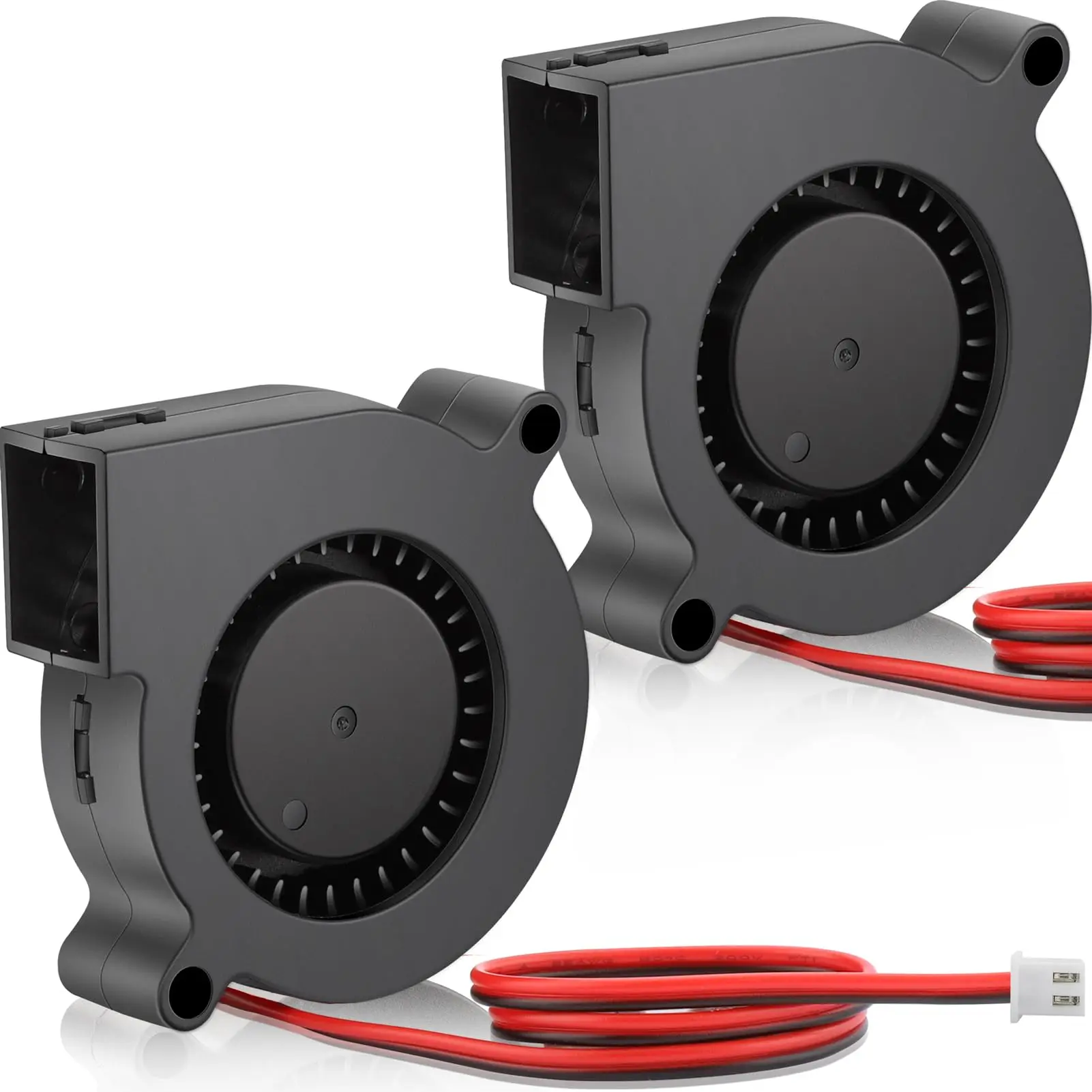
The fan unit itself measures 50x50x15mm, a compact form factor ideal for integration into tight spaces. Its housing is constructed from a matte black plastic, visually consistent across various units. This material choice contributes to its light weight and ease of mounting in custom enclosures or print head assemblies.
This small size is a significant advantage for 3D printer hotends and part cooling systems, where space is often at a premium. Users frequently design custom shrouds or mounts to direct the fan's output precisely where needed. The compact nature allows for dual-fan setups without adding excessive bulk to the print head, a common modification for advanced cooling.
Generic axial fans of similar dimensions often lack the necessary static pressure for ducted applications. Their open design means air disperses more readily. The enclosed volute of the 5015 fan channels air efficiently. It's a focused tool.
Power is supplied via a 2-pin XH2.54 connector, a common standard in DIY electronics and 3D printing. The wiring is typically red for positive and black for negative, a universal color code that simplifies integration. The connector's standard 2.54mm spacing ensures compatibility with many existing boards and breakout modules, reducing the need for custom adapters.
This standard connector simplifies wiring into existing circuits or custom PCBs. Makers can easily tap into 5V, 12V, or 24V power rails, depending on the specific fan model purchased. The simplicity of a two-wire connection means straightforward power delivery. No complex signals are required.
Many stock 3D printer fans use similar 2-pin connectors, making these 5015 blowers direct replacements or easy upgrades. Unlike proprietary connectors that might require soldering or specialized adapters, the XH2.54 standard offers broad plug-and-play potential. This encourages experimentation.
The availability of 5V, 12V, and 24V variants means these fans can be integrated into a wide range of projects. A 5V model is perfect for Raspberry Pi cooling or small USB-powered devices. The 12V and 24V versions are standard for most 3D printers and many industrial control systems.
Selecting the correct voltage is paramount for longevity and performance. Running a 5V fan on a 12V supply will quickly burn it out, while a 12V fan on 5V will spin slowly or not at all. Users must always verify the voltage of their power source against the fan's rating. Proper voltage ensures optimal RPM.
This multi-voltage availability gives the maker community immense flexibility. Unlike fans fixed to a single voltage, these 5015 blowers can be sourced to match nearly any existing system voltage. This adaptability reduces project complexity and cost, avoiding the need for voltage converters in many cases. It is truly versatile.
Beyond 3D printing, these fans find homes in various DIY projects. They serve as cooling elements for humidifiers, ensuring consistent vapor output. Laser engravers benefit from their ability to clear smoke and debris from the focal point, improving cut quality and safety. Audio amplifiers often use them for internal component cooling, preventing thermal throttling during extended use.
In a scenario where a custom electronics enclosure needs spot cooling, the 5015 fan provides a compact solution. Its focused airflow can be directed precisely at hot components like power regulators or microcontrollers. This prevents overheating and extends the lifespan of electronic parts. It keeps things cool.
Many off-the-shelf cooling solutions are bulky or not designed for specific DIY enclosures. The 5015 blower's small size and directional airflow offer a custom-fit alternative. This allows for optimized thermal management in bespoke projects that generic fans cannot achieve. Customization is key here.
The fixed rotation direction is a characteristic of centrifugal blowers, which is critical for proper installation. The air intake is typically on the side, and the exhaust port is clearly defined, often with an arrow indicating airflow direction on the housing. Incorrect mounting can lead to inefficient cooling or air recirculation.
When integrating these fans, understanding the airflow path is non-negotiable. For a 3D printer hotend, the fan must blow air directly onto the heatsink fins. For part cooling, the air needs to be directed at the freshly extruded plastic. A simple visual check confirms correct orientation. Air must flow correctly.
This directional nature differentiates them from reversible axial fans. While axial fans can sometimes be flipped for different airflow, a centrifugal fan's volute design dictates a single efficient flow path. This is a design trade-off for focused power. It's a specialized tool.
For those who love to modify and improve their machines, these fans are a common upgrade. Replacing a noisy or underperforming stock fan with a higher-quality 5015 blower can significantly improve cooling efficiency and reduce print defects. The physical dimensions are standardized, simplifying replacement.
Experimentation with custom parts is a hallmark of the maker community. Users frequently design and 3D print custom fan shrouds or ducting to optimize airflow. This allows for highly tailored cooling solutions that precisely match the geometry of a specific hotend or print bed. It's about optimizing performance.
The ability to swap out components and design custom mounts fosters a culture of continuous improvement. Unlike closed systems, the open-source nature of many 3D printers and DIY electronics encourages users to experiment with different cooling solutions, including these versatile blower fans. This drives innovation.
Ensuring the fan operates efficiently requires occasional inspection. Dust and debris can accumulate on the impeller blades and within the housing, reducing airflow and increasing noise. Regular cleaning with compressed air or a soft brush maintains peak performance. A clean fan works better.
Proper mounting is also crucial. The fan should be securely fastened to prevent vibrations, which can lead to premature wear and increased noise. Using anti-vibration gaskets or rubber standoffs can further reduce operational noise and improve stability. Secure mounting is important.
Compared to fans in sealed industrial environments, these smaller, often open-frame fans used in DIY projects require more user intervention for maintenance. Their accessible nature, however, makes cleaning and inspection straightforward, allowing the user to prolong their lifespan with simple steps. Longevity is in your hands.
The widespread use of 5015 blower fans in 3D printing and DIY electronics means a robust online community exists for support and shared knowledge. Forums, social media groups, and model repositories are filled with insights on installation, troubleshooting, and advanced modifications. Help is readily available.
Accessing community troubleshooting resources can save significant time. If a fan is making an unusual noise or not spinning, chances are someone else has encountered and solved a similar problem. These shared experiences provide valuable diagnostic pathways. Collective knowledge is powerful.
This community aspect is a significant advantage over products with limited user bases. The sheer volume of shared designs for fan ducts, mounting brackets, and wiring diagrams means that users rarely have to start from scratch. This collaborative environment accelerates project development and problem-solving. It's a shared journey.
These 5015 centrifugal blower fans represent a significant value proposition for any maker or tinkerer. Their low cost, coupled with their specific performance characteristics, makes them an economical choice for both new builds and repairs. The initial investment is minimal.
Considering the potential improvements in print quality for 3D printers or the extended lifespan of electronic components, the return on investment is substantial. Preventing failed prints or component burnout quickly justifies the small cost of these fans. They save money in the long run.
Unlike more expensive, proprietary cooling solutions, these standardized fans offer an accessible entry point for performance upgrades. Their widespread availability and compatible nature ensure that parts are easy to source, keeping project costs down and maintenance simple. Affordability meets utility.
Imagine the satisfaction of perfectly cooled prints, free from warping and stringing, or the confidence in your custom electronics running smoothly without thermal concerns. The integration of these reliable 5015 blower fans allows for more ambitious projects and consistent, high-quality results. Your creations will thrive under optimal conditions, pushing the boundaries of what's possible in your workshop. This small component empowers significant improvements, turning complex challenges into manageable adjustments and ensuring your efforts are rewarded with functional, durable outcomes. The precision cooling enables superior craftsmanship.
Precision Airflow for the Workshop
Centrifugal fans, often called blowers or radial fans, operate by drawing air in axially and expelling it radially through a ninety-degree turn. This design creates a concentrated, high-pressure airflow, unlike axial fans that produce a broader, lower-pressure flow. The tight stream of air is crucial for specific cooling demands.
For 3D printing, this focused airflow directly impacts print quality. A hotend, for instance, requires efficient cooling to prevent heat creep, a common issue where heat travels up the filament path, causing clogs. Similarly, part cooling fans solidify extruded plastic layers quickly, preventing warping and improving overhang quality. Precise airflow matters.
Compared to a standard axial fan, the centrifugal design excels at pushing air through restrictive ducts or targeted nozzles. Axial fans, while great for general case cooling, struggle to build the static pressure needed for directed air streams. This distinction makes the 5015 blower fan a superior choice for applications where air needs to be channeled effectively.
Dissecting the Blower's Anatomy
The fan unit itself measures 50x50x15mm, a compact form factor ideal for integration into tight spaces. Its housing is constructed from a matte black plastic, visually consistent across various units. This material choice contributes to its light weight and ease of mounting in custom enclosures or print head assemblies.
This small size is a significant advantage for 3D printer hotends and part cooling systems, where space is often at a premium. Users frequently design custom shrouds or mounts to direct the fan's output precisely where needed. The compact nature allows for dual-fan setups without adding excessive bulk to the print head, a common modification for advanced cooling.
Generic axial fans of similar dimensions often lack the necessary static pressure for ducted applications. Their open design means air disperses more readily. The enclosed volute of the 5015 fan channels air efficiently. It's a focused tool.
Power is supplied via a 2-pin XH2.54 connector, a common standard in DIY electronics and 3D printing. The wiring is typically red for positive and black for negative, a universal color code that simplifies integration. The connector's standard 2.54mm spacing ensures compatibility with many existing boards and breakout modules, reducing the need for custom adapters.
This standard connector simplifies wiring into existing circuits or custom PCBs. Makers can easily tap into 5V, 12V, or 24V power rails, depending on the specific fan model purchased. The simplicity of a two-wire connection means straightforward power delivery. No complex signals are required.
Many stock 3D printer fans use similar 2-pin connectors, making these 5015 blowers direct replacements or easy upgrades. Unlike proprietary connectors that might require soldering or specialized adapters, the XH2.54 standard offers broad plug-and-play potential. This encourages experimentation.
Powering Your DIY Ambitions
The availability of 5V, 12V, and 24V variants means these fans can be integrated into a wide range of projects. A 5V model is perfect for Raspberry Pi cooling or small USB-powered devices. The 12V and 24V versions are standard for most 3D printers and many industrial control systems.
Selecting the correct voltage is paramount for longevity and performance. Running a 5V fan on a 12V supply will quickly burn it out, while a 12V fan on 5V will spin slowly or not at all. Users must always verify the voltage of their power source against the fan's rating. Proper voltage ensures optimal RPM.
This multi-voltage availability gives the maker community immense flexibility. Unlike fans fixed to a single voltage, these 5015 blowers can be sourced to match nearly any existing system voltage. This adaptability reduces project complexity and cost, avoiding the need for voltage converters in many cases. It is truly versatile.
Beyond 3D printing, these fans find homes in various DIY projects. They serve as cooling elements for humidifiers, ensuring consistent vapor output. Laser engravers benefit from their ability to clear smoke and debris from the focal point, improving cut quality and safety. Audio amplifiers often use them for internal component cooling, preventing thermal throttling during extended use.
In a scenario where a custom electronics enclosure needs spot cooling, the 5015 fan provides a compact solution. Its focused airflow can be directed precisely at hot components like power regulators or microcontrollers. This prevents overheating and extends the lifespan of electronic parts. It keeps things cool.
Many off-the-shelf cooling solutions are bulky or not designed for specific DIY enclosures. The 5015 blower's small size and directional airflow offer a custom-fit alternative. This allows for optimized thermal management in bespoke projects that generic fans cannot achieve. Customization is key here.
The Modder's Toolkit Essential
The fixed rotation direction is a characteristic of centrifugal blowers, which is critical for proper installation. The air intake is typically on the side, and the exhaust port is clearly defined, often with an arrow indicating airflow direction on the housing. Incorrect mounting can lead to inefficient cooling or air recirculation.
When integrating these fans, understanding the airflow path is non-negotiable. For a 3D printer hotend, the fan must blow air directly onto the heatsink fins. For part cooling, the air needs to be directed at the freshly extruded plastic. A simple visual check confirms correct orientation. Air must flow correctly.
This directional nature differentiates them from reversible axial fans. While axial fans can sometimes be flipped for different airflow, a centrifugal fan's volute design dictates a single efficient flow path. This is a design trade-off for focused power. It's a specialized tool.
For those who love to modify and improve their machines, these fans are a common upgrade. Replacing a noisy or underperforming stock fan with a higher-quality 5015 blower can significantly improve cooling efficiency and reduce print defects. The physical dimensions are standardized, simplifying replacement.
Experimentation with custom parts is a hallmark of the maker community. Users frequently design and 3D print custom fan shrouds or ducting to optimize airflow. This allows for highly tailored cooling solutions that precisely match the geometry of a specific hotend or print bed. It's about optimizing performance.
The ability to swap out components and design custom mounts fosters a culture of continuous improvement. Unlike closed systems, the open-source nature of many 3D printers and DIY electronics encourages users to experiment with different cooling solutions, including these versatile blower fans. This drives innovation.
Maintaining Optimal Air Dynamics
Ensuring the fan operates efficiently requires occasional inspection. Dust and debris can accumulate on the impeller blades and within the housing, reducing airflow and increasing noise. Regular cleaning with compressed air or a soft brush maintains peak performance. A clean fan works better.
Proper mounting is also crucial. The fan should be securely fastened to prevent vibrations, which can lead to premature wear and increased noise. Using anti-vibration gaskets or rubber standoffs can further reduce operational noise and improve stability. Secure mounting is important.
Compared to fans in sealed industrial environments, these smaller, often open-frame fans used in DIY projects require more user intervention for maintenance. Their accessible nature, however, makes cleaning and inspection straightforward, allowing the user to prolong their lifespan with simple steps. Longevity is in your hands.
Community Insights and Customizations
The widespread use of 5015 blower fans in 3D printing and DIY electronics means a robust online community exists for support and shared knowledge. Forums, social media groups, and model repositories are filled with insights on installation, troubleshooting, and advanced modifications. Help is readily available.
Accessing community troubleshooting resources can save significant time. If a fan is making an unusual noise or not spinning, chances are someone else has encountered and solved a similar problem. These shared experiences provide valuable diagnostic pathways. Collective knowledge is powerful.
This community aspect is a significant advantage over products with limited user bases. The sheer volume of shared designs for fan ducts, mounting brackets, and wiring diagrams means that users rarely have to start from scratch. This collaborative environment accelerates project development and problem-solving. It's a shared journey.
The Long-Term Project Partner
These 5015 centrifugal blower fans represent a significant value proposition for any maker or tinkerer. Their low cost, coupled with their specific performance characteristics, makes them an economical choice for both new builds and repairs. The initial investment is minimal.
Considering the potential improvements in print quality for 3D printers or the extended lifespan of electronic components, the return on investment is substantial. Preventing failed prints or component burnout quickly justifies the small cost of these fans. They save money in the long run.
Unlike more expensive, proprietary cooling solutions, these standardized fans offer an accessible entry point for performance upgrades. Their widespread availability and compatible nature ensure that parts are easy to source, keeping project costs down and maintenance simple. Affordability meets utility.
Envisioning Enhanced Creations
Imagine the satisfaction of perfectly cooled prints, free from warping and stringing, or the confidence in your custom electronics running smoothly without thermal concerns. The integration of these reliable 5015 blower fans allows for more ambitious projects and consistent, high-quality results. Your creations will thrive under optimal conditions, pushing the boundaries of what's possible in your workshop. This small component empowers significant improvements, turning complex challenges into manageable adjustments and ensuring your efforts are rewarded with functional, durable outcomes. The precision cooling enables superior craftsmanship.