3DSWAY T8 Anti-Backlash Lead Screw Nut for 3D Printers
Official Store Deal
Expert Analysis Overview
Precision Motion Control for Additive Manufacturing
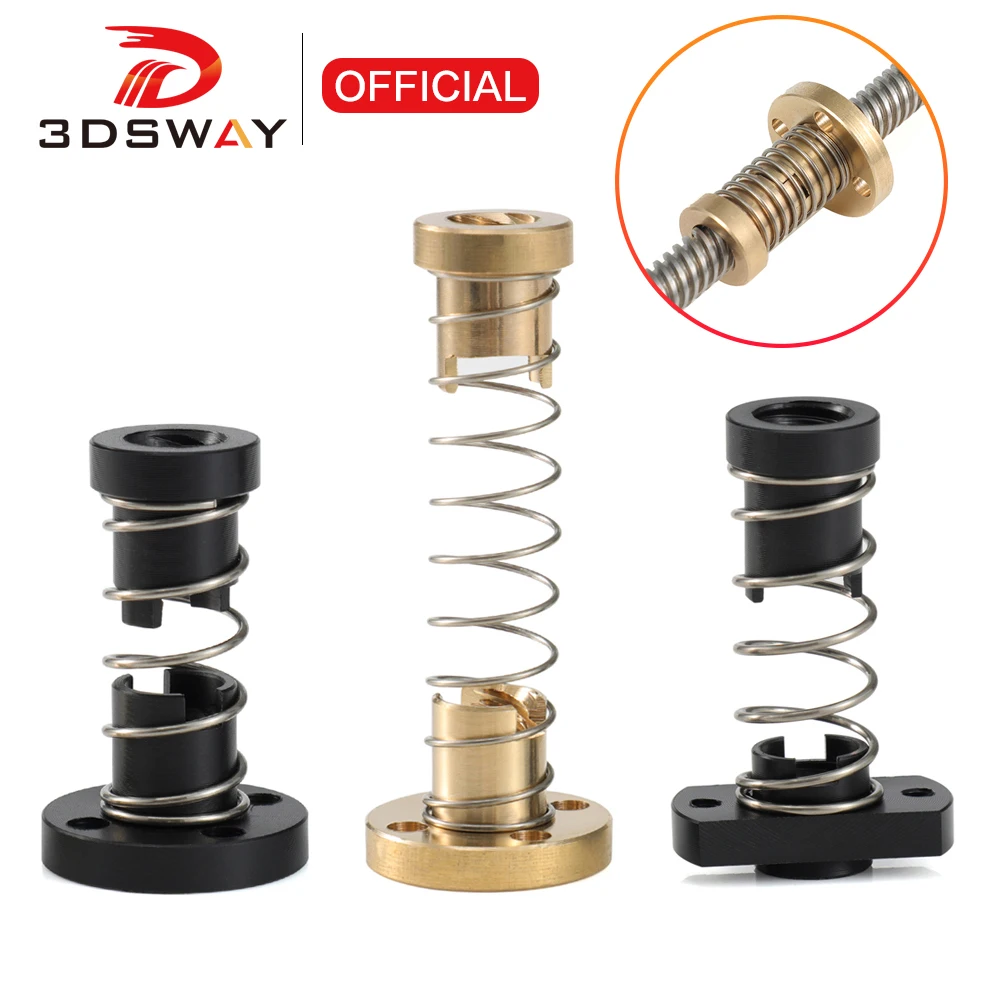
The 3DSWAY T8 Anti-backlash Lead Screw Nut is a critical component designed for enhancing the accuracy and stability of linear motion systems in 3D printers and CNC machines. This specialized nut, available in both brass and POM (Polyoxymethylene) materials, directly addresses the common issue of backlash in lead screw assemblies. Backlash, or play, in the Z-axis of a 3D printer can lead to visible imperfections such as Z-wobble, inconsistent layer heights, and overall reduced print quality. This component mitigates such issues by maintaining constant tension against the lead screw threads.
Engineering for Enhanced Axis Stability
The fundamental design of these anti-backlash nuts involves a spring-loaded split nut mechanism. Two threaded nut sections are held apart by a compression spring. This spring applies continuous pressure, forcing the nut threads to engage tightly with the lead screw threads from both sides. Any minute gap that would typically allow for axial play is effectively eliminated. This constant engagement is crucial for maintaining precise positioning throughout the entire travel range of the Z-axis. Consistent layer deposition relies on this stability.
Traditional lead screw nuts, particularly those made from single-piece designs, inevitably develop some degree of play over time due to wear. This wear is exacerbated by the constant reversal of motion and the inherent tolerances in manufacturing. The anti-backlash design actively compensates for these factors, ensuring a tighter fit even as minor wear occurs. This proactive approach to precision is a significant upgrade for any motion system.
Material Science and Performance Characteristics
Users can select between brass and POM variants, each offering distinct material properties suited for different application requirements. Brass, an alloy of copper and zinc, is known for its high strength, good wear resistance, and excellent thermal conductivity. It provides a robust mechanical connection and can withstand higher axial loads without deformation. However, brass typically exhibits a higher coefficient of friction compared to POM, which might necessitate more frequent lubrication to ensure smooth operation and prevent premature wear on the lead screw itself. The visible brass components suggest a durable, long-lasting solution.
POM, a high-performance engineering thermoplastic, offers several advantages, primarily its low coefficient of friction and self-lubricating properties. This reduces the need for external lubricants and minimizes wear on the lead screw, potentially extending the lifespan of the entire assembly. POM also tends to operate more quietly than brass, which can be a desirable trait in a workshop environment. Its inherent elasticity allows for a forgiving engagement with the lead screw, absorbing minor misalignments. This material choice is ideal for applications prioritizing smooth, quiet operation and reduced maintenance.
Compared to standard brass nuts, the POM variant offers a quieter operation. The choice between brass and POM often depends on the specific demands of the application. For heavy-duty CNC applications with high axial forces, brass might be preferred for its rigidity. For 3D printers where smooth, precise, and quiet operation is paramount, POM often presents a superior option.
Lead Screw Compatibility and Integration
These anti-backlash nuts are specifically designed for T8 lead screws, a common standard in 3D printing and small-scale CNC applications. The 'T8' designation refers to a lead screw with an 8mm diameter. Furthermore, the product offers compatibility with different lead pitches: 2mm, 4mm, and 8mm. The lead refers to the axial distance the nut travels for one complete revolution of the screw. A 2mm lead means the nut moves 2mm per rotation, while an 8mm lead (often referred to as a 'multi-start' or 'fast lead' screw) moves 8mm per rotation. This versatility allows users to select the appropriate nut for their existing lead screw, ensuring proper integration and desired motion resolution.
Selecting the correct lead is paramount for accurate stepper motor configuration. An incorrect lead will result in inaccurate axis movement. For instance, a 2mm lead screw provides finer resolution per motor step, ideal for highly detailed prints. An 8mm lead screw, conversely, offers faster travel speeds, which can be beneficial for rapid prototyping or less demanding movements. The availability of multiple lead options ensures broad compatibility with various machine designs and performance requirements.
Many entry-level 3D printers come with standard lead screws that may not have anti-backlash nuts. Upgrading to these specific T8 nuts can significantly improve the Z-axis performance. This is a direct enhancement over basic, non-compensating nut designs.
Installation and Maintenance Considerations
Proper installation of an anti-backlash nut is crucial for its effective operation. The nut must be aligned correctly with the lead screw to prevent binding or excessive friction. While the spring mechanism compensates for minor misalignments, gross errors can still lead to increased wear and reduced performance. Users should ensure the lead screw is straight and properly lubricated, especially when using brass nuts. Regular inspection of the spring for fatigue and the threads for wear is recommended to maintain optimal performance. The simplicity of the design facilitates straightforward replacement.
Maintaining the lead screw and nut assembly is a straightforward process. For brass nuts, a light application of lithium grease or a specialized lead screw lubricant is recommended periodically to reduce friction and extend component life. POM nuts, while largely self-lubricating, can also benefit from occasional cleaning to remove dust and debris that might accumulate in the threads. This minimal maintenance ensures consistent, high-precision operation over extended periods.
Unlike complex ball screw assemblies that require specialized tools for maintenance, these lead screw nuts are relatively simple to service. Their open design allows for easy access to threads for cleaning and lubrication. This ease of maintenance contributes to the overall practicality and cost-effectiveness of using these components in 3D printing and CNC applications.
Value Proposition for Precision Prototyping
For anyone involved in precision prototyping, 3D printing, or small-scale CNC machining, the elimination of backlash is not merely an improvement; it is a necessity for achieving high-quality results. The 3DSWAY T8 Anti-backlash Lead Screw Nut offers a cost-effective solution to a fundamental mechanical challenge. By ensuring consistent and accurate linear motion, these nuts directly contribute to dimensionally accurate engineering parts, reliable printing of difficult materials (which often highlight mechanical imperfections), and a significant minimization of print failures caused by Z-axis inconsistencies. The investment in these components translates into higher quality output, reduced material waste, and increased operational efficiency.
Imagine a scenario where every layer of your 3D print aligns perfectly, free from the subtle shifts and wobbles that plague less precise machines. Visualize intricate CNC carvings executed with crisp, clean lines, reflecting the exact digital model. This level of precision is not just about aesthetics; it is about functional integrity and the ability to produce parts that meet strict engineering tolerances. These anti-backlash nuts are a foundational upgrade, enabling creators to push the boundaries of what their machines can achieve. The consistent performance they deliver allows for greater confidence in producing complex geometries and fine details, ultimately elevating the standard of your additive manufacturing and CNC work.